
Presentation
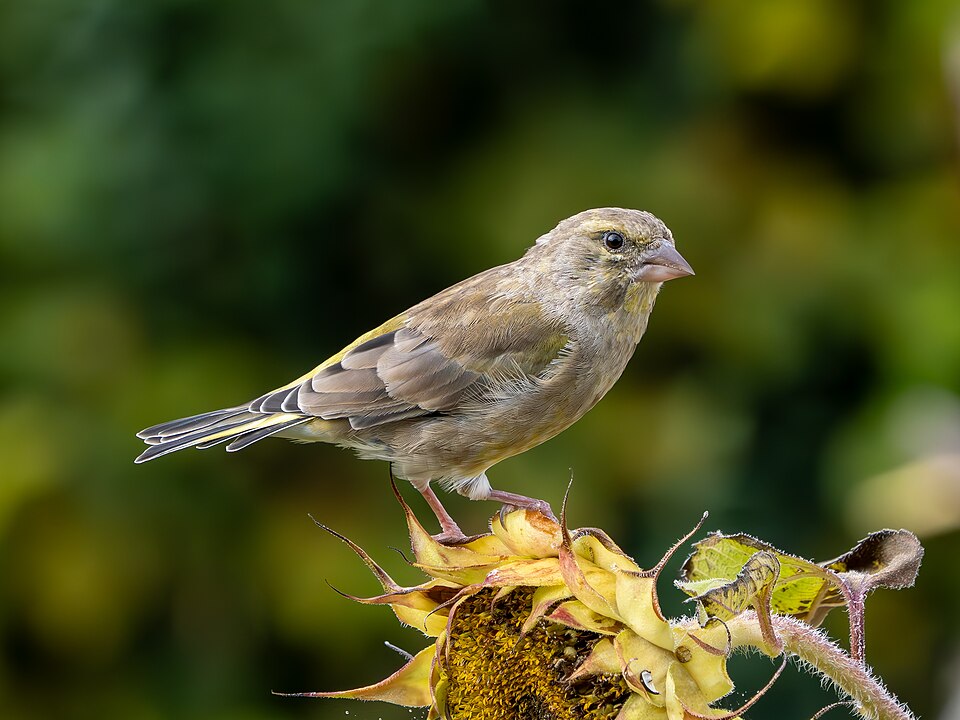
The European Greenfinch (Chloris chloris) is a small seed-eating songbird belonging to the finch family. It is recognized by its olive-green plumage tinged with yellow, brighter in males, with yellow markings visible on the wings and tail. Found throughout Europe, North Africa, and western Asia, it inhabits both rural areas and urban gardens and parks. In Tunisia, it is present notably in the northern and central regions. Outside the breeding season, it is a gregarious bird, often seen in small flocks around bird feeders.
The Greenfinch measures approximately 5.5 to 6.3 inches in length with a wingspan of 9.4 to 10.6 inches. Its bill is short, thick, and conical, adapted for cracking seeds. The male displays more vibrant green and yellow plumage than the female, whose colors are duller and more brownish. The wings feature a characteristic yellow stripe, visible in flight.
Characteristics
Indicative values: they vary by subspecies, sex and region.
Habitat and distribution
The European Goldfinch frequents forest edges, hedgerows, orchards, gardens and urban parks. It prefers semi-open habitats offering both trees for nesting and open spaces for feeding. It adapts well to human presence, particularly in agricultural and suburban areas.
CURRENT RANGE
The species is widely distributed across Europe, North Africa and western and central Asia. In North Africa it is found in Morocco, Algeria and Tunisia. In Tunisia it is observed mainly in the northern and central regions of the country where vegetation is denser.
Behaviour
This is a sociable species that forms flocks outside the breeding season, sometimes mixed with other finches. The male's song, nasal and prolonged, is given from a prominent perch to mark his territory. Its flight is undulating, alternating rapid wing beats with short glides.
Reproduction
The female builds a discreet nest in a shrub or dense hedge, often at low height. She typically lays 4 to 6 eggs, which she incubates alone for about two weeks. Both parents feed the young, which fledge after around two weeks but remain dependent for some time longer.
Peculiarities
The male's nasal song, often described as a drawling 'dzwiii', is a distinctive trait of the species. The yellow-green plumage colour provides camouflage in foliage while also playing a role in courtship display. The European Goldfinch can form large winter flocks with other finches.
Threats and conservation
The species has declined in some European regions, partly linked to a parasitic disease (trichomoniasis) transmitted via bird feeders. The loss of hedgerows and semi-natural habitats in intensive agricultural areas also reduces available nesting sites. Overall, the global population remains abundant.
Numbers and trends vary across sources and regions. See the IUCN assessment for the latest reference data.
Gallery
1 documented photographs.
References
Profile updated 05 September 2026 · Reviewed by the TunisieVet editorial team.
Comments (0)
No comments yet.
CONSERVATION STATUS
Least concern (LC)
IUCN source, latest published assessment.
Species health
Documented diseases for this species.
Find a veterinarianThis information is provided for educational purposes only and is not a substitute for a veterinary consultation. If you have any concerns about your animal's health, consult a veterinarian.
Similar animals
Other species documented in Animalpedia.

TunisieVet in your pocket 📱🐾 Access your veterinary services wherever you are. [ Download the app ]
Learn more