
Presentation
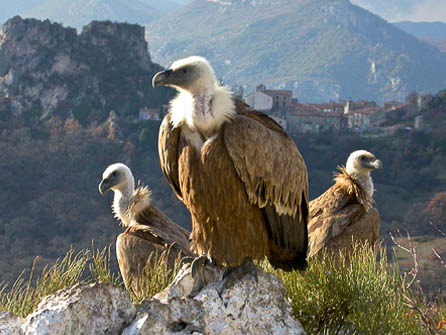
The Vulture is a large scavenging raptor recognizable by its imposing wingspan, its bare neck and its powerful, hooked beak adapted to tearing flesh. It feeds exclusively on dead animal carcasses, playing an essential ecological role as a natural renderer. An excellent glider, it exploits ascending thermal currents to cover very large distances in search of food, almost without flapping its wings. Several species of Vultures exist worldwide, including the tawny Vulture, widely distributed in North Africa, Southern Europe and Asia. In Tunisia, it mainly frequents mountain ranges and desert areas in the north and center of the country. Long unloved and persecuted, it now benefits from protection measures due to its marked decline.
The Vulture has brown-beige to gray plumage depending on the species, a long and sparsely feathered neck facilitating hygiene when consuming carcasses, as well as keen eyesight allowing it to spot corpses from very high altitude. Its broad, rectangular wings are designed for prolonged gliding rather than flapping flight. Its claws are less powerful than those of hunting raptors, because it does not capture live prey.
Characteristics
Indicative values: they vary by subspecies, sex and region.
Habitat and distribution
The Vulture favors mountainous areas, rocky cliffs and open environments such as steppes and desert areas, which offer it both safe nesting sites and vast carrion hunting territories. It generally avoids dense forest areas which limit its gliding and visual tracking ability.
CURRENT RANGE
Vulture is present in Africa, Southern Europe and Asia depending on the species considered. In North Africa, it remains in a few isolated mountain ranges, notably in Tunisia, Algeria and Morocco. Its populations are now fragmented and declining in several regions of its range.
Behaviour
The Vulture is a gregarious bird that often nests and feeds in colonies or groups. It spends much of the day gliding at altitude, saving its energy thanks to ascending currents. Its social hierarchy is expressed in particular around carcasses, where the dominant individuals have first access to food.
Reproduction
Vulture generally forms faithful pairs over several years and nests on steep rock ledges or in cliffs that are difficult to access. The female generally lays a single egg, incubated by both parents for a period of seven to eight weeks. The young remain dependent on adults several months after hatching before taking flight.
Peculiarities
Vulture plays a crucial health role by quickly eliminating carcasses, thus limiting the spread of disease. Its stomach has extremely high acidity which allows it to digest pathogens that are deadly to other animals. Contrary to popular belief, it never attacks live prey.
Threats and conservation
The Vulture is threatened by poisoning, voluntary or accidental, in particular via carcasses treated with pesticides or intended to eliminate predators. Collisions with power lines and wind turbines, as well as the scarcity of available food linked to changes in breeding practices, are aggravating its decline. Human disturbance of nesting sites also poses a significant threat.
Numbers and trends vary across sources and regions. See the IUCN assessment for the latest reference data.
Gallery
1 documented photographs.
References
Profile updated 03 September 2026 · Reviewed by the TunisieVet editorial team.
Comments (0)
No comments yet.
CONSERVATION STATUS
Endangered (EN)
IUCN source, latest published assessment.
Species health
Documented diseases for this species.
See the 6 diseases of this species Find a veterinarianThis information is provided for educational purposes only and is not a substitute for a veterinary consultation. If you have any concerns about your animal's health, consult a veterinarian.
To discover around: Vulture
Videos, facts, stories and records linked to this species.
Similar animals
Other species documented in Animalpedia.

TunisieVet in your pocket 📱🐾 Access your veterinary services wherever you are. [ Download the app ]
Learn more