
Presentation
The wallaby is a medium-sized herbivorous marsupial, related to the kangaroo from which it is distinguished mainly by its smaller size. Native to Australia and New Guinea, it brings together several genera and species adapted to varied environments, from dense forests to rocky areas. This animal moves in powerful leaps thanks to its developed hind limbs and uses its robust tail for support. It is well known to the general public for its ventral pouch housing the young, a characteristic common to marsupials. Some species of wallabies have been introduced to other regions of the world, such as New Zealand or the United Kingdom. Its popularity today makes it an animal sometimes held in captivity outside its native range.
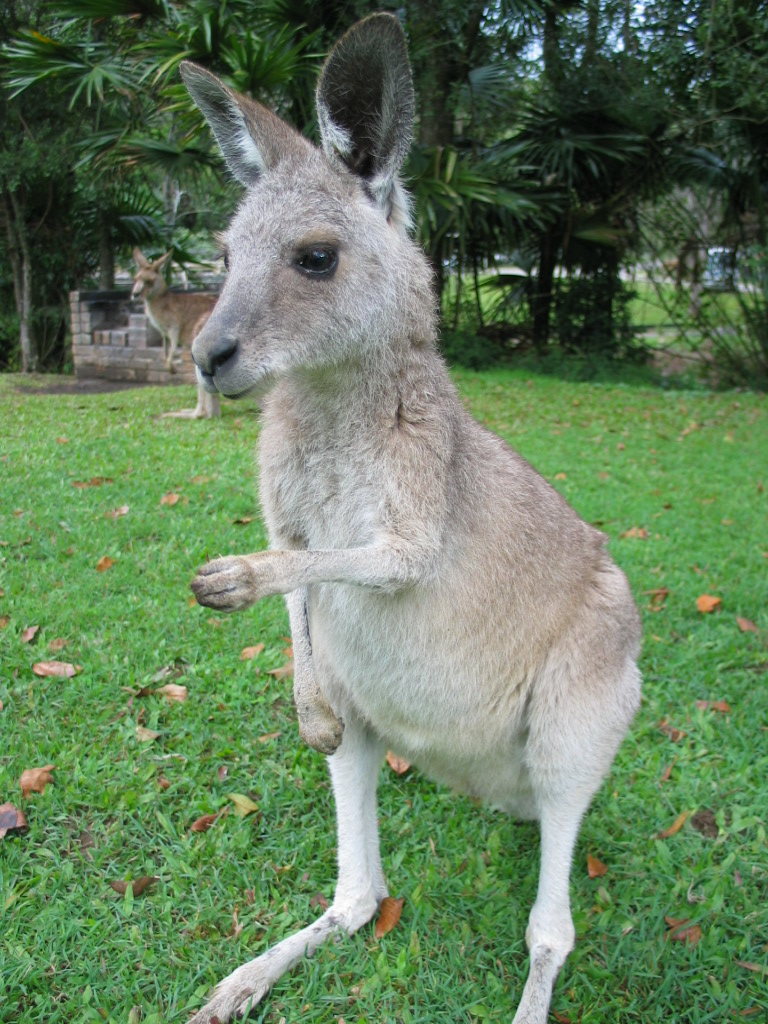
The wallaby resembles a scale-model kangaroo, with long, muscular hind legs suitable for jumping. Its dense fur varies from gray-brown to red depending on the species. It has a thick, muscular tail used for support and balance, as well as small front legs used to handle food. Females carry a ventral marsupial pouch where the young develop after a very short gestation.
Characteristics
Indicative values: they vary by subspecies, sex and region.
Habitat and distribution
The wallaby occupies a wide variety of environments depending on the species, ranging from dense tropical forests to arid rocky areas. Some species prefer the open grasslands and savannahs of Australia, while others live in steep mountain ranges. It generally seeks proximity to plant cover for shelter and safe reproduction. Its capacity for adaptation allows it to colonize habitats sometimes modified by humans.
CURRENT RANGE
wallaby is native to Australia and New Guinea, where it occupies a wide diversity of environments. Several species have been introduced deliberately or accidentally outside their native range, notably in New Zealand, the United Kingdom and France. It is not present in the natural state in Tunisia. However, its global distribution remains centered on Oceania.
Behaviour
The wallaby is a primarily crepuscular and nocturnal animal, active mainly at dawn and dusk to feed. It lives alone or in small, loose groups called mobs, without a strict social hierarchy. It moves by leaps thanks to its powerful hind legs and uses its tail as a balancer and support when resting. Cautious, it stays close to plant cover to escape quickly in case of danger.
Reproduction
The wallaby female gives birth after a very short gestation, around 30 days, giving birth to a little developed baby. The young then continue to grow for several months in the marsupial pouch, clinging to a pacifier. He gradually comes out of it around 6 to 8 months while continuing to breastfeed occasionally. Sexual maturity is generally reached between 1 and 2 years depending on the species.
Peculiarities
The wallaby, like all marsupials, gives birth to a very poorly developed young which finishes its growth in the maternal pouch. It can perform leaps of up to several meters in length thanks to an energy-efficient tendon mechanism. Some species are able to go long periods without drinking by obtaining the necessary water from their plant diet. It is also an iconic animal associated with Australian wildlife in popular culture.
Threats and conservation
The wallaby is locally threatened by the destruction of its natural habitat and forest fragmentation. Predation by introduced species such as the red fox or the domestic cat affects certain Australian populations. Food competition with livestock and forest fires pose additional threats depending on the region. Some isolated species are considered vulnerable due to their restricted range.
Numbers and trends vary across sources and regions. See the IUCN assessment for the latest reference data.
Gallery
1 documented photographs.
References
Profile updated 24 August 2026 · Reviewed by the TunisieVet editorial team.
Comments (0)
No comments yet.
CONSERVATION STATUS
Least concern (LC)
IUCN source, latest published assessment.
Species health
Documented diseases for this species.
See the 8 diseases of this species Find a veterinarianThis information is provided for educational purposes only and is not a substitute for a veterinary consultation. If you have any concerns about your animal's health, consult a veterinarian.
To discover around: wallaby
Videos, facts, stories and records linked to this species.
Similar animals
Other species documented in Animalpedia.

TunisieVet in your pocket 📱🐾 Access your veterinary services wherever you are. [ Download the app ]
Learn more