
Presentation
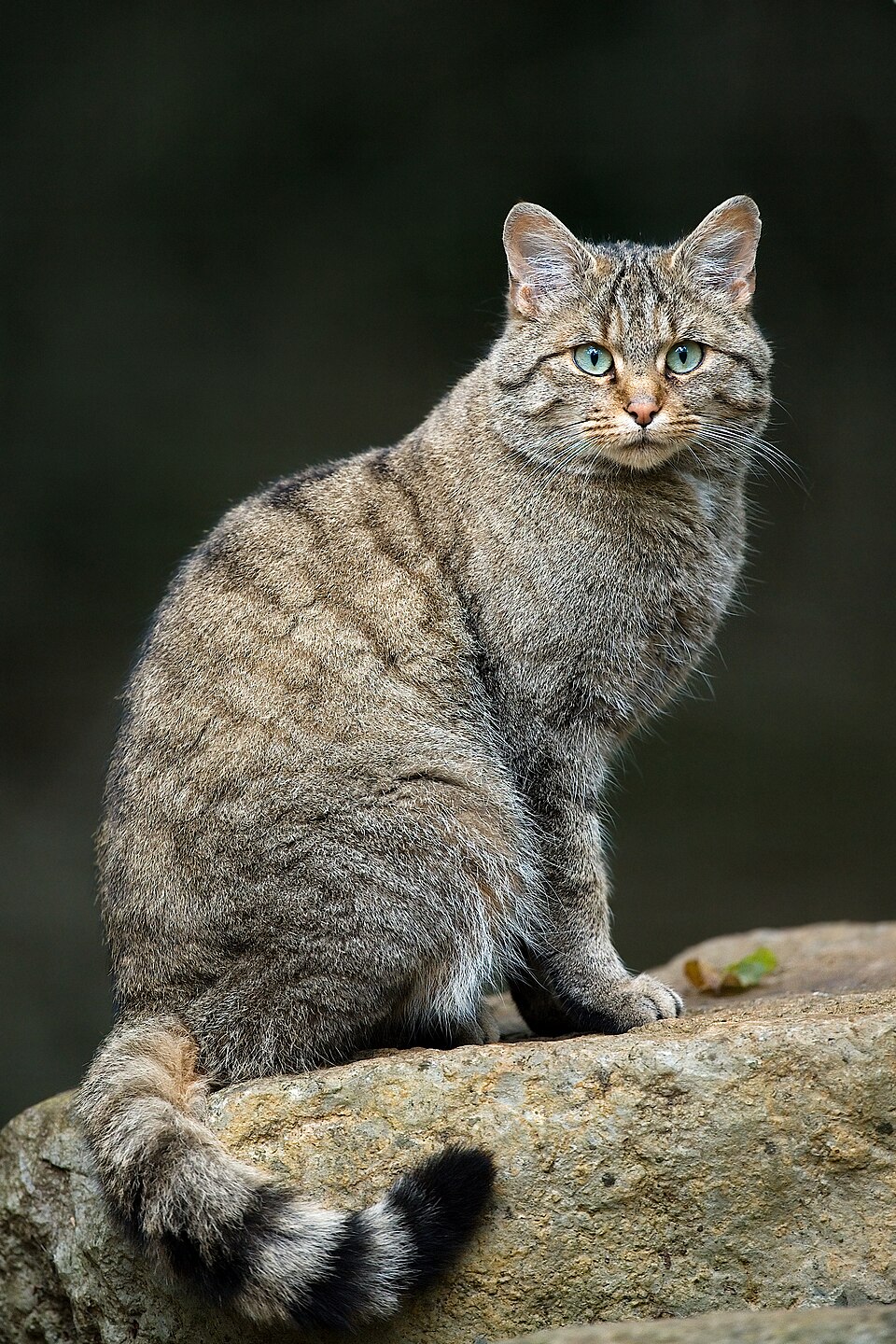
The Wild cat (Felis silvestris) is a medium-sized feline, close relative of the domestic cat but much more robust and fierce. It is found in Europe, Africa and western Asia in various natural environments. Its spotted or striped coat provides excellent camouflage in brush and forests. Solitary and discreet, it mainly hunts small mammals. In Tunisia, a subspecies of the African Wild cat is present and is the subject of particular attention due to the risks of hybridization with the domestic cat.
The Wild cat has a stocky body, relatively short legs and a thick tail with a rounded, black tip, ringed along its length. Its coat is gray-brown to fawn, decorated with stripes or spots depending on the subspecies. It differs from the domestic cat by having more powerful musculature and a slightly more massive skull.
Characteristics
Indicative values: they vary by subspecies, sex and region.
Habitat and distribution
The Wild cat frequents forests, scrub, rocky areas and sometimes semi-arid steppes. It looks for environments offering dense plant cover to hide and hunt. It generally avoids urban and intensive agricultural areas.
CURRENT RANGE
The species is widely distributed in Europe, Africa and western and central Asia. In North Africa, including Tunisia, we find the African Wild cat (Felis lybica), sometimes considered as a distinct species. Its distribution remains fragmented due to the degradation of natural habitats.
Behaviour
The Wild cat is a solitary and territorial animal, active mainly at dawn and dusk. It marks its territory with deposits of urine, scratches and feces. Very shy towards humans, it actively avoids heavily anthropized areas.
Reproduction
The breeding period is generally between January and March depending on the region. After a gestation of about two months, the female gives birth to two to four kittens in a hidden shelter. The young are weaned around three months and acquire their independence before the age of one year.
Peculiarities
Wild cat can hybridize with domestic cats, posing a major threat to the genetic integrity of wild populations. Its ringed tail and nocturnal lifestyle make it difficult to observe in the wild.
Threats and conservation
The main threats are hybridization with stray domestic cats, habitat destruction and fragmentation, and road collisions. Direct persecution by humans remains locally significant.
Numbers and trends vary across sources and regions. See the IUCN assessment for the latest reference data.
Gallery
1 documented photographs.
References
Profile updated 25 August 2026 · Reviewed by the TunisieVet editorial team.
Comments (0)
No comments yet.
CONSERVATION STATUS
Least concern (LC)
IUCN source, latest published assessment.
Species health
Documented diseases for this species.
See the 4 diseases of this species Find a veterinarianThis information is provided for educational purposes only and is not a substitute for a veterinary consultation. If you have any concerns about your animal's health, consult a veterinarian.
Related species
To discover around: Wild cat
Videos, facts, stories and records linked to this species.
Similar animals
Other species documented in Animalpedia.
