
Presentation
The Zander (Sander lucioperca) is a freshwater fish from the Percidae family, appreciated for its fine flesh and sport fishing. Native to central and eastern Europe, it has been widely introduced elsewhere in Europe for fish farming and recreational fishing. Its elongated body, its grayish coloring with greenish reflections and its large teeth make it a recognizable predator. It frequents calm or moderately flowing waters, often murky, where it hunts in search of small fish. This predator plays an important role in regulating forage fish populations. It is not naturally present in Tunisia.
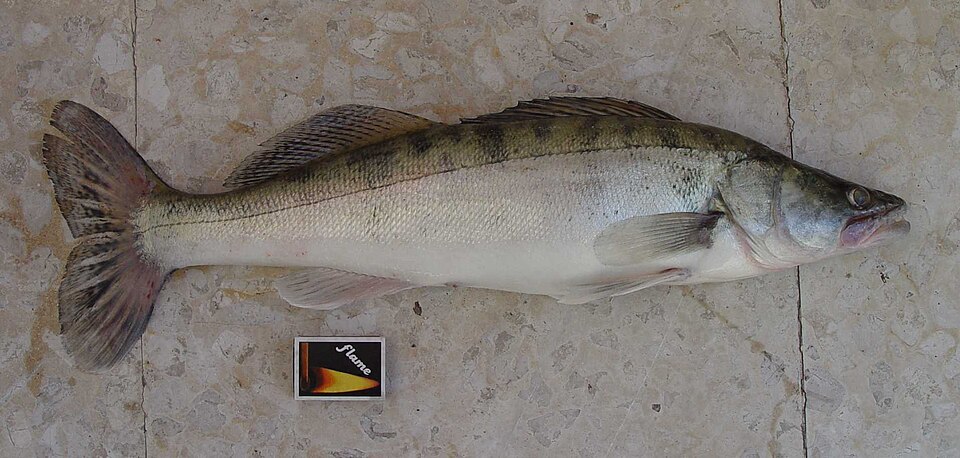
The Zander has a tapered body, two distinct dorsal fins, the first of which is spiny, and a gray coat with green highlights with faint dark vertical bands. Its mouth is armed with prominent canine teeth, particularly developed in large individuals. Its eyes, adapted to vision in murky or poorly lit water, give it a clear nocturnal advantage.
Characteristics
Indicative values: they vary by subspecies, sex and region.
Habitat and distribution
The Zander lives in lakes, reservoirs and large slow-moving rivers, preferring slightly turbid waters. It also tolerates the brackish waters of certain estuaries and coastal lagoons. He looks for varied bottoms offering hiding places, such as seagrass beds, branches or rock structures.
CURRENT RANGE
Zander is native to the Ponto-Caspian Basin, Baltic Sea basins, and many rivers of Central and Eastern Europe. It has been successfully introduced in many Western European countries, notably in France, for sport fishing. Its natural range does not include North Africa or Tunisia.
Behaviour
The Zander is a rather solitary and territorial fish, active mainly at dusk and at night. It favors deep, murky waters during the day, approaching shallow areas to hunt at dusk. It sometimes forms small, loose groups in winter, in deeper areas of lakes and rivers.
Reproduction
Reproduction takes place in spring, when the water temperature reaches around 12 to 14°C. The male prepares a basic nest on a hard bottom or among roots, where the female lays her eggs. The male monitors and fans the eggs until hatching, a rare parental guarding behavior among freshwater fish.
Peculiarities
Zander is renowned for its fine, low-fat white flesh, highly sought after in gastronomy. Its vision adapted to darkness, thanks to a reflective layer in the eye (tapetum lucidum), allows it to hunt effectively at night. It is one of the rare species of fish in which the male guards the eggs.
Threats and conservation
Zander is not subject to major threats on a global scale, its populations being generally stable or even supported by introductions. Water pollution and degradation of aquatic habitats can locally affect its populations. Overfishing can occasionally reduce numbers in certain busy water bodies.
Numbers and trends vary across sources and regions. See the IUCN assessment for the latest reference data.
Gallery
1 documented photographs.
References
Profile updated 29 August 2026 · Reviewed by the TunisieVet editorial team.
Comments (0)
No comments yet.
CONSERVATION STATUS
Least concern (LC)
IUCN source, latest published assessment.
Species health
Documented diseases for this species.
See the 4 diseases of this species Find a veterinarianThis information is provided for educational purposes only and is not a substitute for a veterinary consultation. If you have any concerns about your animal's health, consult a veterinarian.
Similar animals
Other species documented in Animalpedia.

TunisieVet in your pocket 📱🐾 Access your veterinary services wherever you are. [ Download the app ]
Learn more