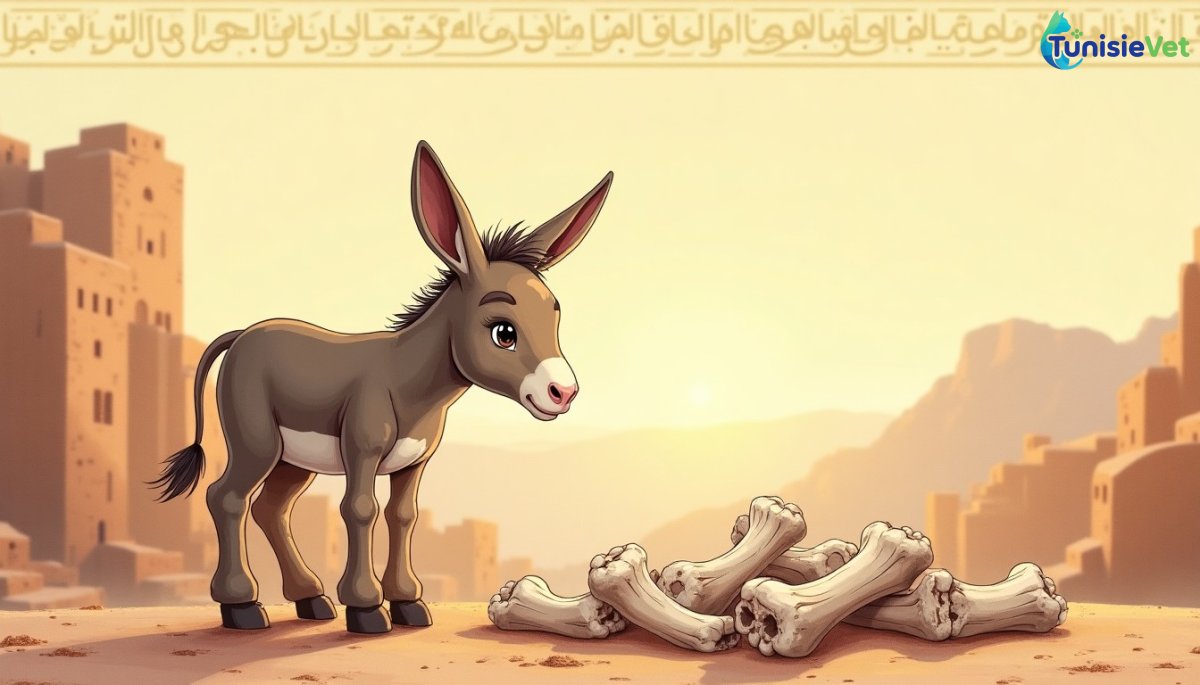
A traveler passes by a ruined village, doubting resurrection. God causes him to die for a hundred years, then brings him back to life with a silent companion at his side: his donkey, whose scattered bones will also come back to life before his eyes.
A man, according to accounts reported by Quranic commentators, was traveling with his donkey near a village that had fallen into ruin, its inhabitants long gone. Contemplating these deserted remains, he wondered: how could God restore life to what had been dead for so long? This doubt, far from being a rebellion, was a sincere question, and God chose to answer it not with words, but with a concrete and striking sign.
A Hundred Years of Sleep
God then caused this man to die, and he remained in that state for a hundred years. Throughout all that time, his donkey stayed near him, but time took its toll on the animal: its flesh disappeared, its bones scattered and bleached by the years. Then, when the moment came, God raised the man back to life and asked him how long he thought he had remained in that state. Knowing nothing of what had passed, the man answered that he thought he had remained for a day, or only part of a day.
It was then that God revealed the truth to him and showed him the most tangible proof of all: his bread and drink, left at his side, had not spoiled, while his donkey had become nothing more than a heap of scattered bones. This contrast between the unspoiled food and the animal reduced to a skeleton was in itself a lesson on divine power, capable of preserving one thing and dissolving another according to His will.
Resurrection Before His Eyes
The narrative reaches its climax when God orders the man to look at the bones of his donkey. Before his very eyes, these scattered bones gathered together, covered themselves with flesh, and the animal stood up, alive, as if it had never ceased to exist. This sight, offered directly to the man's gaze, dispelled all doubt: He who has the power to revive a donkey from its scattered bones necessarily has the power to resurrect people after their death.
﴿ فَانْظُرْ إِلَى طَعَامِكَ وَشَرَابِكَ لَمْ يَتَسَنَّهْ ۖ وَانْظُرْ إِلَى حِمَارِكَ وَلِنَجْعَلَكَ آيَةً لِّلنَّاسِ ۖ وَانْظُرْ إِلَى الْعِظَامِ كَيْفَ نُنشِزُهَا ثُمَّ نَكْسُوهَا لَحْمًا ۚ فَلَمَّا تَبَيَّنَ لَهُ قَالَ أَعْلَمُ أَنَّ اللَّهَ عَلَىٰ كُلِّ شَيْءٍ قَدِيرٌ ﴾
"Behold thy food and thy drink: they have not become stale; and behold thy donkey. We have made thee a sign for mankind. Behold these bones: how We assemble them and clothe them with flesh." When this became clear to him, he said, "I know that God has power over all things."
(Surah Al-Baqarah, verse 259)
A Sign for All
This narrative, placed by God in the Quran, is not intended for that man alone: the verse explicitly specifies that it was made "a sign for mankind," that is, for all humanity that would come after him. The donkey, a humble and faithful traveling companion, thus becomes the instrument chosen by God to illustrate in striking fashion the reality of resurrection, a matter on which so many hearts waver.
This narrative gently reminds us that even the most humble creatures, such as this faithful donkey, hold a place willed by God in His teaching to humankind. To care for animals, to respect their life and their death, is also to honor these signs that God has scattered throughout creation to awaken our hearts and our gratitude.