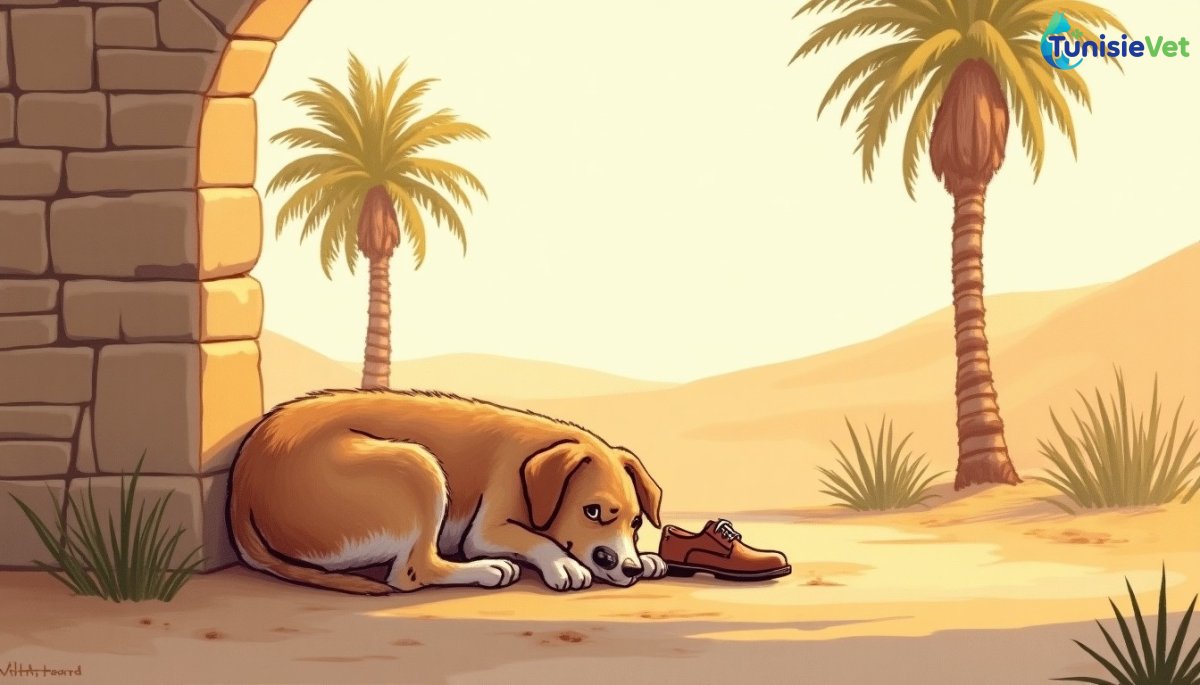
A thirsty man goes down a well, climbs back up, and then notices an exhausted dog. This account, recorded in Sahih al-Bukhari and Sahih Muslim, recalls what Islamic tradition teaches when faced with a creature in distress.
A man was walking along a road when a fierce thirst seized him. He found a well, went down into it, drank until his thirst was quenched, then climbed back up. That was when he saw a dog panting and licking the damp earth, so great was its thirst. This account is related by the Prophet Muhammad ﷺ in Sahih al-Bukhari and Sahih Muslim.
A man who remembers his own thirst
Faced with this dog, the man said to himself, according to the hadith: "This dog has reached the same thirst that I once knew." He did not look away. He went back down into the well, filled his khuff (his leather shoe) with water, held it in his mouth to climb back up, and then gave the dog something to drink.
The Prophet ﷺ said that God thanked this man for his act and forgave him. The Companions then asked: "O Messenger of God, do we receive a reward for what we do for animals?" He replied: "There is a reward for every living creature." (Sahih al-Bukhari and Sahih Muslim)
What the account teaches us
This hadith does not speak of an injured animal as such, but of an animal in distress. It shows the right approach to any creature that is suffering:
- stopping instead of walking on;
- putting oneself in the animal's place, as the man remembers his own thirst;
- acting with the means at hand, however modest, such as a simple shoe filled with water.
The tradition also reports another episode, in Sunan Abi Dawud. The Prophet ﷺ passed by a camel so thin that its back seemed stuck to its belly. He said: "Fear God regarding these animals that cannot speak." Once again, the suffering animal calls for the attention and care of the person who sees it.
The Quran, moreover, presents the Prophet ﷺ as a mercy that is not limited to human beings alone:
﴿ وَمَا أَرْسَلْنَاكَ إِلَّا رَحْمَةً لِّلْعَالَمِينَ ﴾
"And We have not sent you except as a mercy to the worlds."
(Surah Al-Anbiya, verse 107)
From the account to today's action
Faced with an injured animal, the spirit of these texts calls us not to ignore it. In practice, you can report it to a competent person, call a veterinarian or an animal protection association, or bring it water if this presents no danger. An injured animal may be frightened and may defend itself. It is therefore important to remain cautious and not put yourself at risk.
Thus, the story of the man and the dog reminds us that a simple gesture of compassion can count for a great deal with God. Each time we care for a fragile creature, we follow the example of a mercy that extends to all living beings.