
Presentation
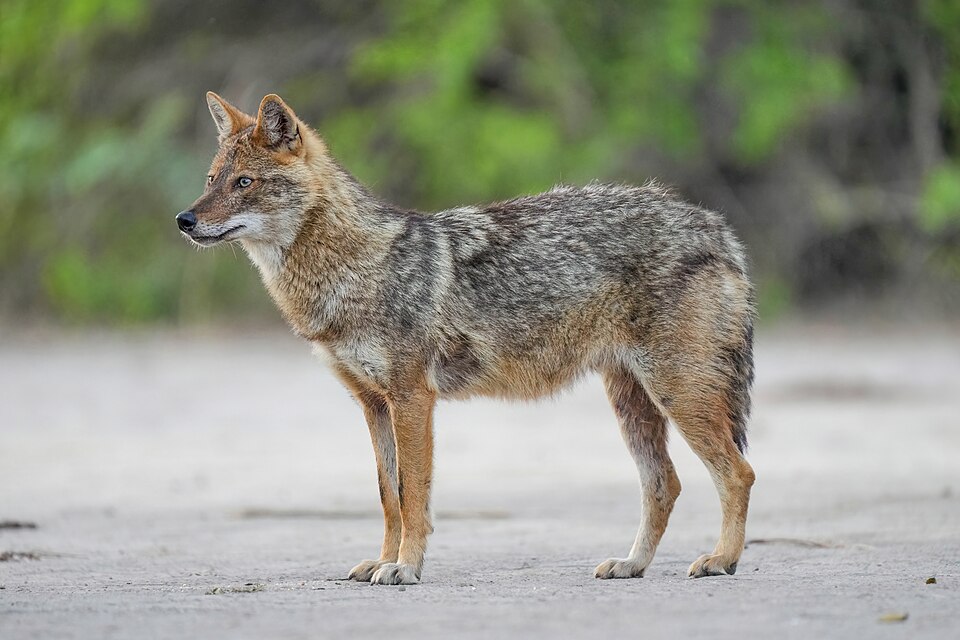
The Golden jackal is a small, slender canid, resembling a miniature wolf, characterized by a golden to grayish coat and a slender silhouette. This sociable and adaptable animal thrives in a wide variety of environments, from the Mediterranean to South Asia. Despite its superficial resemblance to the wolf, it belongs to a distinct lineage within the Canidae.
The Golden jackal has a compact and muscular body, relatively long and thin legs, and pointed erect ears. Its coat varies from golden to gray depending on the season and region, often with darker areas on the back. Its yellow-amber eyes and bushy tail complete its characteristic and recognizable appearance.
Characteristics
Indicative values: they vary by subspecies, sex and region.
Habitat and distribution
The Golden jackal inhabits open forests, steppes, wetlands and marshes, but also semi-arid regions and grasslands. It adapts remarkably well to modified environments, including crops and peri-urban areas. Its ideal habitat combines plant cover and access to water, allowing it a wide geographical distribution.
CURRENT RANGE
Golden jackal is distributed widely in North and East Africa, the Middle East and South Asia to Southeast Asia. Its area extends from the Mediterranean to beyond the Caspian, via the Arabian Peninsula. In recent decades, its range has expanded towards southern and central Europe.
Behaviour
The Golden jackal is a mainly nocturnal and crepuscular animal, living in family groups of 3 to 6 individuals. It communicates with characteristic calls and howls, particularly at dusk. Its social and territorialist behavior allows it to effectively defend its hunting areas against rivals.
Reproduction
Golden jackal is monogamous with one dominant pair per pack. The breeding period extends from December to February, followed by a gestation of approximately 63 days. The female gives birth to 4 to 6 young per litter, which other members of the group help to raise, strengthening social bonds.
Peculiarities
Golden jackal has an exceptional capacity for adaptation, both ecological and behavioral, allowing it to coexist with humans. It is known for its spectacular vocalizations at sunset, often perceived as disturbing. Unlike wolves, it is less aggressive towards livestock and more inclined to exploit anthropogenic resources.
Threats and conservation
The species does not face major threats on a global scale and its IUCN status is “Least Concern”. However, it may face local persecution due to predation on livestock and habitat loss in some areas.
Numbers and trends vary across sources and regions. See the IUCN assessment for the latest reference data.
Gallery
1 documented photographs.
References
UICN — Liste rouge des espèces menacées
Profile updated 02 September 2026 · Reviewed by the TunisieVet editorial team.
Comments (0)
No comments yet.
CONSERVATION STATUS
Least concern (LC)
IUCN source, latest published assessment.
Species health
Documented diseases for this species.
See the 4 diseases of this species Find a veterinarianThis information is provided for educational purposes only and is not a substitute for a veterinary consultation. If you have any concerns about your animal's health, consult a veterinarian.
Related species
To discover around: Golden jackal
Videos, facts, stories and records linked to this species.
Similar animals
Other species documented in Animalpedia.

TunisieVet in your pocket 📱🐾 Access your veterinary services wherever you are. [ Download the app ]
Learn more