Presentation
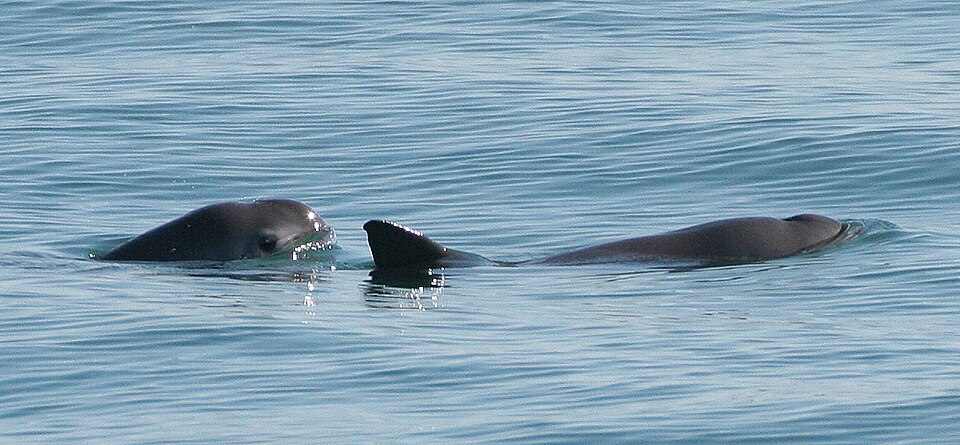
The vaquita (Phocoena sinus) is a small porpoise found only in the northern Gulf of California, Mexico. First scientifically documented in 1958, it is the rarest and most endangered cetacean in the world. Its population, reduced to just a few dozen individuals, is declining rapidly due to accidental catches in fishing nets. The vaquita is distinctive for its small size and the dark rings around its eyes and mouth. Shy and wary, it typically avoids boats, making sightings exceptionally rare.
The vaquita is the smallest known cetacean, with a stocky body that is dark grey on the back, gradually lightening toward the belly. It has characteristic black patches around the eyes and lips, and a proportionally large, triangular dorsal fin. Its body is adapted for discrete movement through shallow, turbid waters.
Characteristics
Indicative values: they vary by subspecies, sex and region.
Habitat and distribution
The vaquita lives exclusively in the shallow, turbid waters of the northern Gulf of California. It inhabits coastal zones less than 50 metres deep, often near lagoon mouths. This restricted habitat makes it particularly vulnerable to local human activities.
CURRENT RANGE
The vaquita has the most restricted range of all cetaceans, limited to a small area in the northern Gulf of California, Mexico. It is found nowhere else in the world. This extremely localized distribution makes it a strict endemic species.
Behaviour
The vaquita is a solitary animal or lives in small groups of two to three individuals. It is notably discreet, avoids boats, and does not leap out of the water, unlike many other cetaceans. Its movements are slow and its surface appearances are brief, which makes study of this species difficult.
Reproduction
Females reach sexual maturity between 3 and 6 years of age and give birth to a single calf approximately every two years. Gestation lasts about 10 to 11 months. The naturally low reproductive rate of the species complicates its recovery in the face of current threats.
Peculiarities
The vaquita is often nicknamed the "panda of the sea" because of the dark patches around its eyes. It holds the grim distinction of being the most critically endangered cetacean, with a population estimated at fewer than 10 individuals in the 2020s. Its disappearance is closely linked to illegal totoaba fishing, a fish whose swim bladder is highly prized in Asia.
Threats and conservation
The main threat is accidental capture in gillnets used for illegal totoaba fishing. International trafficking of totoaba swim bladders, highly sought for traditional Asian medicine, sustains this destructive fishing. Despite protective measures and net bans, the population continues to decline.
Numbers and trends vary across sources and regions. See the IUCN assessment for the latest reference data.
Gallery
1 documented photographs.
References
Profile updated 03 September 2026 · Reviewed by the TunisieVet editorial team.
Comments (0)
No comments yet.
CONSERVATION STATUS
Critically endangered (CR)
IUCN source, latest published assessment.
Species health
Documented diseases for this species.
This information is provided for educational purposes only and is not a substitute for a veterinary consultation. If you have any concerns about your animal's health, consult a veterinarian.
To discover around: Vaquita
Videos, facts, stories and records linked to this species.
RECORD
Fewer than 10 individuals estimated
The most critically endangered cetacean
Population estimate based on acoustic and visual surveys conducted in the Gulf of Californ...
Similar animals
Other species documented in Animalpedia.

Be among the first to use our app. Sign up and get early Google Play access.
Discover