
Presentation
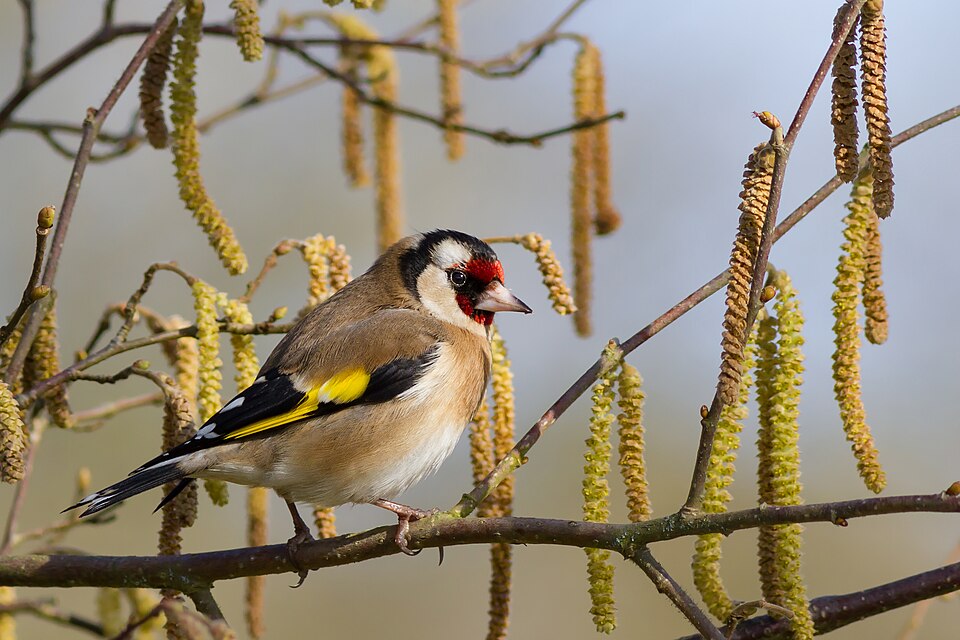
The European goldfinch is a small songbird that stands out for its striking bright red face, black and white head markings, and black wings crossed by a broad yellow band. Its tan-brown body and slender, pointed bill—perfectly suited to extracting seeds—give it an elegant appearance. Its melodious, varied song makes it a highly prized pet bird in several parts of the world, including Tunisia. It frequents open areas, gardens, wasteland, and field borders where seeded plants grow. Outside the breeding season, it is sociable and often gathers in small flocks called charms. Its adaptability allows it to thrive in both rural and urban-fringe settings.
The goldfinch measures roughly 12 to 13 cm long with a wingspan of 21 to 25 cm. It is distinguished by its scarlet-red face, black and white crown, and broad bright yellow wing band visible in flight. The bill is fine, conical, and pale, suited to eating small seeds.
Characteristics
Indicative values: they vary by subspecies, sex and region.
Habitat and distribution
The goldfinch inhabits open and semi-open environments rich in seed-bearing plants: wasteland, orchards, gardens, roadsides, and forest edges. It is particularly fond of agricultural areas where thistles and other wild plants grow. It is found both in lowlands and in suburban zones.
CURRENT RANGE
The species is widely distributed across Europe, North Africa, the Middle East, and western and central Asia. In Tunisia, it is present throughout the country, from the humid north to the southern oases. It has also been introduced to certain regions such as Australia and South America.
Behaviour
This bird is active during the day, often seen flitting from seed head to seed head in mixed flocks with other finches. Its song, made up of trills and crystalline notes, is used for courtship display and social communication. Outside the breeding season, it forms wandering flocks that move in search of areas rich in seeds.
Reproduction
The female builds a neat cup-shaped nest woven from mosses, lichens, and plant fibres, usually located at the tip of tree branches. She lays 4 to 6 eggs and incubates them alone for about two weeks. The young leave the nest after two weeks but remain dependent on their parents for a few more days.
Peculiarities
The goldfinch has traditionally been highly valued for its song and its ability to be kept in captivity, leading to significant illegal trapping for the cage bird trade in several Mediterranean countries, including Tunisia. Its capacity to hybridize with the domestic canary is also well known to breeders.
Threats and conservation
The main threat to the species is illegal trapping for the cage bird trade, particularly intense in the Mediterranean basin. Loss of fallow habitats and non-intensive agricultural areas also reduces available food resources. Despite these local pressures, the global population remains broadly stable.
Numbers and trends vary across sources and regions. See the IUCN assessment for the latest reference data.
Gallery
1 documented photographs.
References
Profile updated 05 September 2026 · Reviewed by the TunisieVet editorial team.
Comments (0)
No comments yet.
CONSERVATION STATUS
Least concern (LC)
IUCN source, latest published assessment.
Species health
Documented diseases for this species.
See the 4 diseases of this species Find a veterinarianThis information is provided for educational purposes only and is not a substitute for a veterinary consultation. If you have any concerns about your animal's health, consult a veterinarian.
Similar animals
Other species documented in Animalpedia.

TunisieVet in your pocket 📱🐾 Access your veterinary services wherever you are. [ Download the app ]
Learn more