
Presentation
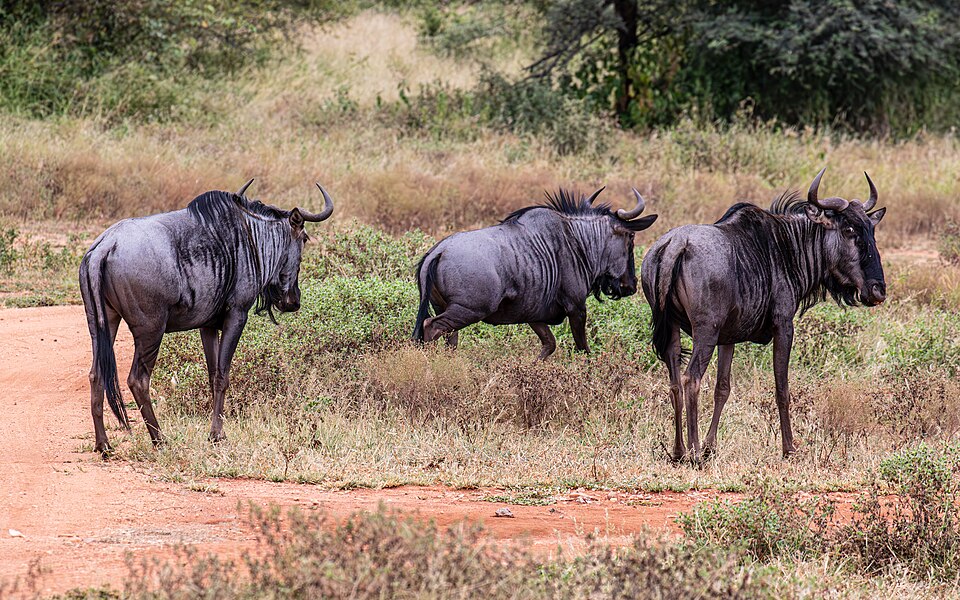
The Wildebeest is a large African herbivorous mammal belonging to the Bovidae family, known for its massive migrations in East Africa. It has a massive head with curved horns, a robust forebody and a lighter hindquarters, giving it a characteristic silhouette. Two main species exist: the black Wildebeest and the blue Wildebeest, the latter being the most widespread and the most observed during the great migrations in the Serengeti. A gregarious animal, it lives in herds that can number several thousand individuals. Wildebeest plays an important ecological role by shaping the structure of the savannah through its intensive grazing.
The Wildebeest is distinguished by its large head, crescent-shaped horns and shaggy mane. Its body is sturdier in front than in back, with slender legs suitable for fast running. The coat varies from gray-brown to dark brown depending on the species and subspecies. A black beard and mane complete his distinctive appearance.
Characteristics
Indicative values: they vary by subspecies, sex and region.
Habitat and distribution
The Wildebeest lives mainly in the open savannahs and grassy plains of eastern and southern Africa. It also frequents transition zones between savannah and light forest, provided that grass is abundant there. Its presence is closely linked to the availability of water and seasonal pastures.
CURRENT RANGE
Wildebeest is present mainly in East Africa, notably in Kenya and Tanzania where the great Serengeti migration takes place, as well as in southern Africa. The black Wildebeest is found mainly in South Africa, while the blue Wildebeest occupies a larger area including several countries in sub-Saharan Africa. It is not present in the wild in Tunisia.
Behaviour
The Wildebeest is a gregarious animal living in organized herds, often mixed with zebras and gazelles for mutual protection against predators. He takes part in one of the world's largest land migrations, traveling hundreds of kilometers between the Serengeti and the Masai Mara. Males defend temporary territories during the breeding season and display courtship behaviors to attract females. The herd remains vigilant against predators such as lions and hyenas.
Reproduction
Wildebeest's mating season generally occurs at the end of the rainy season, during which males compete to establish small, temporary territories. Gestation lasts approximately eight to nine months and results in the birth of a single young. Births are highly synchronized, with the majority of fawns born within a few weeks, which reduces predation pressure on each individual. The young are able to move quickly after birth to follow the migrating herd.
Peculiarities
The Wildebeest is famous for its participation in the annual Great Migration, one of the most spectacular natural phenomena of African wildlife. It emits distinctive low, nasal growls, which gave it its onomatopoeic name. Despite its unsightly appearance, it can reach high running speeds to escape predators.
Threats and conservation
Major threats to the Wildebeest include habitat reduction due to agricultural expansion and fences that disrupt traditional migration routes. Natural predation by large carnivores remains important but is part of the ecological balance. Poaching and competition with domestic livestock for grazing are also local pressures in some areas.
Numbers and trends vary across sources and regions. See the IUCN assessment for the latest reference data.
Gallery
1 documented photographs.
References
Profile updated 21 August 2026 · Reviewed by the TunisieVet editorial team.
Comments (0)
No comments yet.
CONSERVATION STATUS
Least concern (LC)
IUCN source, latest published assessment.
Species health
Documented diseases for this species.
See the 8 diseases of this species Find a veterinarianThis information is provided for educational purposes only and is not a substitute for a veterinary consultation. If you have any concerns about your animal's health, consult a veterinarian.
To discover around: Wildebeest
Videos, facts, stories and records linked to this species.
Similar animals
Other species documented in Animalpedia.

TunisieVet in your pocket 📱🐾 Access your veterinary services wherever you are. [ Download the app ]
Learn more