
Presentation
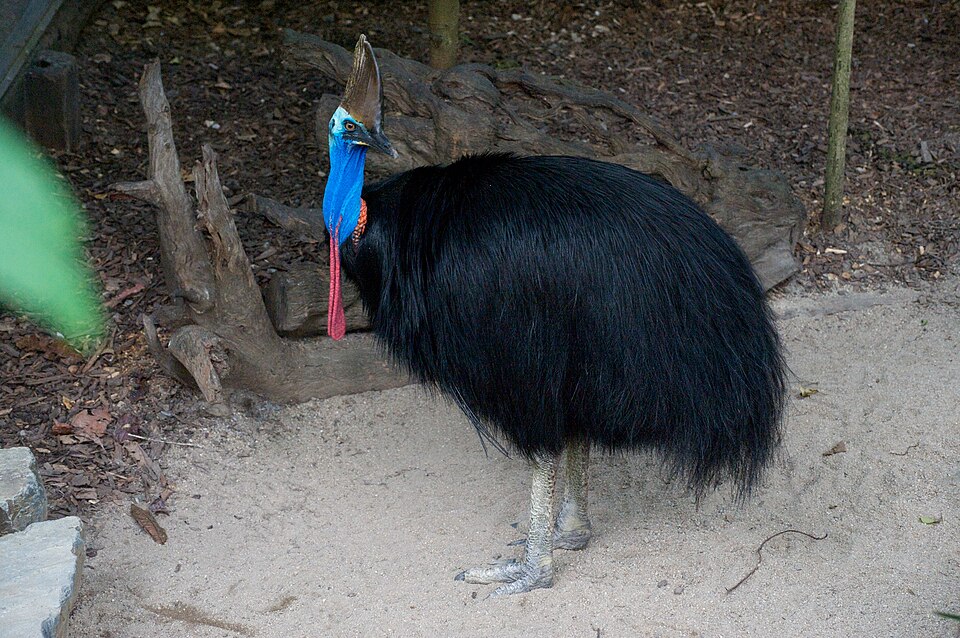
The cassowary is a large flightless running bird native to the tropical forests of northern Australia and New Guinea. It is distinguished by its black, rigid plumage, a bright blue neck adorned with red wattles, and a horny casque on its head. Its powerful legs have three toes, one bearing a long, sharp claw that serves as a defensive weapon. Regarded as one of the world's most dangerous birds to humans in a direct confrontation, it remains shy and reclusive in the wild. It plays a major ecological role in dispersing seeds from many tropical rainforest plant species.
The cassowary has black plumage made up of long, hair-like filamentous feathers. Its neck and head, which are featherless, display bright colours ranging from blue to red depending on the area. The horny casque on its skull, whose exact function remains debated, may help it push through dense vegetation or play a role in social communication.
Characteristics
Indicative values: they vary by subspecies, sex and region.
Habitat and distribution
The cassowary lives in dense tropical rainforests, where it finds both food and protective vegetation. It occasionally frequents forest edges and swampy areas near its primary habitat.
CURRENT RANGE
The species is found in northeastern Australia (Queensland) as well as in New Guinea and certain neighbouring Indonesian islands. Its range is fragmented due to deforestation that reduces its natural habitat.
Behaviour
It is a solitary, territorial animal that generally avoids contact with humans. It can nevertheless become aggressive if it feels threatened or if people approach too closely, particularly if they attempt to feed it. Its sharp-clawed kicks can inflict serious injuries, which accounts for its reputation as a dangerous bird.
Reproduction
The female lays several green eggs in a simple ground nest, then leaves incubation and chick-rearing entirely to the male. Incubation lasts around 50 days, during which the male rarely leaves the nest. The young stay with their father for several months after hatching before becoming independent.
Peculiarities
The cassowary has an inner claw that can reach up to 12 cm, capable of causing severe or even fatal injuries. It is also one of the rare birds in which the male alone undertakes incubation and rearing of the young.
Threats and conservation
Deforestation linked to agriculture and urbanization is the main threat to the species. Road collisions and attacks by domestic dogs also contribute to population decline in certain regions.
Numbers and trends vary across sources and regions. See the IUCN assessment for the latest reference data.
Gallery
1 documented photographs.
References
Profile updated 07 September 2026 · Reviewed by the TunisieVet editorial team.
Comments (0)
No comments yet.
CONSERVATION STATUS
Least concern (LC)
IUCN source, latest published assessment.
Species health
Documented diseases for this species.
This information is provided for educational purposes only and is not a substitute for a veterinary consultation. If you have any concerns about your animal's health, consult a veterinarian.
To discover around: Cassowary
Videos, facts, stories and records linked to this species.
RECORD
Inner claw up to 12 cm
The most dangerous bird to humans
Measurement taken on the inner toe of adult specimens, capable of inflicting serious wound...
Similar animals
Other species documented in Animalpedia.

TunisieVet in your pocket 📱🐾 Access your veterinary services wherever you are. [ Download the app ]
Learn more