
Presentation
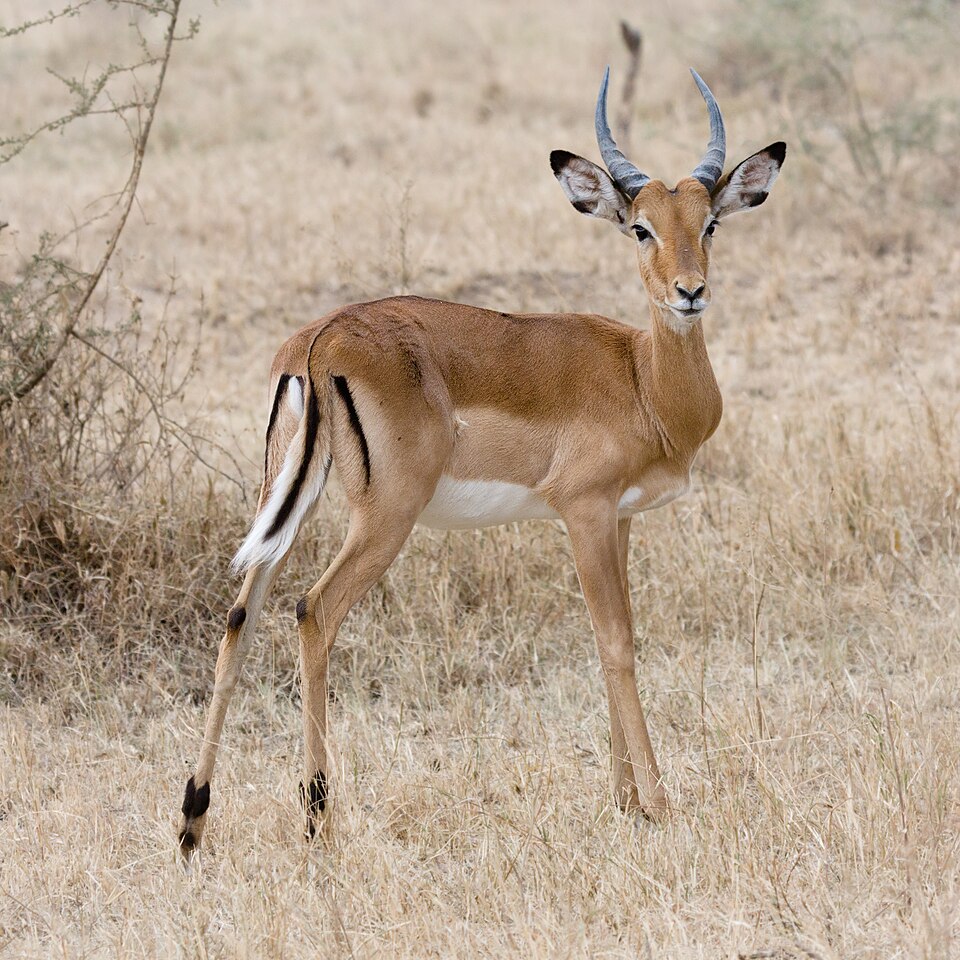
The Impala is a medium-sized antelope native to the savannahs of eastern and southern Africa. Its reddish-brown coat contrasts with a white belly and characteristic black bands on the hindquarters and tail. Only males have long, lyre-shaped horns, which can exceed 70 cm. Renowned for its agility, it is capable of spectacular leaps in height and length to escape predators. The species lives in herds whose composition varies according to the seasons. It is a key prey in the African savannah ecosystem, serving as a food base for many carnivores.
Slender body with long, thin legs suitable for running and jumping. Reddish-brown color on the back, lighter sides, white belly, with vertical black lines on the back of the thighs and the tip of the tail. Males display ringed, lyre-shaped horns, which are absent in females. Scent glands located on the heels release scent when they jump, making it easier to regroup the fleeing herd.
Characteristics
Indicative values: they vary by subspecies, sex and region.
Habitat and distribution
The Impala frequents wooded savannahs and the edges of light forests, near water points. It avoids areas that are too dense or too open, preferring a mixture of shrub cover and open grassy areas. Its presence is closely linked to the availability of water and mixed vegetation.
CURRENT RANGE
The species is widely distributed in eastern and southern Africa, including Kenya, Tanzania, Botswana, Namibia, Zimbabwe and South Africa. It is absent from North Africa and has no natural population in Tunisia. Large populations remain in national parks and reserves in these regions.
Behaviour
A gregarious animal, the Impala lives in structured herds: groups of females and young, herds of single males, and solitary territorial males during the breeding season. It is capable of leaps reaching several meters in height and length to overwhelm a predator or overcome an obstacle. Very vigilant, it often relies on hearing and smell to detect danger, and alternates grazing phases with moments of surveillance.
Reproduction
Breeding is seasonal, with a marked rut at the end of the rainy season during which males defend a territory and gather a harem of females. Gestation lasts approximately six to seven months and results in the birth of a single fawn. Females may delay giving birth slightly to synchronize it with a favorable resource period. The young remain hidden in the vegetation for the first few days before joining the herd.
Peculiarities
The scientific name of the genus, Aepyceros, means "high horn", referring to the horns of males. Scent glands located near the hind hooves play a unique role in group cohesion during collective escape. The Impala is also known for its impressive leaps, sometimes used to confuse predators rather than fleeing in a straight line.
Threats and conservation
The main threats are natural predation by African big cats and canids, as well as habitat loss linked to agricultural expansion in some regions. Hunting and poaching remain limited because the species is abundant, but habitat fragmentation can affect local populations. Overall, the species is not considered threatened.
Numbers and trends vary across sources and regions. See the IUCN assessment for the latest reference data.
Gallery
1 documented photographs.
References
Profile updated 21 August 2026 · Reviewed by the TunisieVet editorial team.
Comments (0)
No comments yet.
CONSERVATION STATUS
Least concern (LC)
IUCN source, latest published assessment.
Species health
Documented diseases for this species.
See the 8 diseases of this species Find a veterinarianThis information is provided for educational purposes only and is not a substitute for a veterinary consultation. If you have any concerns about your animal's health, consult a veterinarian.
To discover around: Impala
Videos, facts, stories and records linked to this species.
RECORD
up to 10 m in length and 3 m in height
Exceptional long jump for an antelope
Leap measured when fleeing from a predator, allowing you to overcome bushes and obstacles.
Similar animals
Other species documented in Animalpedia.

TunisieVet in your pocket 📱🐾 Access your veterinary services wherever you are. [ Download the app ]
Learn more