
Presentation
The European Anchovy (Engraulis encrasicolus) is a small pelagic fish living in schools in the coastal waters of the Eastern Atlantic and Mediterranean. It is distinguished by its elongated, silvery body, its prominent jaw and its modest size. A key species in marine ecosystems, it constitutes a major food resource for many marine predators and for humans. In Tunisia, it is the subject of significant traditional fishing, particularly for the production of preserves and fish-based sauces. Its biology is marked by rapid growth and abundant reproduction, making it a resilient species but sensitive to overfishing.
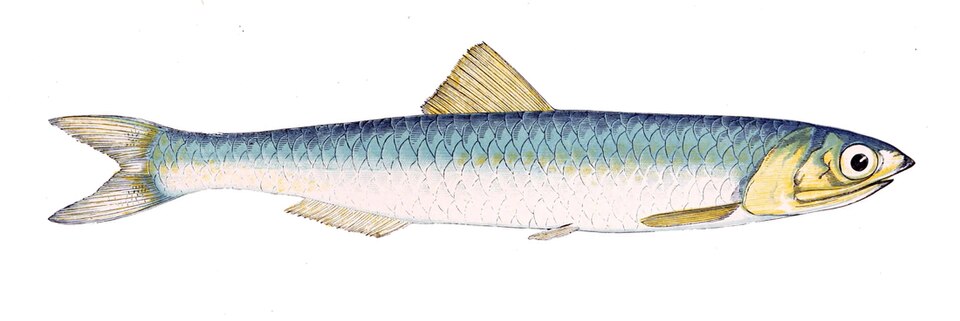
The Anchovy has a spindle-shaped, laterally compressed body, covered in easy-to-detach silvery scales. Its head is pointed with a widely slit mouth extending beyond the eye, characteristic of the Engraulis genus. The back is blue-green and the sides have a typical longitudinal silver stripe.
Characteristics
Indicative values: they vary by subspecies, sex and region.
Habitat and distribution
Anchovy frequents shallow coastal waters and neritic areas, often near estuaries and nutrient-rich areas. It tolerates a wide range of salinities and temperatures, allowing it to colonize varied habitats along the coasts. It is found both in open water and near the coast depending on the season.
CURRENT RANGE
The species is present in the Eastern Atlantic, from the North Sea to the coasts of West Africa, as well as throughout the Mediterranean and the Black Sea. In Tunisia, it is particularly abundant in the Gulf of Gabès and along the coasts of Cap Bon, traditional fishing areas.
Behaviour
The Anchovy is a gregarious species which forms large schools that can number several thousand individuals, a behavior which protects it from predators. It performs seasonal vertical and horizontal migrations linked to water temperature and food availability. Active mainly during the day, it sometimes rises to the surface at night.
Reproduction
Spawning occurs mainly in spring and summer, when water temperatures are favorable. Females release pelagic eggs in open water, which are externally fertilized by males. Sexual maturity is reached in the first or second year, and fecundity is high with several clutches per season.
Peculiarities
The Anchovy is often confused with the sardine, although it is smaller and has a significantly more prominent jaw. Its flesh, rich in fatty acids, is traditionally salted and preserved in oil or salt. It plays an essential ecological role as an intermediate link in the marine food chain.
Threats and conservation
The main threat to Anchovy populations is overfishing, particularly in years of low recruitment. Climatic variations and changes in water temperature also strongly affect stock abundance. Coastal pollution and degradation of breeding areas constitute additional threats.
Numbers and trends vary across sources and regions. See the IUCN assessment for the latest reference data.
Gallery
1 documented photographs.
References
Profile updated 29 August 2026 · Reviewed by the TunisieVet editorial team.
Comments (0)
No comments yet.
CONSERVATION STATUS
Least concern (LC)
IUCN source, latest published assessment.
Species health
Documented diseases for this species.
This information is provided for educational purposes only and is not a substitute for a veterinary consultation. If you have any concerns about your animal's health, consult a veterinarian.
Similar animals
Other species documented in Animalpedia.

TunisieVet in your pocket 📱🐾 Access your veterinary services wherever you are. [ Download the app ]
Learn more