
Presentation
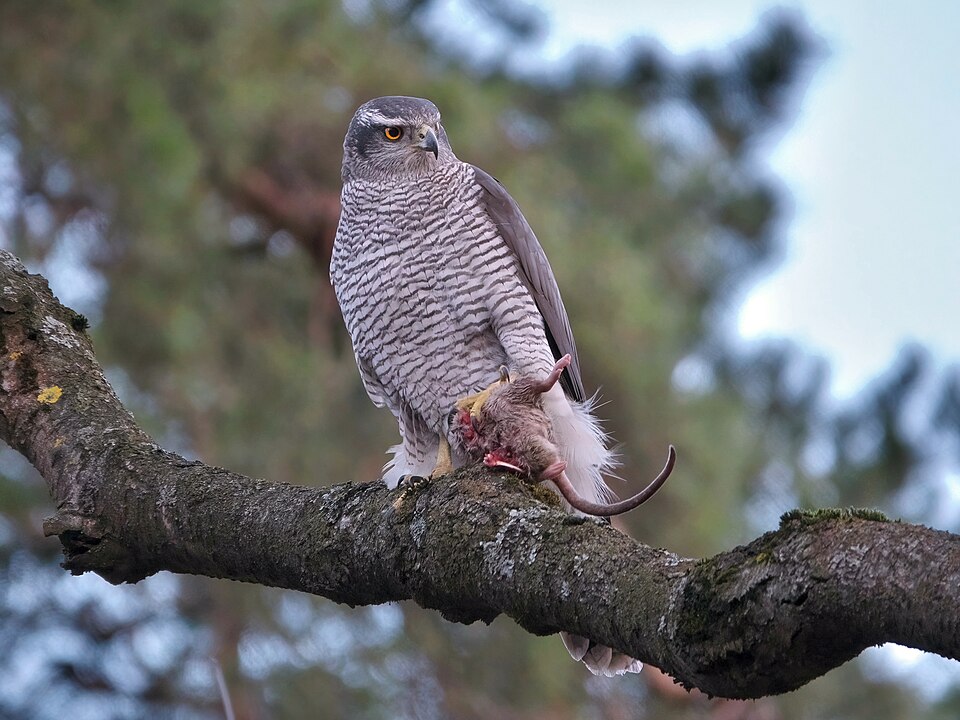
The Around northern goshawk (Accipiter gentilis) is a medium to large diurnal raptor, renowned for its fast and agile flight in forest environments. It is distinguished by its finely barred chest and its orange to red eyes in adults. This discreet predator mainly hunts birds and small mammals which it surprises in grazing flight. Present in the forests of the northern hemisphere, it also occupies certain wooded regions of North Africa, including Tunisia. Long used in falconry, it remains a symbol of temperate and Mediterranean forests.
The Around woodpigeon shows marked sexual dimorphism, with the female being significantly larger than the male. Its gray-brown plumage above and barred with gray on a white background below offers it effective camouflage in the undergrowth. Its broad, rounded wings and long tail give it great maneuverability in flight between trees. The powerful claws and hooked bill are adapted to capturing and killing prey of varying size.
Characteristics
Indicative values: they vary by subspecies, sex and region.
Habitat and distribution
The Around prefers mature, dense and mixed forests, offering both cover and hunting space. It also frequents wooded mountain areas and certain Mediterranean forests in North Africa. In winter, some individuals may move closer to more open areas such as meadows bordering woods. The presence of large trees for nesting is essential for its establishment.
CURRENT RANGE
The species is widely distributed across Europe, Asia and North America, in the temperate and boreal zone. A disjunct population also exists in North Africa, particularly in the forests of Tunisia, Algeria and Morocco. North African populations are considered a distinct, smaller, darker subspecies. In Tunisia, Around is found mainly in the forests of Kroumirie and Mogods.
Behaviour
This raptor is discreet and solitary outside the breeding season, leading a marked territorial life. It hunts from a perch before suddenly swooping down on its prey. Very shy, it generally avoids areas frequented by humans. The pair vigorously defends its nesting territory against intruders, including humans approaching the nest.
Reproduction
The female usually lays two to four eggs in a large nest built high in a tree. Incubation lasts approximately 35 to 38 days and is carried out mainly by the female. The young leave the nest after six to seven weeks but remain dependent on the parents for several more weeks. Sexual maturity is reached around two to three years of age.
Peculiarities
The Around woodpigeon has long been the emblematic raptor of medieval European falconry, used for hunting game. Its scientific name Accipiter gentilis refers to its noble status in this tradition. The North African subspecies shows notable morphological differences compared to European populations. Its ability to maneuver at high speed between branches makes it a formidable hunter in dense forest environments.
Threats and conservation
The main threat to Around is the destruction and fragmentation of its forest habitat. It is also subject to direct persecution pressure by certain poultry or feathered game breeders. The more restricted North African subspecies is particularly vulnerable to local deforestation. In Tunisia, it benefits from protected species status due to its rarity and its threatened habitat.
Numbers and trends vary across sources and regions. See the IUCN assessment for the latest reference data.
Gallery
1 documented photographs.
References
Profile updated 03 September 2026 · Reviewed by the TunisieVet editorial team.
Comments (0)
No comments yet.
CONSERVATION STATUS
Least concern (LC)
IUCN source, latest published assessment.
Species health
Documented diseases for this species.
See the 8 diseases of this species Find a veterinarianThis information is provided for educational purposes only and is not a substitute for a veterinary consultation. If you have any concerns about your animal's health, consult a veterinarian.
To discover around: Around
Videos, facts, stories and records linked to this species.
Similar animals
Other species documented in Animalpedia.

TunisieVet in your pocket 📱🐾 Access your veterinary services wherever you are. [ Download the app ]
Learn more