
Presentation
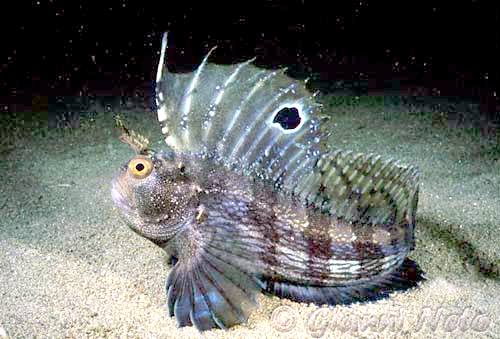
Blennie is a small benthic fish belonging to the Blenniidae family, present in the Mediterranean and the near Atlantic. It is characterized by an elongated body without scales, a head often decorated with fleshy cirri above the eyes, and cave habits. This fish lives in shallow rocky areas, coastal pools and seagrass beds, where it hides between stones and algae. Its modest size and discreet behavior make it a species little known to the general public but common during shore fishing or coastal diving. Several species of Blennies frequent the Tunisian coasts.
The body of the Blennie is elongated, laterally compressed and devoid of scales, covered with a protective mucus. Its head often bears fleshy appendages called cirri, above the eyes or nostrils depending on the species. The dorsal fin is long and continuous, extending almost the entire length of the back. The eyes, placed high on the head, allow it to monitor its environment while remaining hidden in a crevice.
Characteristics
Indicative values: they vary by subspecies, sex and region.
Habitat and distribution
The Blennie favors rocky coastal bottoms, foreshore areas, intertidal pools and shallow seagrass beds. It looks for cavities, crevices and empty shells which serve as shelter against predators and currents. Certain species tolerate variations in salinity and also frequent the areas around river mouths.
CURRENT RANGE
Blennies are widely distributed in the Mediterranean and the Eastern Atlantic, from European to North African coasts. They are common along the Tunisian coast, particularly on the rocky coasts of the north and Cape Bon. Other species of the genus exist in various temperate and tropical seas around the globe.
Behaviour
The Blennie is a sedentary and territorial fish, which often remains confined to the same rock shelter or cavity for long periods. It moves by small jerky jumps rather than by continuous swimming, sometimes relying on its pectoral fins. Some species can survive briefly out of water, at low tide, by remaining moist in a crevice. The male actively defends his territory and the nest against intruders.
Reproduction
Breeding generally takes place in spring and summer, during which the male prepares a nest in a rock cavity or empty shell. The female lays her eggs there, which the male fertilizes then monitors and aerates until hatching. The larvae are pelagic after hatching, before settling on the bottom once metamorphosed into benthic juveniles.
Peculiarities
The Blennie can stay out of the water for short periods during low tide, breathing thanks to the moisture retained in its skin and gills. Its head cirri, which vary depending on the species, are probably used for sensory detection of the nearby environment. Its mimicry with rocky or algal substrates makes it difficult to spot.
Threats and conservation
Coastal pollution and the degradation of coastal rocky habitats constitute the main pressures on Blennies populations. Trampling of intertidal zones by human activities can also locally affect its natural shelters. The species is, however, not considered threatened on a global scale.
Numbers and trends vary across sources and regions. See the IUCN assessment for the latest reference data.
Gallery
1 documented photographs.
References
Profile updated 31 August 2026 · Reviewed by the TunisieVet editorial team.
Comments (0)
No comments yet.
CONSERVATION STATUS
Least concern (LC)
IUCN source, latest published assessment.
Species health
Documented diseases for this species.
This information is provided for educational purposes only and is not a substitute for a veterinary consultation. If you have any concerns about your animal's health, consult a veterinarian.
Similar animals
Other species documented in Animalpedia.

TunisieVet in your pocket 📱🐾 Access your veterinary services wherever you are. [ Download the app ]
Learn more