
Presentation
The musk ox is a large herbivorous mammal of the Arctic, recognizable by its thick brown coat and curved horns. It owes its name to the musky odor emitted by males during the rutting season. Although it resembles cattle, it is genetically closer to goats and sheep within the Caprine subfamily. Its stocky build and double-layered fur, with an undercoat called qiviut, allow it to survive extreme temperatures. The species lives in organized herds that adopt a characteristic collective defense against predators. It came close to extinction in the nineteenth and twentieth centuries before benefiting from protection programs.
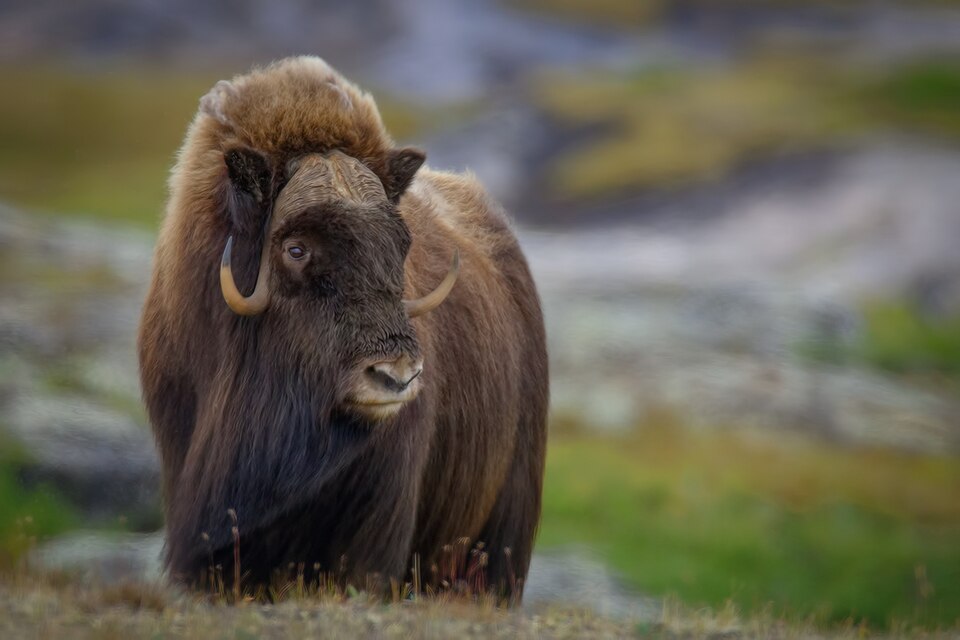
The musk ox has a massive body supported by short, sturdy legs. Its coat, composed of long guard hairs and very dense insulating down, protects it from intense cold and wind. Both sexes bear horns that are wide at the base, forming a frontal shield in adult males.
Characteristics
Indicative values: they vary by subspecies, sex and region.
Habitat and distribution
The musk ox inhabits the Arctic tundra, grasslands, and windswept rocky areas where snow accumulates minimally. It also frequents river valleys and wetland areas in summer to take advantage of more abundant vegetation. Its habitat is characterized by extreme climate conditions and sparse vegetation.
CURRENT RANGE
The species is native to Greenland and the North American Arctic, particularly northern Canada. It was successfully reintroduced to Alaska, Siberia, and Scandinavia in the twentieth century. Its range remains limited to high northern latitudes in the Northern Hemisphere.
Behaviour
The musk ox lives in herds ranging from a few individuals to several dozen animals. When threatened, adults form a defensive circle with horns pointing outward, protecting the young at the center. Males engage in spectacular frontal charges during the mating season. The species is generally not aggressive toward humans but can become dangerous if it feels cornered.
Reproduction
Mating occurs in summer, when males compete for access to females. Gestation lasts about eight months and results in a single calf born the following spring. The calf can follow the herd shortly after birth and is weaned around one year of age.
Peculiarities
Qiviut, the musk ox's undercoat, is one of the warmest and lightest natural fibers in the world, prized for handcraft weaving. The herd's formation of a defensive circle is a remarkable behavior observed in response to wolves and bears. The musky odor that gives the animal its name is produced by glands located beneath the eyes of males.
Threats and conservation
The species was threatened by intensive hunting in the nineteenth and early twentieth centuries, leading to its disappearance in several regions. Climate change is now altering its habitat, particularly through freezing rain events that restrict access to winter food. Some populations remain locally vulnerable to predation by wolves and polar bears.
Numbers and trends vary across sources and regions. See the IUCN assessment for the latest reference data.
Gallery
1 documented photographs.
References
Profile updated 06 September 2026 · Reviewed by the TunisieVet editorial team.
Comments (0)
No comments yet.
CONSERVATION STATUS
Least concern (LC)
IUCN source, latest published assessment.
Species health
Documented diseases for this species.
Find a veterinarianThis information is provided for educational purposes only and is not a substitute for a veterinary consultation. If you have any concerns about your animal's health, consult a veterinarian.
To discover around: Musk ox
Videos, facts, stories and records linked to this species.
Similar animals
Other species documented in Animalpedia.

TunisieVet in your pocket 📱🐾 Access your veterinary services wherever you are. [ Download the app ]
Learn more