
Presentation
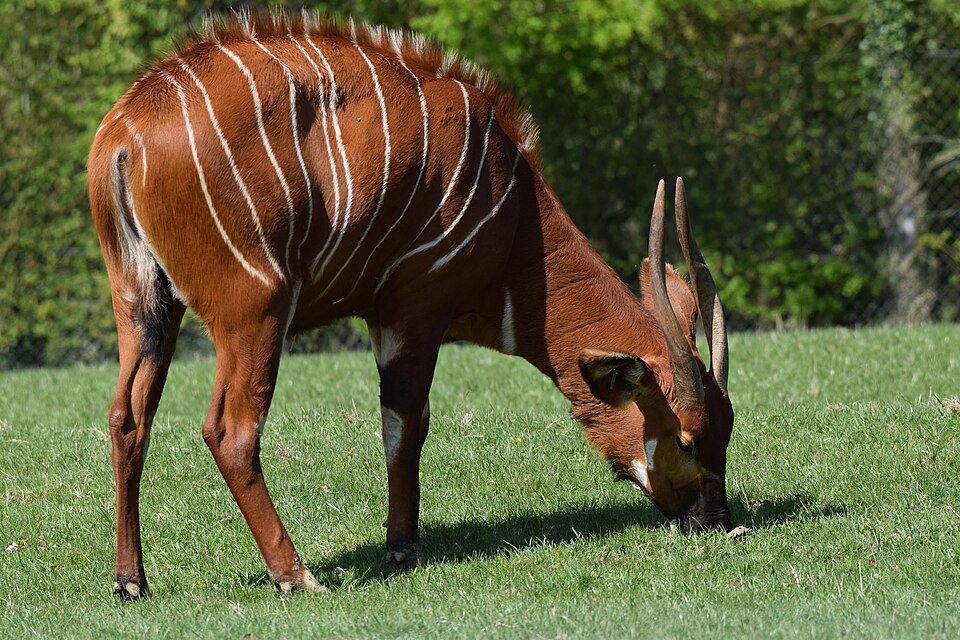
The Bongo is a large African forest antelope, recognizable by its red coat marked with fine vertical white stripes. Both sexes have long, spirally twisted horns, a rare trait among bovids. It is one of the largest antelopes in the tropical forests of Africa, living in small, discreet groups. Its massive silhouette and large ears allow it to move easily in dense vegetation. Two forms are recognized: the more common lowland Bongo, and the mountain Bongo, a rare and endangered subspecies from Kenya.
The orange-red coat has 10 to 15 white vertical stripes on the sides. The spiral horns, present in both males and females, can exceed 80 cm. The body is massive with a slightly arched back and legs marked with white.
Characteristics
Indicative values: they vary by subspecies, sex and region.
Habitat and distribution
The Bongo lives in dense, humid tropical forests, with a preference for areas of thick undergrowth providing significant plant cover. The mountain Bongo frequents high altitude forests, particularly on the slopes of Mount Kenya. The species avoids open areas and relies heavily on the presence of dense vegetation for hiding.
CURRENT RANGE
Bongo is present in Central and West Africa in the form of the plains, in countries such as Cameroon, the Democratic Republic of Congo or the Central African Republic. The mountain subspecies is confined to a few isolated forest areas in central Kenya. Its global distribution has declined sharply due to deforestation.
Behaviour
The Bongo is a rather solitary animal or living in small family groups, mainly active at dusk and at night. Discreet and fierce, it takes refuge in dense vegetation at the slightest danger rather than fleeing into open ground. Adult males are often isolated, while females and young form small herds. The species communicates by grunting and remains very sensitive to human disturbance.
Reproduction
Gestation lasts approximately nine months and results in the birth of a single calf. The young remain hidden in the vegetation during the first weeks to escape predators, the mother coming to breastfeed regularly. Sexual maturity is reached around two years of age. Breeding is not strictly seasonal and can occur all year round.
Peculiarities
The Bongo is one of the rare antelopes in which horns are present in both sexes. Its striped dress acts as effective camouflage in the dappled light of the forest. It is the largest spiral-horned antelope of its kind.
Threats and conservation
Deforestation and fragmentation of forest habitat constitute the main threat to the species. The mountain Bongo is particularly affected by poaching and the drastic reduction of its range, now numbering only a few hundred individuals. Natural predation by big cats and diseases transmitted by domestic livestock add to the pressure on isolated populations.
Numbers and trends vary across sources and regions. See the IUCN assessment for the latest reference data.
Gallery
1 documented photographs.
References
Profile updated 21 August 2026 · Reviewed by the TunisieVet editorial team.
Comments (0)
No comments yet.
CONSERVATION STATUS
Near threatened (NT)
IUCN source, latest published assessment.
Species health
Documented diseases for this species.
See the 8 diseases of this species Find a veterinarianThis information is provided for educational purposes only and is not a substitute for a veterinary consultation. If you have any concerns about your animal's health, consult a veterinarian.
Similar animals
Other species documented in Animalpedia.

TunisieVet in your pocket 📱🐾 Access your veterinary services wherever you are. [ Download the app ]
Learn more