
Presentation
Japanese quail is a small gallinaceous native to East Asia, known both in the migratory wild state and in domesticated form, which is very widespread throughout the world. It is distinguished by its modest size, its spotted brown plumage and its rapid growth. Domesticated for several centuries in Japan, it is today one of the poultry species most used for the production of eggs and meat as well as in scientific research. Its very short reproduction cycle and its ease of breeding have made it a species appreciated by small breeders and backyard enthusiasts. It remains discreet, undemanding and well adapted to life in captivity.
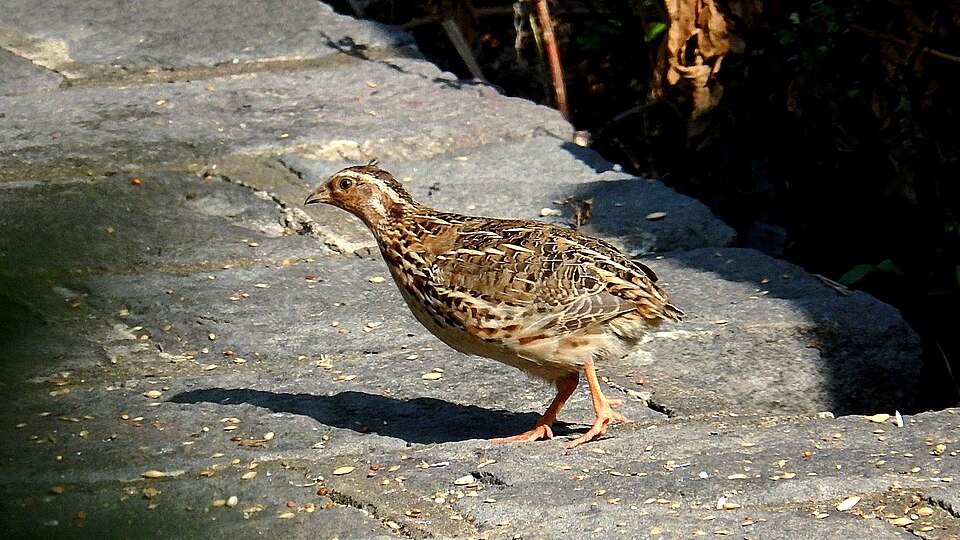
Small, stocky gallinacean with a rounded body, short wings and a reduced tail. The plumage is reddish-brown mottled with cream and black, providing effective camouflage on the ground. Domestic strains have color variations (white, fawn, spotted) obtained by selection. The beak is short and robust, adapted to a granivorous and insectivorous diet.
Characteristics
Indicative values: they vary by subspecies, sex and region.
Habitat and distribution
In the wild, the species frequents the steppes, grassy meadows and cultivated fields of Asia. It favors areas of low, dense vegetation providing cover against predators. In breeding, it easily adapts to aviaries and equipped farm spaces.
CURRENT RANGE
The wild form is found in East Asia, notably Japan, China, Korea and eastern Russia, with migratory populations. The domestic form, derived from ancient Japanese selections, is now bred throughout the world for egg and meat production. In Tunisia, only the domestic form is present, in family and commercial farms.
Behaviour
The Japanese quail is a gregarious bird and not very shy in breeding, forming stable groups when domesticated. It is diurnal, runs more than flies and often moves on the ground in small groups. In the wild, migratory populations gather in flocks during seasonal movements. The domestic male emits a characteristic song repeated to mark its presence.
Reproduction
The female reaches sexual maturity very quickly, often within six to eight weeks. She can lay one egg per day in good breeding conditions, with high annual productivity. Incubation lasts approximately 16 to 18 days, carried out naturally or in an artificial incubator. Chicks are precocial and capable of feeding on their own shortly after hatching.
Peculiarities
The Japanese quail is one of the most used avian models in biological and genetic research due to its very short reproduction cycle. Its small size and rapid growth make it a popular species for producing miniature eggs. Some domestic lineages have lost some of the migratory behavior of their wild ancestors.
Threats and conservation
Wild populations are under pressure from hunting and the loss of steppe habitats in parts of Asia. The domestic form is not threatened, its reproduction in captivity being controlled on a large scale. There are no significant threats to the species as a whole globally.
Numbers and trends vary across sources and regions. See the IUCN assessment for the latest reference data.
Gallery
1 documented photographs.
References
Profile updated 18 August 2026 · Reviewed by the TunisieVet editorial team.
Comments (0)
No comments yet.
CONSERVATION STATUS
Least concern (LC)
IUCN source, latest published assessment.
Species health
Documented diseases for this species.
See the 8 diseases of this species Find a veterinarianThis information is provided for educational purposes only and is not a substitute for a veterinary consultation. If you have any concerns about your animal's health, consult a veterinarian.
To discover around: Japanese quail
Videos, facts, stories and records linked to this species.
Similar animals
Other species documented in Animalpedia.

TunisieVet in your pocket 📱🐾 Access your veterinary services wherever you are. [ Download the app ]
Learn more