
Presentation
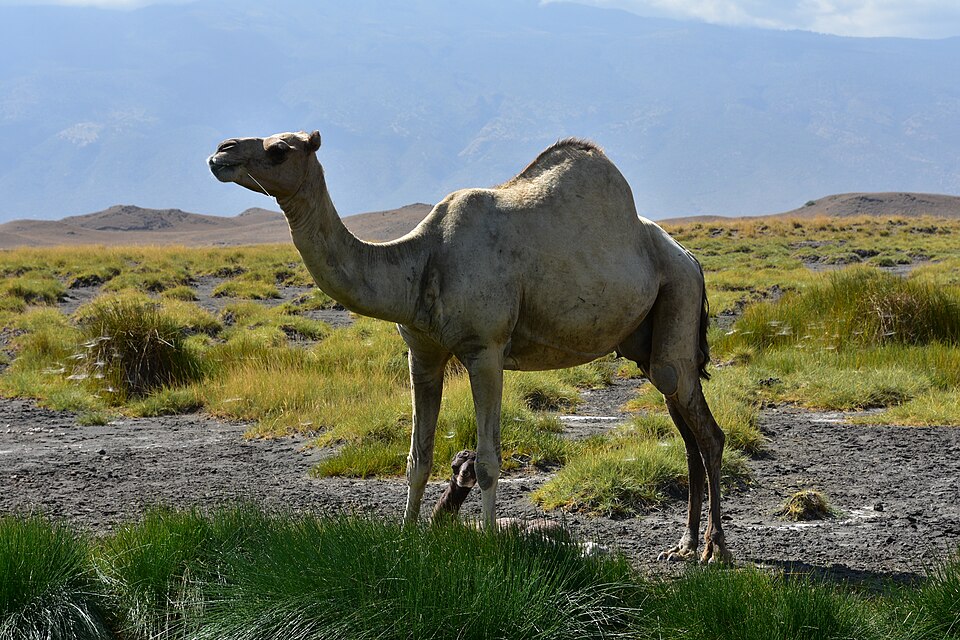
Camel commonly refers to the dromedary (Camelus dromedarius), a one-humped ungulate mammal native to the arid regions of North Africa and the Middle East. Domesticated for several millennia, it constitutes a pack, saddle and milk production animal essential to Saharan and desert populations. Its body is remarkably adapted to heat and lack of water, allowing it to survive several days without drinking. In Tunisia, it remains closely associated with Saharan culture and tourism in the south of the country.
The dromedary is characterized by a single hump of fat on its back, long legs and a long neck. Its large, cushioned feet allow it to walk on sand without sinking. Its thick eyelids, long eyelashes and its ability to close its nostrils effectively protect it from sand and wind.
Characteristics
Indicative values: they vary by subspecies, sex and region.
Habitat and distribution
The Camel is perfectly suited to desert and arid environments, including sandy and rocky areas as well as semi-arid steppes. It also frequents poor grazing areas around oases and Saharan farms. This adaptation allows it to tolerate extreme thermal amplitudes between day and night.
CURRENT RANGE
The dromedary is native to the Arabian Peninsula and North Africa, but its breeding has spread to many arid regions of the world. It is found today from the Sahara to Central Asia and Australia, where populations returned to the wild state persist. In Tunisia, it is present mainly in the southern regions, notably around Douz and Ksar Ghilane.
Behaviour
A gregarious animal, the Camel traditionally lives in herds led by humans or, in a semi-wild state, organized around a dominant male. It adopts a calm behavior but can be aggressive or nervous during the rutting season. Its characteristic gait, called amble, consists of simultaneously moving both legs on the same side.
Reproduction
The female camel carries her young for about 13 months before giving birth to a single camel, capable of moving shortly after birth. Weaning generally occurs around a year to a year and a half. Sexual maturity is reached between three and five years of age depending on the sex.
Peculiarities
Contrary to popular belief, the Camel bump does not store water but fat reserves that can be mobilized in the event of a shortage. The animal can lose up to a quarter of its weight in water without danger to life, an exceptional tolerance among mammals. Its oval-shaped red blood cells facilitate blood circulation even in cases of severe dehydration.
Threats and conservation
The domestic species is not subject to any significant conservation threat, its breeding being widespread and supervised. The ancestral wild populations, on the other hand, have disappeared, with only the camel returned to the wild in Australia constituting a free population. The degradation of desert areas and the mechanization of transport are gradually reducing its traditional use.
Numbers and trends vary across sources and regions. See the IUCN assessment for the latest reference data.
Gallery
1 documented photographs.
References
Profile updated 20 August 2026 · Reviewed by the TunisieVet editorial team.
Comments (0)
No comments yet.
CONSERVATION STATUS
Least concern (LC)
IUCN source, latest published assessment.
Species health
Documented diseases for this species.
See the 8 diseases of this species Find a veterinarianThis information is provided for educational purposes only and is not a substitute for a veterinary consultation. If you have any concerns about your animal's health, consult a veterinarian.
To discover around: Camel
Videos, facts, stories and records linked to this species.
Similar animals
Other species documented in Animalpedia.

TunisieVet in your pocket 📱🐾 Access your veterinary services wherever you are. [ Download the app ]
Learn more