
Presentation
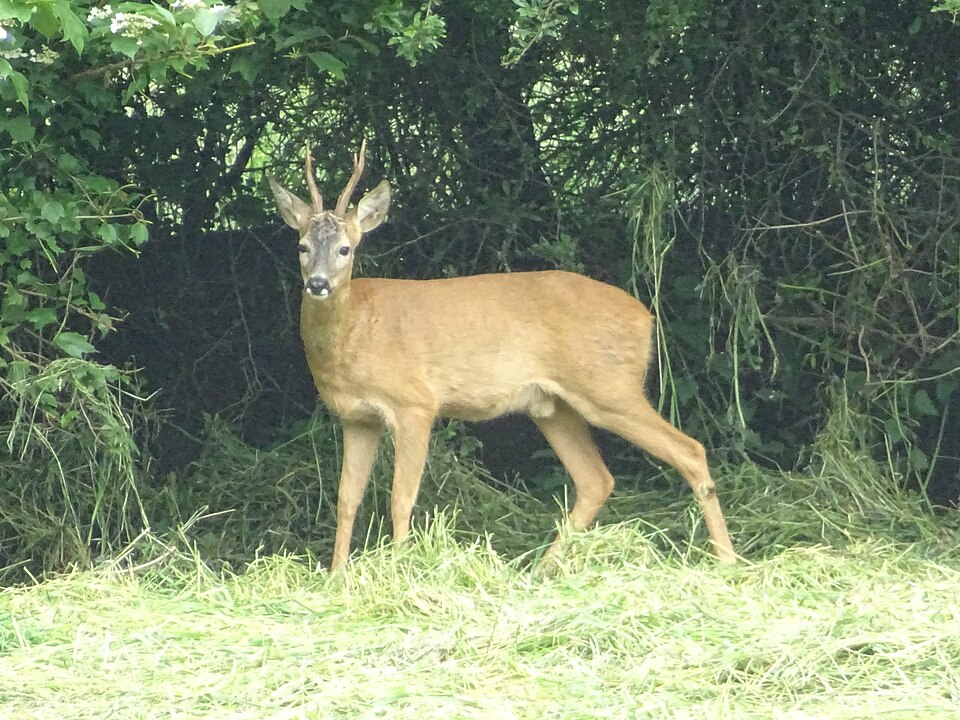
The Roe deer (Capreolus capreolus) is a small deer widely distributed in Europe and part of western Asia. It is distinguished by its slender silhouette, its tawny coat in summer and gray in winter, as well as the absence of a visible tail. Males have short, branched antlers, which they shed and renew each year. A discreet and adaptable species, the Roe deer frequents both forests and agricultural edges. It is very common in Europe and constitutes the most widespread large game on the continent.
The Roe deer has a thin body, long and thin legs suitable for running and jumping. Its coat changes color depending on the season, going from red-fawn in summer to grey-brown in winter. It has a characteristic white spot on its hindquarters, called a “mirror”. Only males have antlers, generally with three points per side.
Characteristics
Indicative values: they vary by subspecies, sex and region.
Habitat and distribution
The Roe deer likes deciduous and mixed forests, as well as their edges bordering cultivated fields. It also adapts to wooded areas, meadows and sometimes to the edges of urban areas. Its capacity for adaptation allows it to colonize various environments, including agricultural ones, as long as it has wooded cover to take refuge.
CURRENT RANGE
The Roe deer occurs across most of Europe, where it is one of the most common deer. Its range also extends to western Asia and the Caucasus. It is absent from North Africa, including Tunisia, where it does not exist naturally.
Behaviour
The Roe deer is a rather solitary animal or lives in small family groups, except in winter when it can gather in larger groups. It is active mainly at dusk and dawn, during which it actively feeds. Males mark their territory by rubbing their antlers on trees and by scent markings. It is a fierce animal, very sensitive to disturbance, which quickly flees at the slightest danger by performing characteristic leaps.
Reproduction
The rutting period takes place in summer, between July and August. The female, called a doe, gives birth after a gestation which includes a phase of embryonic diapause, leading to a birth the following spring. She generally gives birth to one or two fawns, rarely three. The young remain hidden in the vegetation during their first weeks of life.
Peculiarities
Roe deer has a unique embryonic diapause among European ungulates, delaying embryo implantation. Its characteristic zigzag flight and leaps, sometimes accompanied by an alert bark, are typical of the species. The white “mirror” of the hindquarters serves as a visual signal between individuals.
Threats and conservation
The main threats are hunting, road collisions and the fragmentation of its forest habitat by urbanization and intensive agriculture. Populations remain generally stable and abundant in Europe thanks to controlled hunting management. The species is not threatened on a global scale.
Numbers and trends vary across sources and regions. See the IUCN assessment for the latest reference data.
Gallery
1 documented photographs.
References
Profile updated 20 August 2026 · Reviewed by the TunisieVet editorial team.
Comments (0)
No comments yet.
CONSERVATION STATUS
Least concern (LC)
IUCN source, latest published assessment.
Species health
Documented diseases for this species.
See the 8 diseases of this species Find a veterinarianThis information is provided for educational purposes only and is not a substitute for a veterinary consultation. If you have any concerns about your animal's health, consult a veterinarian.
Similar animals
Other species documented in Animalpedia.

TunisieVet in your pocket 📱🐾 Access your veterinary services wherever you are. [ Download the app ]
Learn more