
Presentation
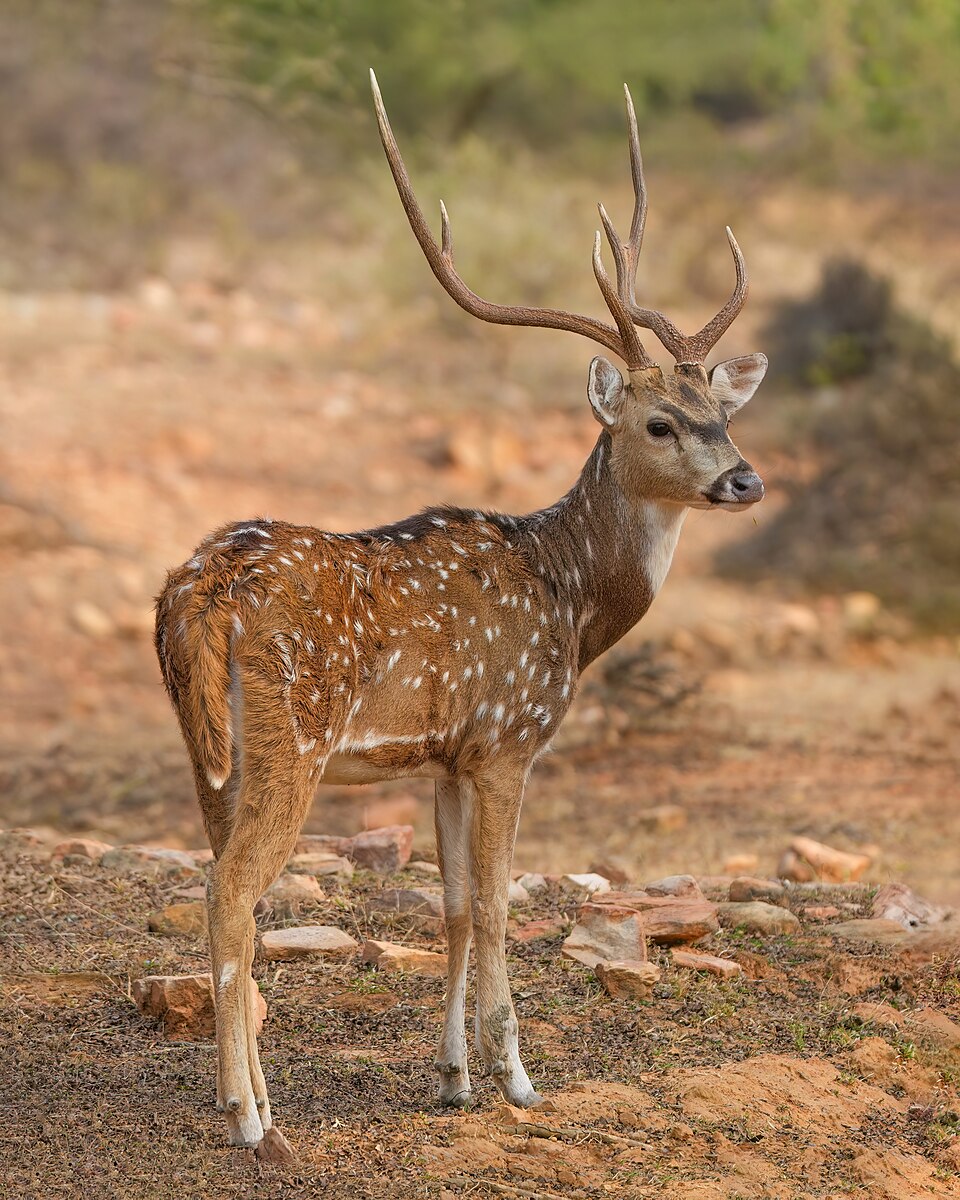
The axis deer is a cervid native to the Indian subcontinent, recognizable by its fawn coat covered with white spots that persist into adulthood. It lives in herds of several dozen individuals, often associated with troops of langurs that alert it to the presence of predators. Males bear three-pointed antlers that are renewed each year. It is one of the most widespread and well-studied deer species in South Asia. It has been successfully introduced to many countries outside its native range. Its spotted coat and gregarious behavior make it an emblematic species of Indian parks and reserves.
The axis deer has a slender build, a reddish-brown coat marked with aligned white spots, and a white belly. Males are distinguished by lyre-shaped antlers with three points that can exceed 30 inches. Females lack antlers and are slightly smaller than males.
Characteristics
Indicative values: they vary by subspecies, sex and region.
Habitat and distribution
The chital inhabits dry and wet tropical forests, wooded savannas, and forest edges near water sources. It avoids dense closed forest, preferring mixed habitats that offer both cover and open grazing areas.
CURRENT RANGE
The species is native to the Indian subcontinent, including India, Sri Lanka, Nepal, and Bangladesh. It has been successfully introduced to several countries such as the United States, Australia, and various islands, where feral populations have become established.
Behaviour
The axis deer is a diurnal and crepuscular species, living in mixed herds whose composition varies with the season. It frequently maintains associations with langurs and sometimes other ungulates, taking advantage of their vigilance against predators such as tigers and leopards. Dominant males defend a temporary territory during the breeding period and emit distinctive vocalizations to attract females.
Reproduction
Chital breeding is not strictly seasonal and can occur year-round, with peaks linked to food availability. After a gestation period of approximately 7 months, the female gives birth to a single fawn, rarely two. The young is able to follow the herd shortly after birth and reaches sexual maturity around 2 years of age.
Peculiarities
The persistence of white spots into adulthood distinguishes the chital from most other deer, in which this coat pattern typically disappears after the juvenile stage. Its close association with langurs is a classic example of vigilance mutualism studied in behavioral ecology.
Threats and conservation
The chital locally suffers from habitat loss due to agricultural expansion and deforestation. Illegal hunting for meat remains a pressure in some regions. Its global populations, however, remain abundant thanks to its wide distribution and adaptability.
Numbers and trends vary across sources and regions. See the IUCN assessment for the latest reference data.
Gallery
1 documented photographs.
References
Profile updated 06 September 2026 · Reviewed by the TunisieVet editorial team.
Comments (0)
No comments yet.
CONSERVATION STATUS
Least concern (LC)
IUCN source, latest published assessment.
Species health
Documented diseases for this species.
Find a veterinarianThis information is provided for educational purposes only and is not a substitute for a veterinary consultation. If you have any concerns about your animal's health, consult a veterinarian.
To discover around: Axis deer
Videos, facts, stories and records linked to this species.
Similar animals
Other species documented in Animalpedia.

TunisieVet in your pocket 📱🐾 Access your veterinary services wherever you are. [ Download the app ]
Learn more