
Presentation
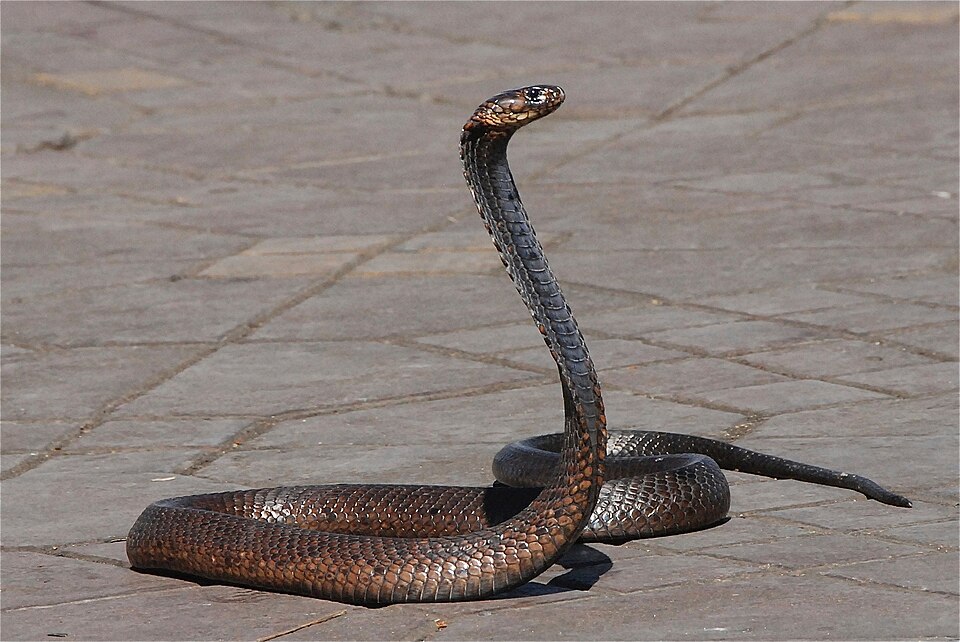
The Egyptian cobra is a medium-sized venomous snake belonging to the Elapidae family. Recognizable by its flat, triangular head, it has a robust body, generally brown or gray in color. A highly venomous species, it is capable of spitting its venom several meters if threatened.
The Egyptian cobra features a head distinct from the body, with medium-sized eyes and lateral nostrils. Its body is covered in smooth, shiny scales, organized in regular rows. Coloration varies from pale yellow to dark brown, often with dark patterns or bands depending on the individual.
Characteristics
Indicative values: they vary by subspecies, sex and region.
Habitat and distribution
The Egyptian cobra inhabits desert and semi-arid regions, preferring dry and rocky environments. It is found along temporary watercourses, in stony and cultivated areas, as well as near human habitations where rodents are abundant. It efficiently exploits burrows and crevices for rest.
CURRENT RANGE
Egyptian cobra is widely distributed in North and sub-Saharan Africa, with its range extending from Morocco to Somalia. It is also found in the Middle East and the Arabian Peninsula. A very common species in certain regions, it has adapted to transformed human environments.
Behaviour
A rather aggressive snake when it feels threatened, the Egyptian cobra raises its head and dilates its characteristic hood, emitting powerful hisses. Capable of causing serious injury with its venomous fangs, it can also spit its venom with great precision. Generally solitary and nocturnal, it is not very active during the day.
Reproduction
The Egyptian cobra is oviparous: the female lays 8 to 20 elongated eggs in a protected place such as a rocky crevice or a burrow. Incubation lasts approximately 60 to 80 days depending on thermal conditions. Young snakes are born independent and venomous from birth.
Peculiarities
A notable characteristic of the Egyptian cobra is its ability to spit venom: when it feels threatened, it projects its toxin into the eyes and face of its potential attacker with impressive precision, potentially causing temporary or permanent blindness. Its venom is also dangerous by direct injection during a bite.
Threats and conservation
The Egyptian cobra has no major threats affecting its survival. Although it is sometimes killed by humans out of fear or for safety, its population remains stable throughout most of its range. The species remains abundant in suitable regions.
Numbers and trends vary across sources and regions. See the IUCN assessment for the latest reference data.
Gallery
1 documented photographs.
References
UICN — Liste rouge des espèces menacées
Profile updated 31 August 2026 · Reviewed by the TunisieVet editorial team.
Comments (0)
No comments yet.
CONSERVATION STATUS
Least concern (LC)
IUCN source, latest published assessment.
Species health
Documented diseases for this species.
This information is provided for educational purposes only and is not a substitute for a veterinary consultation. If you have any concerns about your animal's health, consult a veterinarian.
To discover around: Egyptian cobra
Videos, facts, stories and records linked to this species.
Similar animals
Other species documented in Animalpedia.

TunisieVet in your pocket 📱🐾 Access your veterinary services wherever you are. [ Download the app ]
Learn more