
Presentation
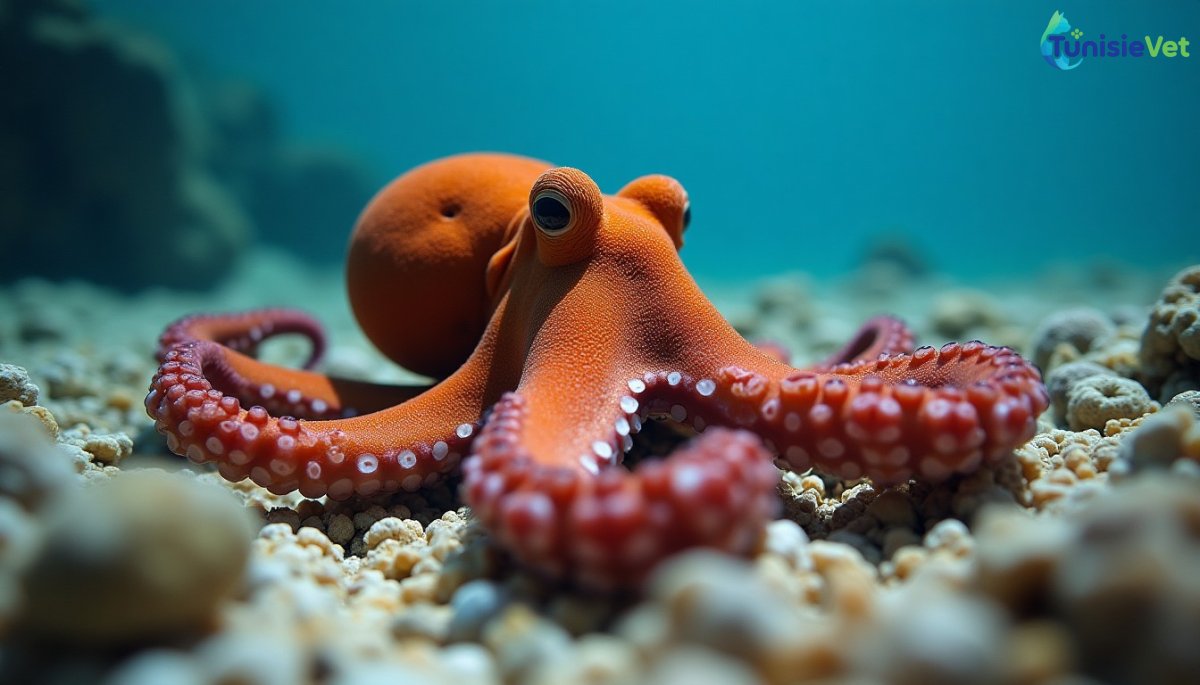
The Common octopus is a cephalopod mollusk present in the Mediterranean and the Atlantic, very common along the Tunisian coasts. He has eight arms covered in suction cups, three hearts and blue blood rich in copper. Master of camouflage, it changes color and texture in a fraction of a second to blend into rocky bottoms. Its intelligence is remarkable for an invertebrate: it opens shells, uses shelters and learns by observation. It hunts crabs, shellfish and fish at night, and lives alone in a den to which it defends the entrance.
The Common octopus has a soft body with no internal skeleton, which allows it to fit into very tight spaces. It has eight arms equipped with sensory and prehensile suction cups, as well as a powerful horny beak. Its skin contains chromatophores allowing almost instantaneous color changes. Its complex nervous system and three hearts make it an invertebrate with high cognitive abilities.
Did you know?
How does the octopus escape its predators?
Characteristics
Indicative values: they vary by subspecies, sex and region.
Habitat and distribution
The Common octopus lives in rocky and sandy seabeds, generally between the surface and 200 meters depth. It likes coastal areas rich in crevices where it can hide during the day. It tolerates a wide range of temperatures, which explains its presence in temperate and tropical seas.
CURRENT RANGE
The species is widely distributed in the eastern Atlantic, Mediterranean and parts of the Indo-Pacific. It is present along the Tunisian coasts, particularly in the Mediterranean. Its distribution mainly follows temperate and tropical coastal areas rich in rocky substrates.
Behaviour
The Common octopus is a solitary animal, mainly active at dusk and night. It displays remarkable intelligence among invertebrates, capable of learning, problem solving, and using tools like shells to protect itself. It quickly changes skin color and texture using specialized pigment cells, to camouflage or communicate. It moves by crawling using its eight arms or by propulsion by ejecting water.
Reproduction
Reproduction takes place by mating during which the male transfers a spermatophore to the female using a specialized arm, the hectocotyl. The female lays several tens of thousands of eggs which she attaches in clusters in a rock cavity. She monitors them and aerates them constantly without feeding until they hatch, then dies shortly after. Young octopuses go through a planktonic phase before reaching the seabed.
Peculiarities
The Common octopus can regenerate a lost arm in the event of injury or attack. He has three hearts and blue blood rich in hemocyanin. Its ability to imitate shapes and colors to conceal itself is among the most developed in the animal kingdom.
Threats and conservation
Overfishing, particularly for human consumption, constitutes the main pressure exerted on populations. The degradation of coastal habitats and marine pollution also affect its breeding areas. However, its rapid growth and high fertility limit the overall risk of population collapse.
Numbers and trends vary across sources and regions. See the IUCN assessment for the latest reference data.
Gallery
1 documented photographs.
References
Profile updated 17 August 2026 · Reviewed by the TunisieVet editorial team.
Comments (0)
No comments yet.
CONSERVATION STATUS
Least concern (LC)
IUCN source, latest published assessment.
Species health
Documented diseases for this species.
This information is provided for educational purposes only and is not a substitute for a veterinary consultation. If you have any concerns about your animal's health, consult a veterinarian.
To discover around: Common octopus
Videos, facts, stories and records linked to this species.
Similar animals
Other species documented in Animalpedia.

TunisieVet in your pocket 📱🐾 Access your veterinary services wherever you are. [ Download the app ]
Learn more