
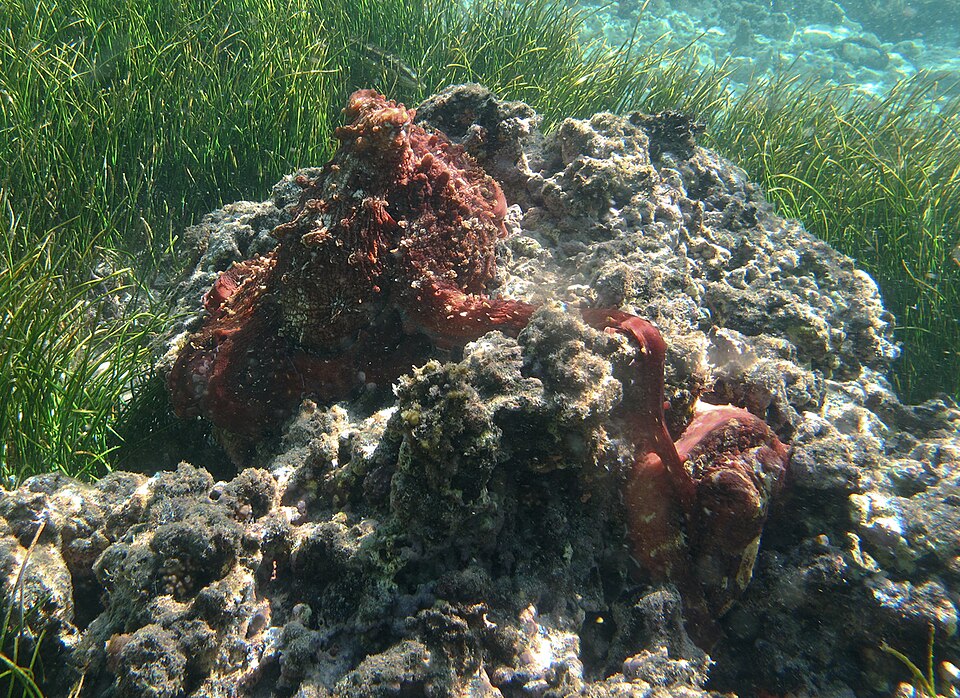
Presentation
The Day octopus, also called the day octopus, is a marine cephalopod renowned for its exceptional camouflage capabilities. Active mainly during the day, it hunts on the shallow coral reefs of the Indo-Pacific. Its soft body, devoid of skeleton, allows it to slip into the smallest rock cracks. It quickly changes color and texture thanks to specialized pigment cells called chromatophores. This solitary species is studied for its remarkable intelligence among invertebrates.
The Day octopus has eight arms covered in suction cups connected to a globular body called a mantle. Its skin is capable of instantly changing its color, pattern, and even texture to blend in with the surroundings. It does not have a shell or rigid bone structure, which gives it great body flexibility. His eyes are very developed and provide him with excellent vision despite the lack of color perception.
Characteristics
Indicative values: they vary by subspecies, sex and region.
Habitat and distribution
The Day octopus lives in shallow lagoons and coral reefs, generally up to around thirty meters deep. It seeks rocky or coral bottoms offering numerous cavities for shelter. The seagrass beds adjacent to the reefs also constitute popular hunting areas. It avoids cold waters and remains confined to warm and clear tropical zones.
CURRENT RANGE
This species is widely distributed in the Indian Ocean and tropical Pacific, from the coasts of East Africa to Hawaii. It particularly frequents the reefs of the Red Sea, Madagascar, Australia and Polynesia. Its distribution closely follows that of healthy tropical coral reefs. It is absent from temperate and cold waters as well as the Mediterranean.
Behaviour
This solitary and territorial animal occupies a burrow which it leaves to hunt and then systematically returns. It uses camouflage and inkjet escape as its primary defenses against predators. Endowed with notable intelligence, it is capable of learning and solving simple problems in captivity. Its locomotion combines crawling on the arms and propulsion by jet of water expelled from the mantle.
Reproduction
Reproduction occurs by transfer of spermatophores from the male to the female using a specialized arm called a hectocotyl. After mating, the female lays several thousand eggs which she fixes in clusters in a protected cavity and watches over them tirelessly. It stops feeding during this period and generally dies shortly after the eggs hatch. The young octopuses, tiny and planktonic, then disperse in the water column before reaching the bottom.
Peculiarities
Day octopus can change its skin color and texture in a fraction of a second using nerve cells directly connected to its skin. It has three hearts and a nervous system, a large part of the neurons of which are distributed in its arms. Each arm can act almost autonomously while remaining coordinated by the central brain. In case of extreme danger, it can sacrifice an arm to escape a predator, this limb can then regenerate.
Threats and conservation
The degradation of coral reefs due to global warming and pollution constitutes the main threat to this species. Local overfishing for human consumption also affects some coastal populations. Day octopus is, however, not considered globally threatened due to its wide distribution and abundant reproduction. No specific protective measures are currently in place on a large scale.
Numbers and trends vary across sources and regions. See the IUCN assessment for the latest reference data.
Gallery
1 documented photographs.
References
Profile updated 19 August 2026 · Reviewed by the TunisieVet editorial team.
Comments (0)
No comments yet.
CONSERVATION STATUS
Data deficient (DD)
IUCN source, latest published assessment.
Species health
Documented diseases for this species.
See the 5 diseases of this species Find a veterinarianThis information is provided for educational purposes only and is not a substitute for a veterinary consultation. If you have any concerns about your animal's health, consult a veterinarian.
To discover around: Day octopus
Videos, facts, stories and records linked to this species.
Similar animals
Other species documented in Animalpedia.

TunisieVet in your pocket 📱🐾 Access your veterinary services wherever you are. [ Download the app ]
Learn more