
Presentation
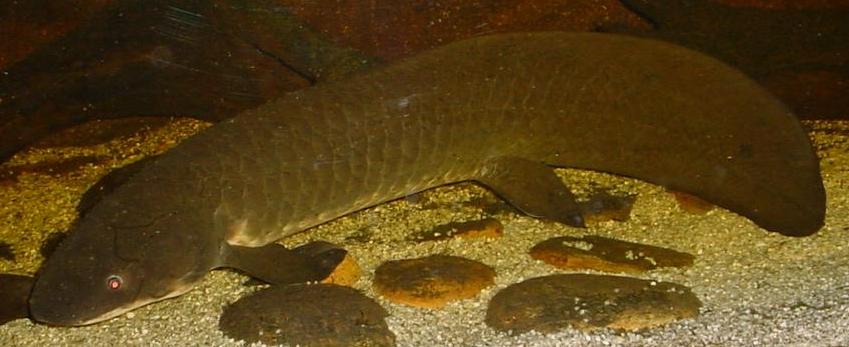
The Lungfish, or lungfish, is a freshwater fish characterized by possessing functional lungs in addition to its gills, allowing it to breathe atmospheric air. This ancestral trait makes it a living witness to the transition between aquatic vertebrates and the first terrestrial tetrapods. There are several species distributed in Africa, South America and Oceania (Australia). Its elongated body, often elongated, and its filiform fins distinguish it from classic bony fish. It is able to survive the drying out of its environment by burying itself in the mud and entering into aestivation. This particular lifestyle makes it a very popular animal among aquarists who love biological curiosities.
The Lungfish has one or two lungs derived from the swim bladder, allowing it to breathe air at the surface. Its body is elongated, covered with fine cycloid scales, and its pectoral and pelvic fins are filiform in certain African species. It retains primitive characteristics close to those of the first fish with fleshy fins (Sarcopterygians).
Characteristics
Indicative values: they vary by subspecies, sex and region.
Habitat and distribution
The Lungfish lives in stagnant or slow-moving fresh water, such as swamps, slow-moving rivers, and seasonal wetlands. It tolerates waters poor in oxygen thanks to its air respiration. Some African species survive the complete drying out of their habitat by burying themselves in mud.
CURRENT RANGE
Lungfishs species are found in sub-Saharan Africa (genus Protopterus), South America (Lepidosiren, Amazon basin) and Australia (Neoceratodus, Queensland rivers). This disjointed distribution illustrates the antiquity of the group, whose ancestors were already present before the separation of the continents of Gondwana. Lungfish is not present in Tunisia or North Africa.
Behaviour
It is a rather solitary and nocturnal animal, active mainly when searching for food. During the dry season, some African species burrow into a cocoon of dried mucus at the bottom of dry swamps, entering aestivation for several months. It regularly rises to the surface to breathe using its lungs, even in well-oxygenated water.
Reproduction
Reproduction takes place in open water during the rainy season, with external fertilization of eggs deposited in burrows or vegetated nests depending on the species. Some African males guard the nest and watch over the eggs until the larvae hatch. The larvae have external gills reminiscent of those of amphibians before developing their adult morphology.
Peculiarities
Lungfish is often referred to as a "living fossil" because its body plan has changed little over tens of millions of years. It is phylogenetically one of the closest groups of fish to terrestrial tetrapods, including amphibians and mammals. Its ability to survive several months or even years out of water during aestivation is unique among fish.
Threats and conservation
The degradation of wetlands and the pollution of fresh water threaten certain populations locally. Overfishing and capture for the aquarium trade can put additional pressure on certain species. Overall, most current species are not considered globally threatened.
Numbers and trends vary across sources and regions. See the IUCN assessment for the latest reference data.
Gallery
1 documented photographs.
References
Profile updated 31 August 2026 · Reviewed by the TunisieVet editorial team.
Comments (0)
No comments yet.
CONSERVATION STATUS
Least concern (LC)
IUCN source, latest published assessment.
Species health
Documented diseases for this species.
This information is provided for educational purposes only and is not a substitute for a veterinary consultation. If you have any concerns about your animal's health, consult a veterinarian.
To discover around: Lungfish
Videos, facts, stories and records linked to this species.
Similar animals
Other species documented in Animalpedia.

TunisieVet in your pocket 📱🐾 Access your veterinary services wherever you are. [ Download the app ]
Learn more