
Presentation
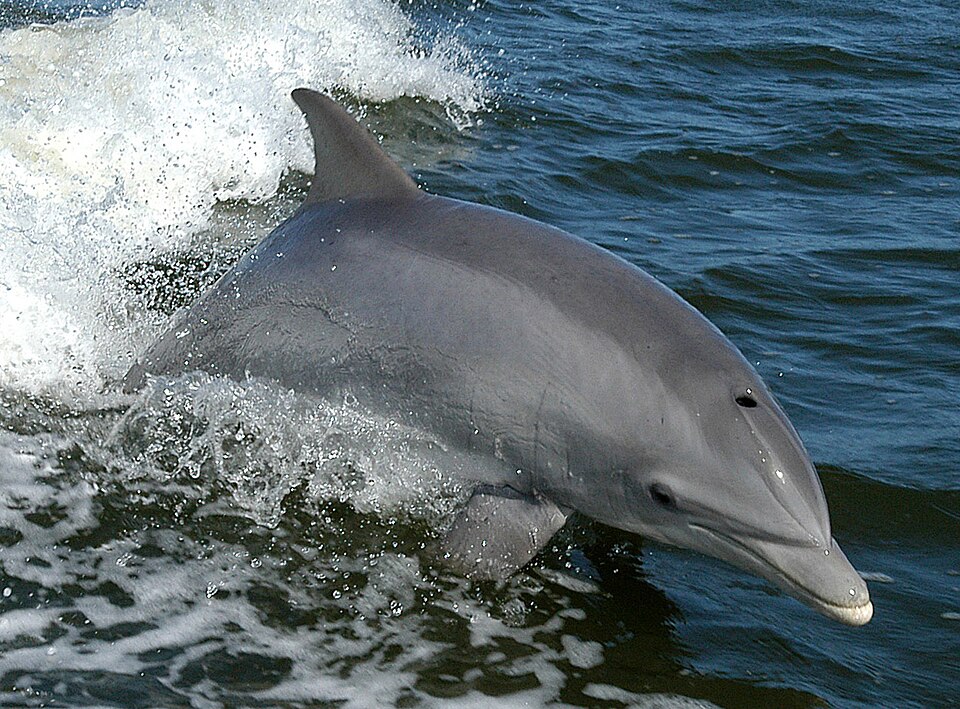
The Common bottlenose dolphin is a marine cetacean of imposing size, recognizable by its short, stocky rostrum (beak) and its gray hue. It is one of the most studied and intelligent species of dolphin, renowned for its exceptional cognitive abilities and complex social behavior.
The Common bottlenose dolphin has a streamlined, sturdy body, an overall gray color with a lighter underbelly. It has a falcate (sickle-shaped) dorsal fin, well-developed pectoral fins and a powerful tail. Its skull contains a large brain, the seat of its remarkable intelligence.
Did you know?
How do dolphins use echolocation?
Characteristics
Indicative values: they vary by subspecies, sex and region.
Habitat and distribution
The Common bottlenose dolphin frequents temperate to tropical coastal and oceanic waters, generally up to 200 meters deep, although it can venture into deeper waters. It prefers areas rich in prey such as estuaries, bays, reefs and cold water upwelling areas. This species adapts remarkably well to different coastal marine environments.
CURRENT RANGE
Common bottlenose dolphin is distributed throughout the world's oceans and seas, from the cold waters of the English Channel and the Baltic to tropical waters. It is present in inland seas such as the Mediterranean and the Black Sea. Its distribution is mainly coastal, with well-established populations in the North Atlantic, Mediterranean and Pacific.
Behaviour
The Common bottlenose dolphin is highly social, living in groups (pods) of varying size, from pairs to hundreds of individuals. It communicates by clicks, whistles and other vocalizations. This species is known for its curiosity towards humans, its acrobatic surface games and its remarkable learning abilities including the use of tools.
Reproduction
The Common bottlenose dolphin reaches sexual maturity around 6 to 12 years old depending on sex. Gestation lasts approximately 12 months, resulting in the birth of a single young. Breastfeeding continues for 2 to 3 years, during which the mother invests massively in the education of the young, teaching it hunting techniques and the social codes of the group.
Peculiarities
The Common bottlenose dolphin has a sophisticated echolocation system allowing it to navigate and hunt in the dark. He is able to recognize and memorize individuals in his group by their unique acoustic signatures. This species is also famous for its play behavior, including the use of floating sargassum as toys and spectacular leaps out of the water.
Threats and conservation
Common bottlenose dolphin is currently classified as Least Concern, but it faces real threats. Marine pollution, especially plastics and chemical pollutants, affects its health. Fishing nets pose a risk of accidental capture (bycatch). Too intensive a fish resource reduces its food availability. Underwater noise and disturbance from coastal human activities also impact its behavior and communication.
Numbers and trends vary across sources and regions. See the IUCN assessment for the latest reference data.
Gallery
1 documented photographs.
References
UICN — Liste rouge des espèces menacées
Profile updated 31 August 2026 · Reviewed by the TunisieVet editorial team.
Comments (0)
No comments yet.
CONSERVATION STATUS
Least concern (LC)
IUCN source, latest published assessment.
Species health
Documented diseases for this species.
This information is provided for educational purposes only and is not a substitute for a veterinary consultation. If you have any concerns about your animal's health, consult a veterinarian.
To discover around: Common bottlenose dolphin
Videos, facts, stories and records linked to this species.
Similar animals
Other species documented in Animalpedia.

TunisieVet in your pocket 📱🐾 Access your veterinary services wherever you are. [ Download the app ]
Learn more