
Presentation
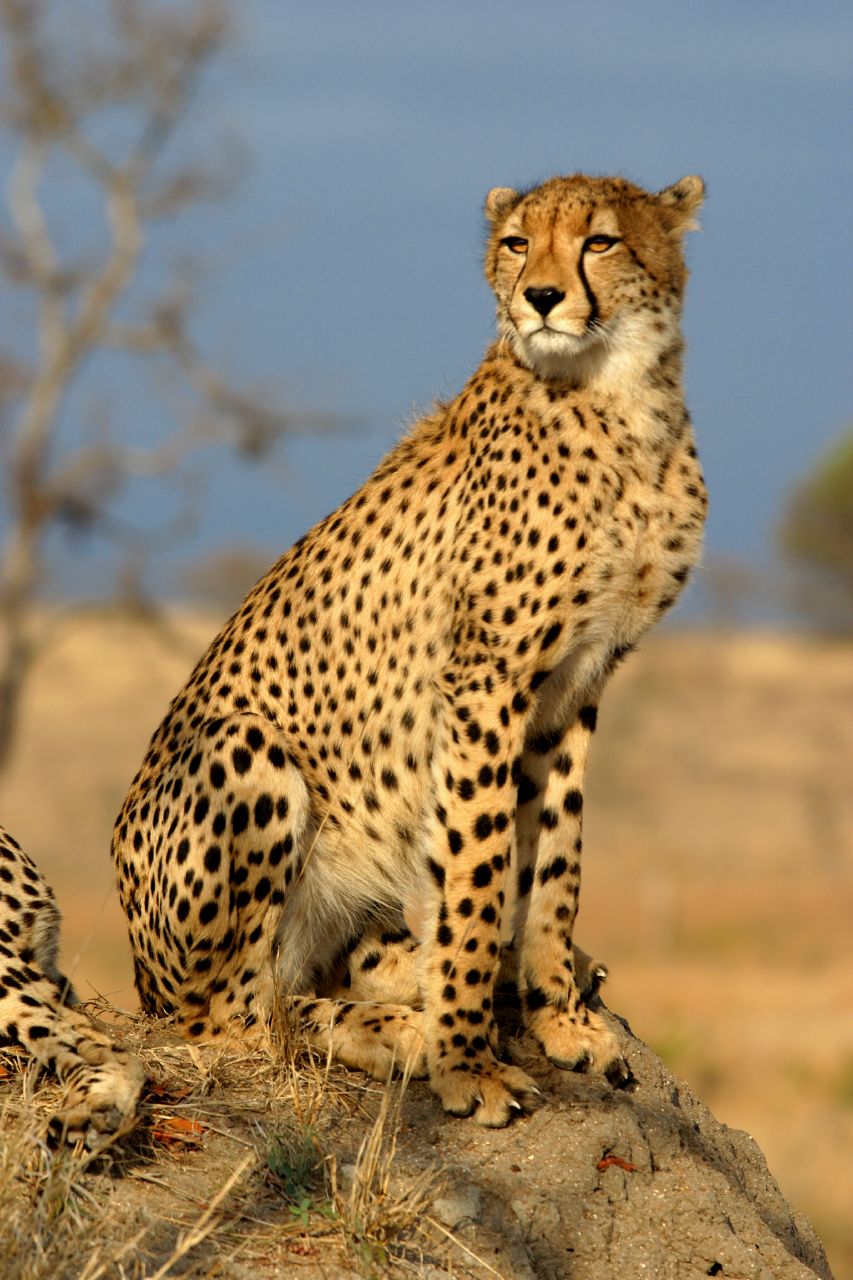
The Cheetah is a slender and graceful feline, ideally suited for fast running. With its elongated body, thin legs and small, rounded head, it clearly stands out from other large carnivores. Its tawny coat dotted with small black dots and its characteristic facial tears make it one of the most recognizable animals in Africa.
The Cheetah has unique physical adaptations: its legs are long and slender, its muscles are particularly developed in the thighs, and its spine is extremely flexible. Its small head and wide nostrils make it easier to breathe while running. The semi-retractable claws give it better grip on the ground.
Did you know?
Why can't the cheetah run for more than thirty seconds?
Characteristics
Indicative values: they vary by subspecies, sex and region.
Habitat and distribution
The Cheetah primarily inhabits the open savannahs and steppes of Africa, where open spaces allow it to exploit its exceptional running speed. It prefers areas with sparse vegetation and avoids dense forests which would hinder its rapid movements. It is also found in some semi-arid regions.
CURRENT RANGE
Cheetah is distributed in sub-Saharan Africa, with populations concentrated primarily in East and South Africa. It is found in countries such as Tanzania, Kenya, Namibia and South Africa. A small relict population persists in Iran. The species has disappeared from most of its historic range in North Africa.
Behaviour
The Cheetah is a diurnal animal that prefers to hunt at dawn or late afternoon to avoid other predators. It is capable of sprinting up to 110 km/h in seconds, the highest speed in the animal kingdom. The Cheetah is generally solitary or lives in small groups, and unlike other felines, it purrs but does not roar.
Reproduction
The Cheetah female has a gestation period of approximately 90 days and gives birth to 3 to 5 young. The young stay with their mother for about 18 months, during which she teaches them essential hunting skills. Sexual maturity is reached around 20-22 months. Cheetahs do not have a permanent fixed territory.
Peculiarities
The Cheetah is the only feline that cannot roar but can purr like a house cat. Its semi-retractable claws, unlike other felines, cannot fully retract, giving it a better grip. Its distinctive black tears reduce glare caused by the sun during high-speed hunting. The Cheetah has limited muscle resistance and expends a lot of energy each sprint.
Threats and conservation
Cheetah is classified as Vulnerable due to habitat loss and fragmentation, primarily caused by human expansion and land conversion. Vehicle collisions, poaching and competition with other predators for prey also pose significant threats. The species' low genetic diversity also makes it more vulnerable to disease.
Numbers and trends vary across sources and regions. See the IUCN assessment for the latest reference data.
Gallery
1 documented photographs.
References
UICN — Liste rouge des espèces menacées
Profile updated 31 August 2026 · Reviewed by the TunisieVet editorial team.
Comments (0)
No comments yet.
CONSERVATION STATUS
Vulnerable (VU)
IUCN source, latest published assessment.
Species health
Documented diseases for this species.
See the 4 diseases of this species Find a veterinarianThis information is provided for educational purposes only and is not a substitute for a veterinary consultation. If you have any concerns about your animal's health, consult a veterinarian.
Related species
To discover around: Cheetah
Videos, facts, stories and records linked to this species.
Similar animals
Other species documented in Animalpedia.

TunisieVet in your pocket 📱🐾 Access your veterinary services wherever you are. [ Download the app ]
Learn more