
Presentation
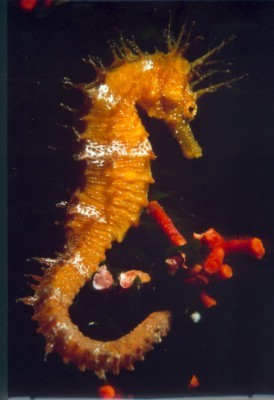
Long-snouted seahorse is a small marine fish with an atypical body, characterized by its horse-like head and coiled prehensile tail. Its body is dotted with small spots or dots which give it its vernacular name. It is a fascinating animal that embodies the extraordinary diversity of Mediterranean and Atlantic marine life.
The Long-snouted seahorse's body is covered in bony protrusions and small spines, giving it a rough appearance. Its coloring varies from beige to gray-brown, always decorated with its characteristic spots. It has reduced dorsal and pectoral fins, making it a slow and difficult to maneuver swimmer.
Did you know?
How does the male seahorse carry the young?
Characteristics
Indicative values: they vary by subspecies, sex and region.
Habitat and distribution
The Long-snouted seahorse inhabits shallow coastal areas, seagrass meadows and Posidonia meadows in calm waters. It prefers protected environments where it can cling to aquatic vegetation. It is generally found between surface level and around thirty meters deep.
CURRENT RANGE
Long-snouted seahorse is present in the Northeast Atlantic, notably along the British and French coasts, as well as throughout the Mediterranean basin. Its range extends from southern Scandinavia to Morocco and the coastal waters of the Middle East. Absent from Tunisia.
Behaviour
The Long-snouted seahorse is a solitary or paired animal, spending most of its time anchored to seagrass or algae thanks to its prehensile tail. It moves slowly and deliberately, never covering great distances. It is a discreet and peaceful animal, disinclined to flee predators.
Reproduction
The Long-snouted seahorse has a unique reproductive system: the male carries the eggs in his ventral pouch, equivalent to a uterus. The female lays her eggs in this pouch where they are fertilized and incubated. The young are born fully-formed after a few weeks and are immediately independent.
Peculiarities
The Long-snouted seahorse is the only fish where the male ensures gestation. Its prehensile tail allows it to stabilize itself in currents and maintain its positioning effortlessly. It can change color slowly to camouflage itself in its surroundings.
Threats and conservation
The Long-snouted seahorse is threatened by the destruction of its coastal habitat, notably the disappearance of seagrass meadows and Posidonia meadows. Coastal trawling, net fishing and pollution are deteriorating its living areas. Accidental capture and the aquarium trade also contribute to its decline.
Numbers and trends vary across sources and regions. See the IUCN assessment for the latest reference data.
Gallery
1 documented photographs.
References
UICN — Liste rouge des espèces menacées
Profile updated 29 August 2026 · Reviewed by the TunisieVet editorial team.
Comments (0)
No comments yet.
CONSERVATION STATUS
Vulnerable (VU)
IUCN source, latest published assessment.
Species health
Documented diseases for this species.
This information is provided for educational purposes only and is not a substitute for a veterinary consultation. If you have any concerns about your animal's health, consult a veterinarian.
To discover around: Long-snouted seahorse
Videos, facts, stories and records linked to this species.
Similar animals
Other species documented in Animalpedia.

TunisieVet in your pocket 📱🐾 Access your veterinary services wherever you are. [ Download the app ]
Learn more