Presentation
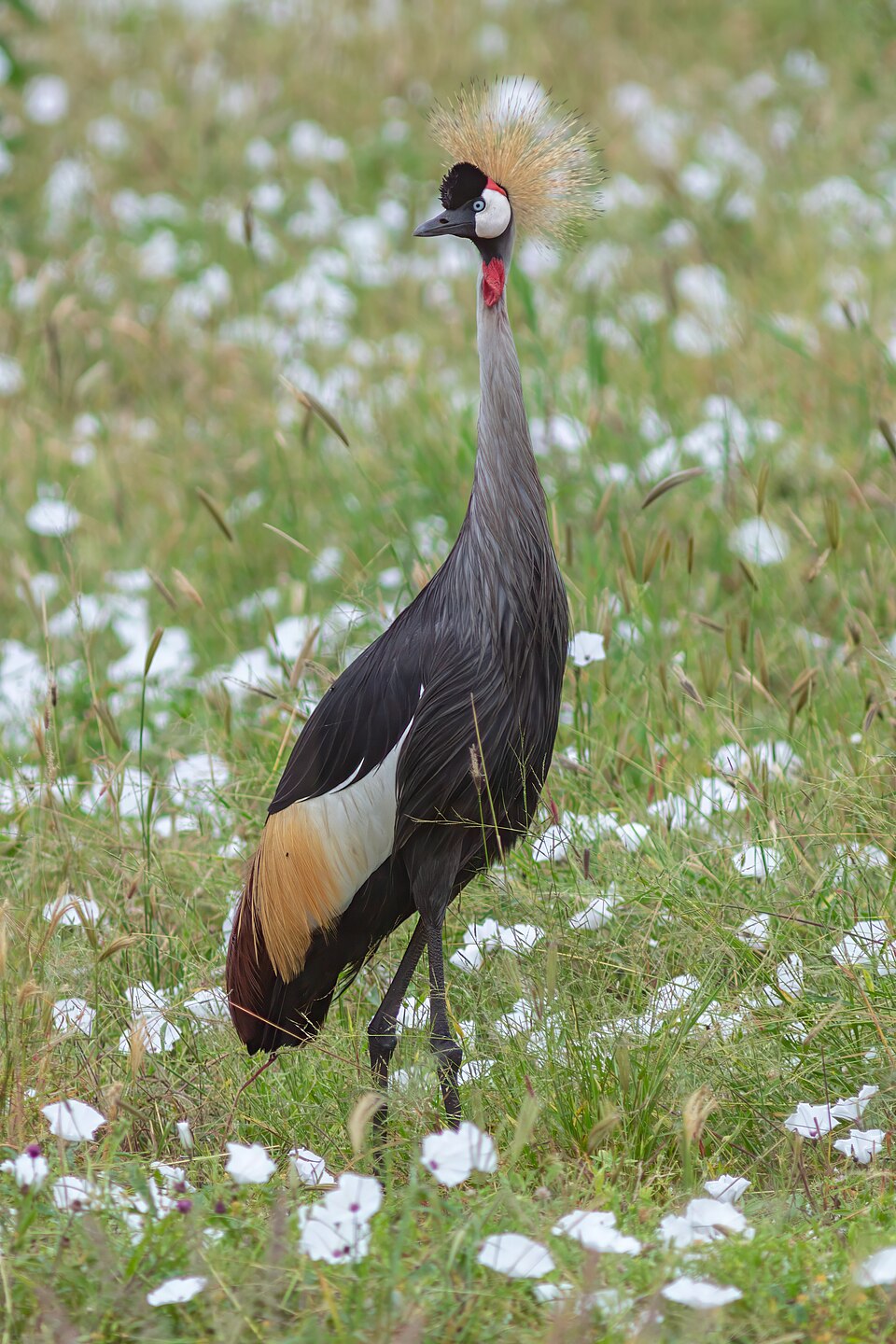
The crowned crane is a large wading bird of sub-Saharan Africa, recognizable by the tuft of stiff golden feathers that crowns the top of its head. Its plumage is slate gray on the body, with wings that are extensively white, gold, and brown, visible in flight. The cheeks bear white patches and a characteristic red zone. This species inhabits wetlands and open savannas, where it forages in small groups or pairs. It is considered one of the most evolutionarily ancient cranes, capable of perching in trees thanks to a well-developed hind toe. Its graceful bearing and elaborate dancing courtship display make it a cherished symbol of African wildlife.
The bird stands about one meter tall and is distinguished by its crest of golden feathers held upright in a crown. Its beak is short and sturdy, suited to an omnivorous diet. The long black legs allow it to walk easily through low vegetation and marshy areas.
Characteristics
Indicative values: they vary by subspecies, sex and region.
Habitat and distribution
The crowned crane inhabits wet savannas, flooded grasslands, and swamps in East and Southern Africa. It also favours the shores of lakes and waterways, as well as agricultural land near wetland areas. The presence of trees nearby is important for roosting at night.
CURRENT RANGE
The species is found in East and Southern Africa, from Kenya and Uganda south to South Africa. It is absent from North Africa and is not native to Tunisia. Its range follows mainly the wetlands and savannas of the continent's south and east.
Behaviour
This species is gregarious outside the breeding season, forming groups that may number dozens of individuals. Pairs are monogamous and perform an elaborate courtship display involving jumps, bows, and wing beats. Unlike many other cranes, it readily perches in trees to rest or sleep in safety.
Reproduction
The female typically lays two to four eggs in a nest built on the ground, concealed in the vegetation of wetland areas. Incubation lasts approximately one month, with both parents sharing incubating duties. The chicks are precocial and leave the nest shortly after hatching, but remain under adult supervision for several months.
Peculiarities
Its unique golden crown sets it apart among cranes and makes it immediately identifiable. It is one of the few crane species capable of perching in trees, an adaptation linked to a well-developed hind toe. It is the national bird of Uganda, where it appears on the national flag.
Threats and conservation
The loss and degradation of wetland habitats represent the primary threat to the species. It is also illegally captured for the pet trade, and accidental or intentional poisoning affects some populations. Agricultural expansion is progressively reducing its natural breeding habitats.
Numbers and trends vary across sources and regions. See the IUCN assessment for the latest reference data.
Gallery
1 documented photographs.
References
Profile updated 04 September 2026 · Reviewed by the TunisieVet editorial team.
Comments (0)
No comments yet.
CONSERVATION STATUS
Endangered (EN)
IUCN source, latest published assessment.
Species health
Documented diseases for this species.
See the 4 diseases of this species Find a veterinarianThis information is provided for educational purposes only and is not a substitute for a veterinary consultation. If you have any concerns about your animal's health, consult a veterinarian.
Similar animals
Other species documented in Animalpedia.

Be among the first to use our app. Sign up and get early Google Play access.
Discover