
Presentation
The Guppy is a small freshwater fish native to South America, which has become one of the most popular species in the world's aquarium hobby. Characterized by its bright colors and varied patterns, it fascinates with the diversity of its shapes and shades.
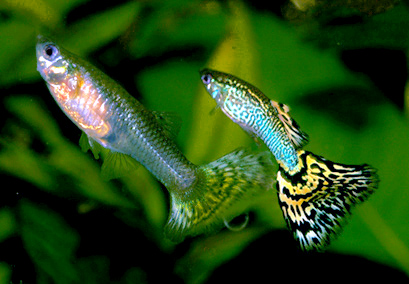
The Guppy has a slender, laterally compressed body. Males are brightly colored with highly developed caudal and anal fins, while females are duller, gray or silver, with less spectacular fins.
Characteristics
Indicative values: they vary by subspecies, sex and region.
Habitat and distribution
In the wild, the Guppy inhabits the tropical freshwater rivers and lakes of the Caribbean, particularly in Trinidad and Tobago. It prefers calm, shallow waters rich in aquatic vegetation. In captivity, it adapts remarkably well to various aquatic environments.
CURRENT RANGE
The Guppy is native to Trinidad and Tobago and northeastern Venezuela. However, due to its repeated introduction by the aquarium trade, it has become established in tropical and subtropical regions around the world, including Africa, Asia and Oceania.
Behaviour
The Guppy is an active, sociable and curious fish that naturally lives in groups. It spends the majority of its time exploring its environment and feeding. Males exhibit elaborate courtship behaviors to attract females.
Reproduction
Guppy is viviparous: females produce live young rather than eggs. They can produce several litters per year, each with 10 to 50 young. Reproduction is extremely rapid, which explains its success in aquariums.
Peculiarities
Guppy exhibits a remarkable capacity for genetic adaptation to extreme environments, including polluted waters. Females retain the male's sperm and can produce several litters without further copulation. Its color patterns are highly variable and hereditary, making it popular with breeders.
Threats and conservation
Guppy is not threatened in the wild and remains abundant in its natural habitats. However, its repeated introduction outside its original area poses ecological problems, particularly for local endemic species.
Numbers and trends vary across sources and regions. See the IUCN assessment for the latest reference data.
Gallery
1 documented photographs.
References
UICN — Liste rouge des espèces menacées
Profile updated 17 August 2026 · Reviewed by the TunisieVet editorial team.
Comments (0)
No comments yet.
CONSERVATION STATUS
Least concern (LC)
IUCN source, latest published assessment.
Species health
Documented diseases for this species.
See the 6 diseases of this species Find a veterinarianThis information is provided for educational purposes only and is not a substitute for a veterinary consultation. If you have any concerns about your animal's health, consult a veterinarian.
Similar animals
Other species documented in Animalpedia.

TunisieVet in your pocket 📱🐾 Access your veterinary services wherever you are. [ Download the app ]
Learn more