
Presentation
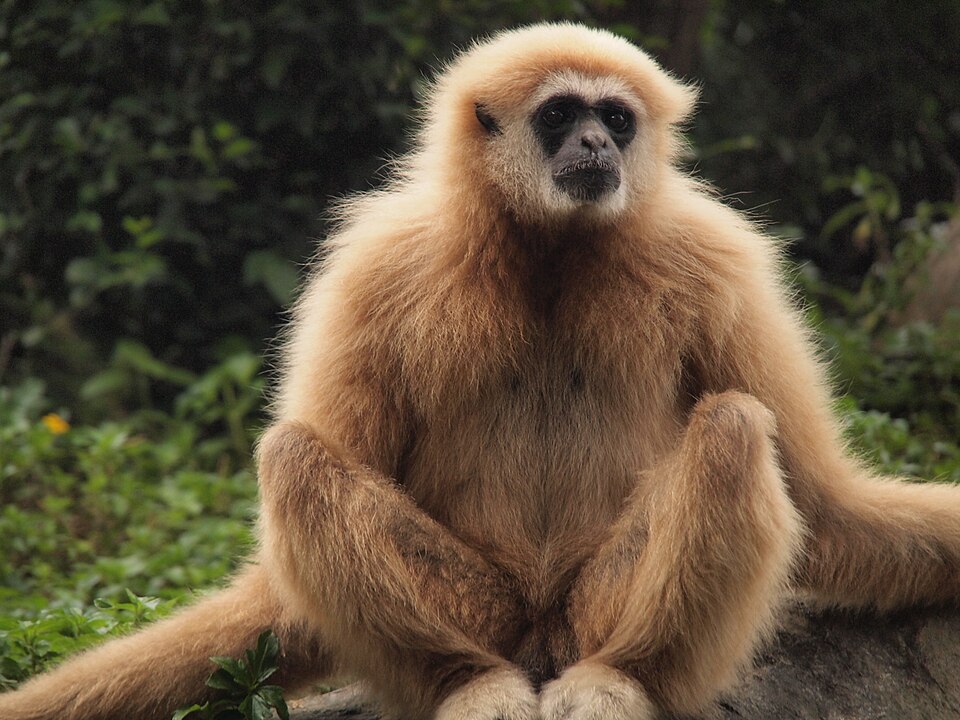
The Gibbon is a small arboreal primate belonging to the Hylobatidae family, distinct from that of the great apes. Distributed in the tropical forests of Southeast Asia, it is distinguished by its extremely long arms adapted to brachiation, a mode of locomotion consisting of moving from branch to branch by swinging. Unlike great apes, Gibbon does not build nests and lives almost exclusively in the canopy. It is renowned for its powerful vocalizations, often emitted in duets by couples, which serve to mark territory. Several species exist, grouped in the genera Hylobates, Nomascus, Hoolock and Symphalangus. Most populations are today threatened by deforestation and poaching.
The Gibbon has a slender body, arms significantly longer than the legs and no tail. Its coat varies from black to light brown or creamy white depending on the species and sometimes depending on the sex. Its hooked hands and long joints allow it to brachiate quickly and precisely through the canopy.
Characteristics
Indicative values: they vary by subspecies, sex and region.
Habitat and distribution
Gibbon inhabits dense, humid tropical forests, including primary and secondary forests with continuous canopies. This continuity of the canopy is essential to its movements by brachiation. Certain species also frequent mountain forests up to medium altitude.
CURRENT RANGE
Gibbon is found in Southeast Asia, including Indonesia, Malaysia, Thailand, Vietnam, Laos, Cambodia and southern China. Each species occupies a geographically restricted range and is often isolated from the others. This natural fragmentation of habitats explains the diversity of recognized species.
Behaviour
Gibbon is diurnal and strictly arboreal, rarely descending to the ground. It lives in monogamous couples accompanied by their young, forming small territorial family units. Partners sing a duet at dawn to defend their territory and strengthen the pair bond. This social organization distinguishes it from other large primates, which are often more gregarious or polygamous.
Reproduction
The Gibbon female gives birth to a single calf after a gestation of approximately seven to eight months. The young remain dependent on their mother for several years before achieving complete independence. Sexual maturity is reached around six to eight years old depending on the species, and the interval between two births is generally two to three years.
Peculiarities
The Gibbon is capable of crossing several meters in a single arm movement thanks to brachiation. Its morning duet vocalizations are among the most complex in the animal kingdom among primates. It does not build a nest, sleeping sitting on high branches.
Threats and conservation
Deforestation linked to agriculture and logging is the main threat to Gibbon. Poaching for the illegal pet trade and traditional medicine is exacerbating population declines. Habitat fragmentation isolates remaining groups, reducing genetic diversity.
Numbers and trends vary across sources and regions. See the IUCN assessment for the latest reference data.
Gallery
1 documented photographs.
References
Profile updated 25 August 2026 · Reviewed by the TunisieVet editorial team.
Comments (0)
No comments yet.
CONSERVATION STATUS
Endangered (EN)
IUCN source, latest published assessment.
Species health
Documented diseases for this species.
See the 7 diseases of this species Find a veterinarianThis information is provided for educational purposes only and is not a substitute for a veterinary consultation. If you have any concerns about your animal's health, consult a veterinarian.
To discover around: Gibbon
Videos, facts, stories and records linked to this species.
Similar animals
Other species documented in Animalpedia.

TunisieVet in your pocket 📱🐾 Access your veterinary services wherever you are. [ Download the app ]
Learn more