
Presentation
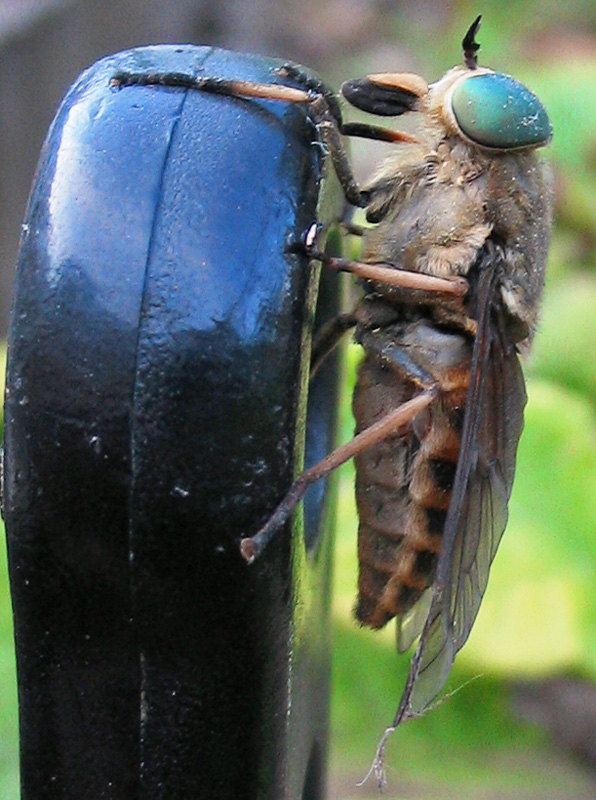
A horsefly is a medium to large dipteran insect belonging to the family Tabanidae. It is characterized by a stocky body, large compound eyes often with a metallic sheen, and a loud, rapid flight. Female horseflies are blood-feeders and bite mammals—including livestock and humans—to obtain blood necessary for their egg production. Males, by contrast, feed only on nectar and pollen. Present on nearly every continent, horseflies are particularly active on hot, sunny summer days. They are well known to farmers for the problems they cause to livestock in pastures.
Horseflies typically measure between 1 and 2.5 cm in length depending on species. Their body is robust, often gray, brown, or black, sometimes marked with bands. Their compound eyes are particularly large and may display colored highlights in certain species. In females, the mouthparts form a piercing-cutting apparatus capable of slashing the skin to draw blood.
Characteristics
Indicative values: they vary by subspecies, sex and region.
Habitat and distribution
The horsefly frequents wetland areas, riverbanks, lakes and ponds where its larvae can develop. It is also very present in meadows and pastures where livestock graze, its main source of blood meals. It is also found at forest edges and in rural areas near water.
CURRENT RANGE
The horsefly is found on almost all continents, except Antarctica, in temperate, tropical and subtropical regions. In North Africa, particularly in Tunisia, several species are common in agricultural and wetland areas. Its distribution is closely linked to the presence of water sources necessary for reproduction.
Behaviour
Horseflies are active during the day, especially in warm, sunny, and calm conditions. Their flight is rapid and loud, and they are attracted by movement, body heat, and the carbon dioxide exhaled by animals. The female bite is painful because she slashes the skin rather than piercing it finely as a mosquito does. They are not social insects and do not form colonies.
Reproduction
After a blood meal, the female lays her eggs in clusters, often on vegetation overhanging water or damp ground. The larvae that emerge from these fall into water or mud where they develop by feeding on small organisms. The duration of the larval cycle varies from a few months to over a year depending on the species and climatic conditions. After several larval stages and pupation, the adult emerges, ready to reproduce in turn.
Peculiarities
The horsefly bite is considerably more painful than a mosquito bite because it results from a laceration of the skin rather than a fine puncture. Some horsefly species can transmit pathogens to livestock during their repeated bites. Horseflies are excellent fliers capable of traveling several kilometres in search of a host.
Threats and conservation
The horsefly is not a threatened species and has no particular conservation status. On the contrary, it is often considered a pest by farmers because of the problems it causes to livestock. Insecticides and specific traps are sometimes used to limit its presence in livestock operations.
Numbers and trends vary across sources and regions. See the IUCN assessment for the latest reference data.
Gallery
1 documented photographs.
References
Profile updated 25 August 2026 · Reviewed by the TunisieVet editorial team.
Comments (0)
No comments yet.
CONSERVATION STATUS
Least concern (LC)
IUCN source, latest published assessment.
Species health
Documented diseases for this species.
Find a veterinarianThis information is provided for educational purposes only and is not a substitute for a veterinary consultation. If you have any concerns about your animal's health, consult a veterinarian.
Similar animals
Other species documented in Animalpedia.
