
Presentation
The Orca is the largest member of the dolphin family and one of the most powerful marine predators on the planet. Recognizable by its distinctive black and white livery, it is distinguished by its imposing dorsal fin and its exceptional intelligence. This apex predator occupies a crucial role in marine ecosystems.
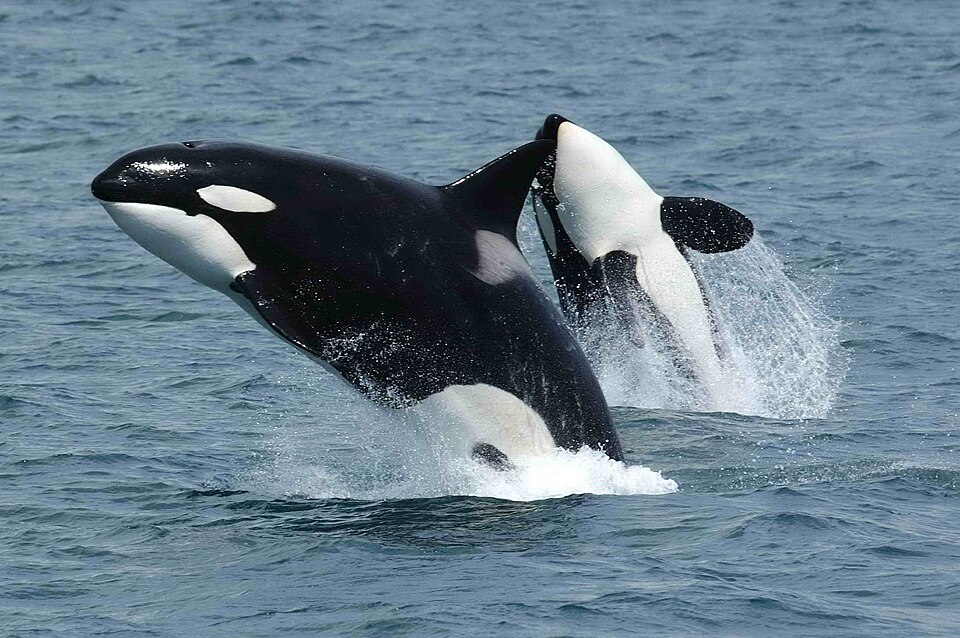
Orca has a robust, hydrodynamic body, covered in smooth black skin with distinctive white markings: an eye spot, a gray patch behind the dorsal fin, and a white belly. Its dorsal fin can reach 1.8 m in males. It has a rounded head without a prominent beak and well-developed eyes.
Did you know?
Which animal has the biggest brain?
Characteristics
Indicative values: they vary by subspecies, sex and region.
Habitat and distribution
The Orca occupies a variety of marine habitats, from cold polar to tropical waters, although it generally prefers more temperate and coastal waters. It frequents coastal areas, estuaries and upwelling regions rich in prey. Some populations are resident and remain in restricted areas, while others migrate long distances.
CURRENT RANGE
Orca has a global distribution in all oceans. It is present in Arctic and Antarctic waters as well as in tropical areas, but shows a preference for temperate waters between 60°N and 60°S. The highest concentrations are found in the North Atlantic, the North Pacific and the waters around New Zealand and Antarctica. Absent from Tunisian waters.
Behaviour
Orcas are highly social animals living in stable groups called pods, usually consisting of 5 to 50 individuals. They communicate through a system of complex sound dialects specific to each population. Known for their remarkable intelligence, they develop sophisticated hunting strategies, cooperate closely and teach their young. They are active day and night.
Reproduction
Orcas have sexual reproduction with a complex mating system. The gestation period lasts approximately 17 months. Females generally give birth to only one young at a time, every 5 to 8 years. Weaning occurs after around 2 years. Orcas have a prolonged lifespan, with a strong matriarchy where adult females play a central role in group cohesion.
Peculiarities
The Orca is notable for its distinct behavioral culture: each population has unique vocal dialects and specific culturally transmitted hunting techniques. Some populations display enigmatic behaviors such as voluntarily stranding themselves on beaches to capture prey. Orca is among the most intelligent animals on the planet, capable of complex problem solving and individual recognition. Its role as super predator profoundly influences the structure of marine ecosystems.
Threats and conservation
Orca is listed on the IUCN Red List with a Data Deficient (DD) status, reflecting the lack of complete demographic data for populations. Some regional populations, notably the southern resident Orca of the North Pacific, are threatened by pollution, declines in prey (particularly salmon), ship strikes, and entanglement in fishing gear. Persistent organic pollutants accumulate in his body.
Numbers and trends vary across sources and regions. See the IUCN assessment for the latest reference data.
Gallery
1 documented photographs.
References
UICN — Liste rouge des espèces menacées
Profile updated 29 August 2026 · Reviewed by the TunisieVet editorial team.
Comments (0)
No comments yet.
CONSERVATION STATUS
Data deficient (DD)
IUCN source, latest published assessment.
Species health
Documented diseases for this species.
This information is provided for educational purposes only and is not a substitute for a veterinary consultation. If you have any concerns about your animal's health, consult a veterinarian.
To discover around: Orca
Videos, facts, stories and records linked to this species.
Similar animals
Other species documented in Animalpedia.

TunisieVet in your pocket 📱🐾 Access your veterinary services wherever you are. [ Download the app ]
Learn more