
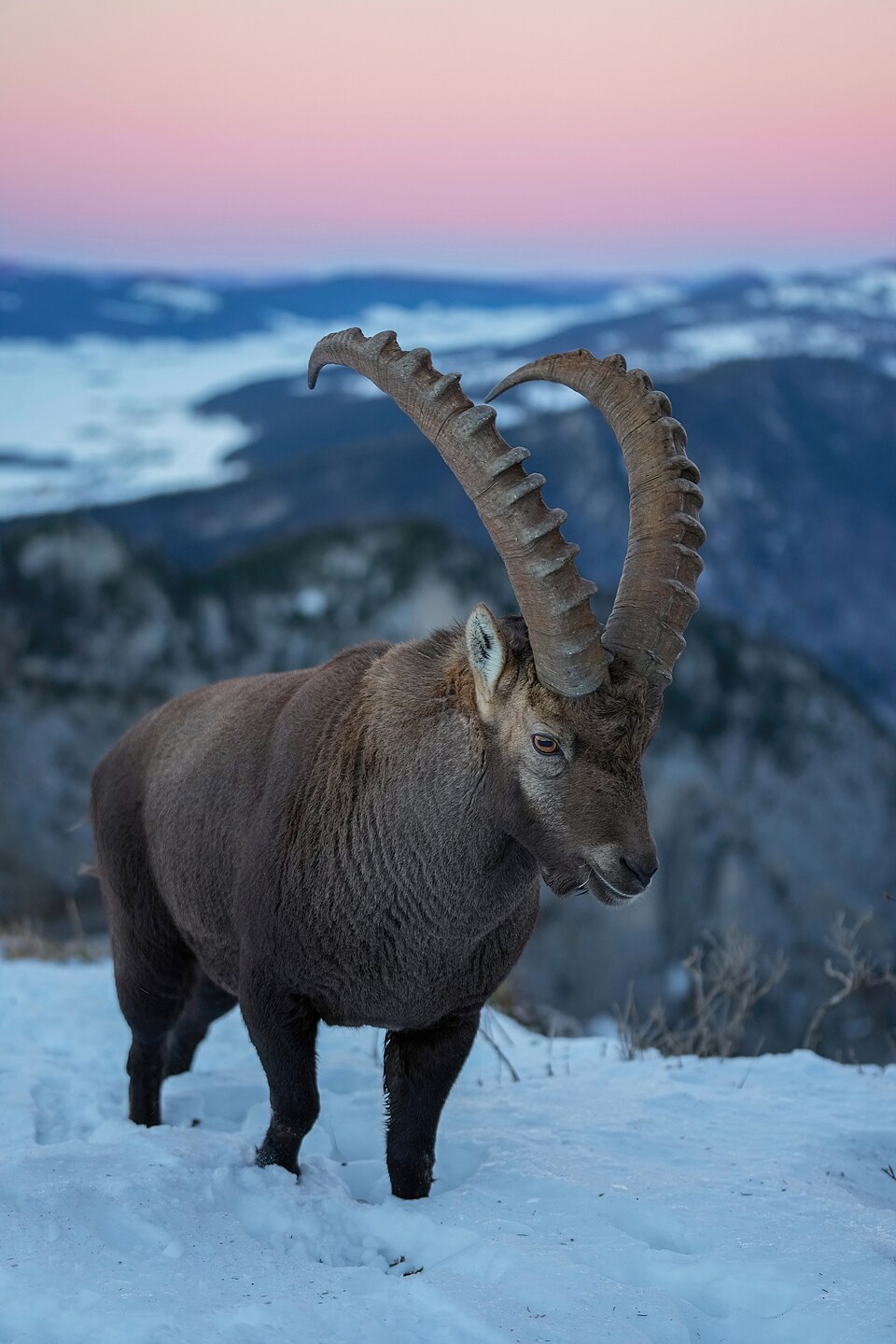
Presentation
The Ibex (Capra ibex) is a species of wild goat living in the mountain ranges of Europe, particularly the Alps. It is distinguished by its long horns curved backwards, particularly developed in the male. This ungulate is perfectly adapted to life on steep and rocky terrain, where it moves with remarkable agility. Long threatened by hunting, it was the subject of successful reintroduction programs in the 20th century. Today, its populations are considered stable throughout most of its range.
The Ibex has a stocky, muscular body suitable for climbing rocky slopes. Males bear massive horns that can exceed a meter in length, marked with annual growth rings, while females have shorter, thinner horns. Its coat is gray-brown in summer and thickens in winter to provide better insulation. Its clogs have a particular structure with a flexible sole, promoting grip on rock.
Characteristics
Indicative values: they vary by subspecies, sex and region.
Habitat and distribution
The Ibex frequents rocky and steep areas of mountain ranges, generally between 1500 and 3000 meters above sea level. It seeks out cliffs and steep slopes offering natural protection against predators. In winter, it may descend to lower altitudes to find accessible food.
CURRENT RANGE
The Ibex of the Alps is present in the Alpine massifs of Europe, notably in France, Italy, Switzerland and Austria. Other related species of Ibexs exist in Spain, the Caucasus and the Middle East. The species has been successfully reintroduced in several regions where it had disappeared in the 19th century.
Behaviour
The Ibex is a gregarious animal living in sex-segregated groups for much of the year. Males only join females during the rutting period, at the end of autumn. Ritual fights between males, consisting of horns against each other, help establish the social hierarchy. It is a diurnal species, active mainly in the morning and at the end of the day.
Reproduction
The rutting period occurs in December-January, during which males compete for access to females. After a gestation of approximately five to six months, the female gives birth to one young, more rarely two, between May and June. The kid is able to follow its mother onto the rocks just a few days after birth. Weaning generally occurs around four to six months of age.
Peculiarities
The Ibex is capable of climbing almost vertical walls thanks to the particular conformation of its hooves. The male's horns continue to grow throughout his life and allow his age to be estimated by counting the rings. This species came close to extinction in the early 19th century, surviving only thanks to a small protected population in Italy.
Threats and conservation
Historically, intensive hunting has brought the species to the brink of extinction. Today, major threats include competition with domestic livestock, certain diseases transmitted by farmed ungulates, and the effects of climate change on its mountain habitat. The fragmentation of populations also limits genetic exchanges between certain isolated nuclei.
Numbers and trends vary across sources and regions. See the IUCN assessment for the latest reference data.
Gallery
1 documented photographs.
References
Profile updated 20 August 2026 · Reviewed by the TunisieVet editorial team.
Comments (0)
No comments yet.
CONSERVATION STATUS
Least concern (LC)
IUCN source, latest published assessment.
Species health
Documented diseases for this species.
See the 8 diseases of this species Find a veterinarianThis information is provided for educational purposes only and is not a substitute for a veterinary consultation. If you have any concerns about your animal's health, consult a veterinarian.
To discover around: Ibex
Videos, facts, stories and records linked to this species.
Similar animals
Other species documented in Animalpedia.

TunisieVet in your pocket 📱🐾 Access your veterinary services wherever you are. [ Download the app ]
Learn more