
Presentation
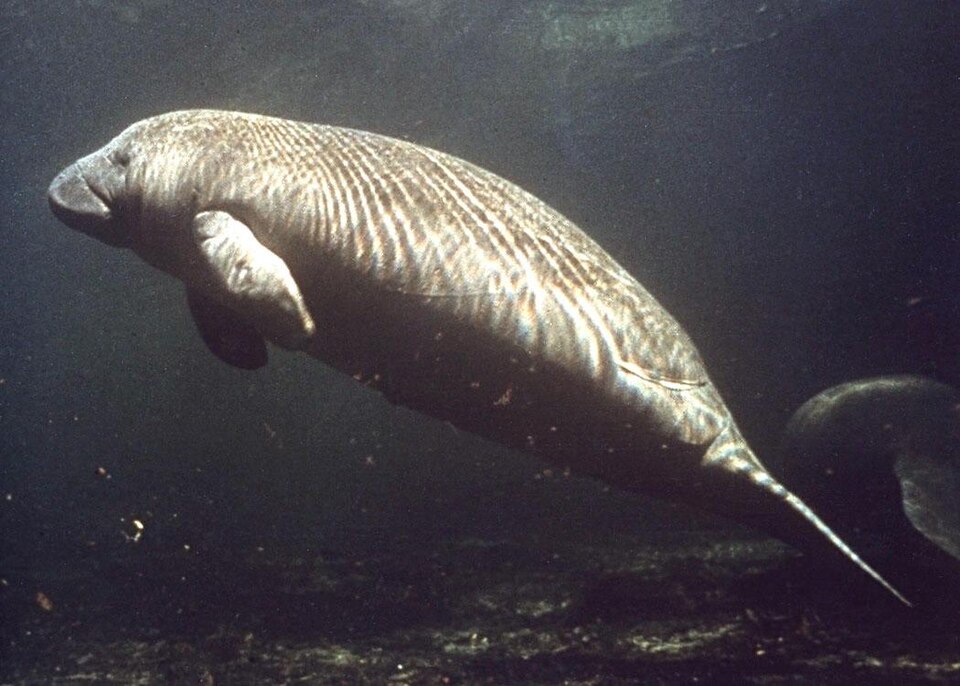
The Manatee is a large herbivorous aquatic mammal belonging to the order Sirenians. Its massive, fusiform body, ending in a rounded, paddle-shaped caudal fin, allows it to swim slowly and peacefully. It lives in shallow coastal waters, estuaries and rivers in tropical and subtropical regions of America and Africa. With thick, wrinkled skin, it moves slowly and spends much of its time grazing on aquatic plants. Its reputation as a peaceful and harmless creature has made it an emblematic species for marine and river conservation. There are several species depending on their distribution area: Manatee from the Caribbean, Manatee from the Amazon and Manatee from Africa.
The Manatee has a massive, rounded, spindle-shaped body that can weigh several hundred kilograms. Its thick, grayish skin, dotted with sparse hair, often has scars from collisions with boats. Its front limbs are transformed into fins equipped with vestigial nails, while its hind limbs have disappeared in favor of a large caudal fin. Its upper lips, mobile and divided, help it to grasp aquatic vegetation.
Characteristics
Indicative values: they vary by subspecies, sex and region.
Habitat and distribution
The Manatee frequents shallow coastal waters, estuaries, rivers and sometimes freshwater or brackish wetlands. It favors areas where aquatic vegetation is abundant and the water is relatively calm. Some populations move between fresh and salt water depending on the seasons. It avoids water that is too cold, remaining sensitive to drops in temperature.
CURRENT RANGE
Manatee is found along the Atlantic coasts of America, in the Caribbean, the Amazon basin and on the coasts of West Africa. The three recognized species occupy distinct geographic ranges and do not overlap. It does not occur naturally in the Mediterranean or in Tunisia.
Behaviour
The Manatee is a solitary animal or living in small, loose groups, without a strict hierarchical social structure. It moves slowly, at a modest cruising speed, but can accelerate briefly in case of danger. It must rise regularly to the surface to breathe, every few minutes when active and longer when resting. Its behavior is generally calm and non-aggressive towards other species.
Reproduction
The Manatee female gives birth after a long gestation, usually around 12 to 14 months, giving birth to a single young. The newborn remains dependent on its mother for one to two years, during which it suckles and learns to feed on vegetation. The interval between two births is usually several years due to this prolonged maternal care. Sexual maturity is reached around the age of 3 to 5 years.
Peculiarities
The Manatee is sometimes nicknamed "sea cow" due to its herbivorous diet and slow movement. It is closely related to the dugong, with which it shares the order of the Sirenians. Some researchers believe that ancient tales of mermaids were partly inspired by sailors' sightings of these animals. His eyesight is weak but his hearing is well developed.
Threats and conservation
The main threats to the Manatee are collisions with motorboats, habitat degradation and pollution of coastal waters. Illegal hunting and accidental capture in fishing nets also contribute to the decline of some populations. Climate change and the reduction of seagrass meadows are worsening the situation in several regions.
Numbers and trends vary across sources and regions. See the IUCN assessment for the latest reference data.
Gallery
1 documented photographs.
References
Profile updated 27 August 2026 · Reviewed by the TunisieVet editorial team.
Comments (0)
No comments yet.
CONSERVATION STATUS
Vulnerable (VU)
IUCN source, latest published assessment.
Species health
Documented diseases for this species.
See the 7 diseases of this species Find a veterinarianThis information is provided for educational purposes only and is not a substitute for a veterinary consultation. If you have any concerns about your animal's health, consult a veterinarian.
To discover around: Manatee
Videos, facts, stories and records linked to this species.
Similar animals
Other species documented in Animalpedia.

TunisieVet in your pocket 📱🐾 Access your veterinary services wherever you are. [ Download the app ]
Learn more