
Presentation
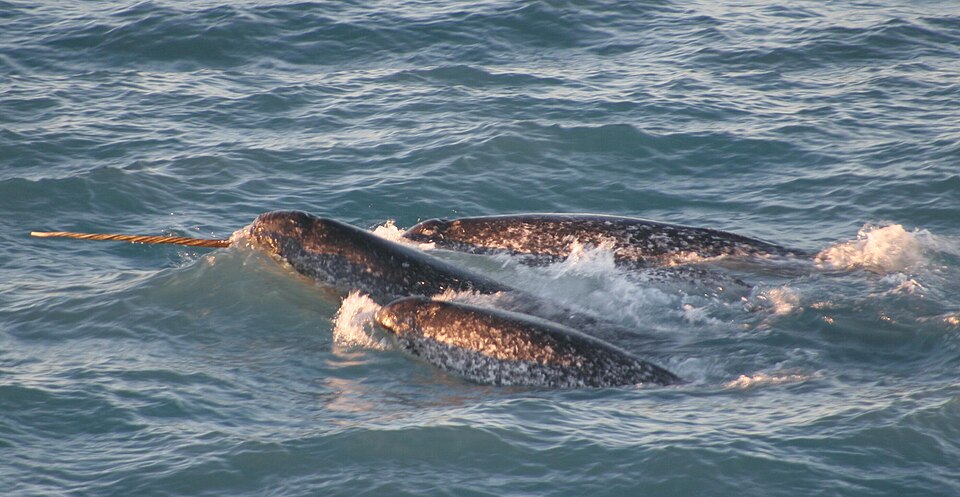
The Narwhal is an Arctic cetacean recognizable by the long spiral tusk worn by the male, originating from an upper incisor pierced through the lip. This tusk can reach more than two meters and has long maintained the legend of the unicorn. The body is stocky, gray spotted with creamy white, without a dorsal fin, an adaptation to life under the ice floe. Narwhal live in groups called herds and often move along ice rifts to breathe. It is one of the marine mammals most linked to a strict polar habitat, migrating according to the formation and melting of ice. It is among the most studied marine species to understand the effects of climate change on the Arctic.
Massive, fusiform body without dorsal fin, replaced by a low dorsal crest. Gray skin speckled with dark and light spots, paler in older individuals. The male wears a spiral tusk that can exceed 2.5 meters, exceptionally present in certain females.
Characteristics
Indicative values: they vary by subspecies, sex and region.
Habitat and distribution
Narwhal frequents cold Arctic waters, often in close association with pack ice and areas of mobile ice. It occupies both coastal waters and deep fjords during the summer. In winter, it remains under a dense ice cover, exploiting polynyas for respiration.
CURRENT RANGE
The species occurs in the Arctic waters of Canada, Greenland, Russia and Svalbard. It does not venture into temperate waters and remains strictly polar. No populations exist in the southern hemisphere.
Behaviour
The Narwhal lives in groups of a few individuals to several dozen, sometimes segregated by sex. It carries out seasonal migrations between summer coastal waters and winter sea ice areas. Males use their tusks during ritual jousting, probably to establish a social hierarchy. The species is not very noisy on the surface but emits clicks and whistles to communicate and navigate under the ice.
Reproduction
Reproduction takes place in winter under the ice floe, with a gestation of approximately 14 months. The female gives birth to a single young, every two to three years. Breastfeeding lasts several months, with the young remaining close to its mother during the first years.
Peculiarities
The Narwhal's tusk, actually a tooth, contains sensitive nerve endings possibly used to detect changes in the environment. The Narwhal is capable of diving to depths of more than 800 meters, a record among marine mammals of this size. Its lack of dorsal fin facilitates its movements under compact ice floes.
Threats and conservation
Climate change is strongly modifying its ice habitat, affecting its migratory routes and access to its prey. Traditional Inuit hunting remains authorized and supervised in certain regions. Increased maritime traffic in the Arctic and underwater noise are emerging threats.
Numbers and trends vary across sources and regions. See the IUCN assessment for the latest reference data.
Gallery
1 documented photographs.
References
Profile updated 18 August 2026 · Reviewed by the TunisieVet editorial team.
Comments (0)
No comments yet.
CONSERVATION STATUS
Near threatened (NT)
IUCN source, latest published assessment.
Species health
Documented diseases for this species.
This information is provided for educational purposes only and is not a substitute for a veterinary consultation. If you have any concerns about your animal's health, consult a veterinarian.
To discover around: Narwhal
Videos, facts, stories and records linked to this species.
RECORD
up to 2.5 to 3 m
The longest tooth in a mammal
Measurement of spiral defense observed in adult males.
Similar animals
Other species documented in Animalpedia.

TunisieVet in your pocket 📱🐾 Access your veterinary services wherever you are. [ Download the app ]
Learn more