
Presentation
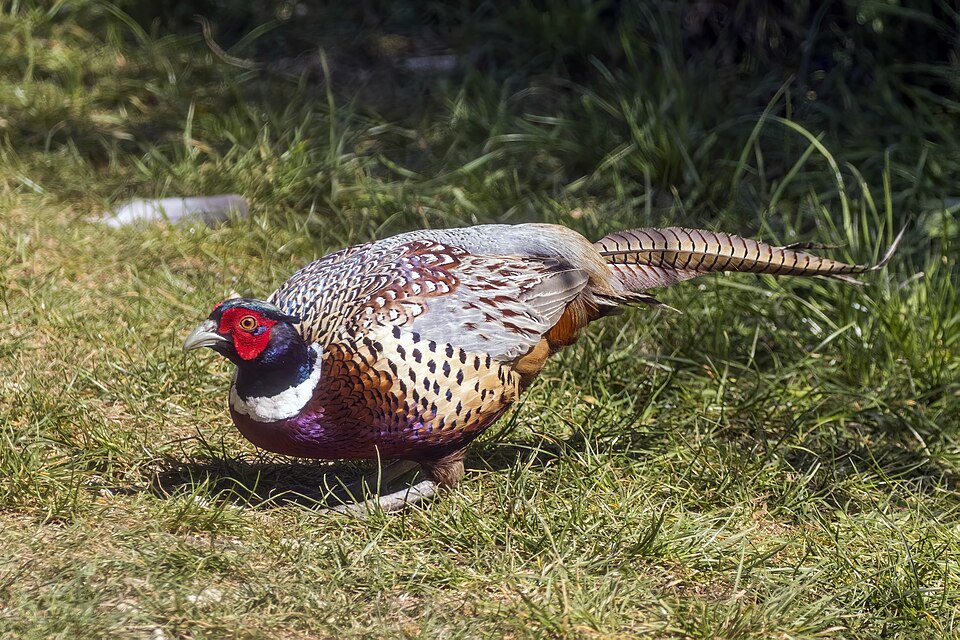
The Ring-necked Pheasant is a medium to large-sized bird belonging to the pheasant family and native to Asia. The male displays colourful plumage with copper and green iridescence, a long tapering tail, and red fleshy patches around the eyes, while the female has more subdued brown plumage. Introduced to Europe since antiquity, the species is now widely established in the wild and is bred for hunting and ornamental purposes. It is a ground-dwelling bird that flies rarely and prefers to run when escaping predators. It inhabits forest edges, cultivated fields, and scrubby areas. Its meat has long been prized, explaining its traditional breeding in many countries.
The male is generally larger than the female and exhibits marked sexual dimorphism in plumage and size. Males have spurs on their legs, which they use in territorial fights. The beak is short and robust, suited to a varied diet.
Characteristics
Indicative values: they vary by subspecies, sex and region.
Habitat and distribution
Pheasants favor mixed open habitats such as forest edges, meadows, cultivated fields, and bushy areas offering dense vegetation cover. They avoid habitats that are too dense or too open, preferring a mosaic of landscapes.
CURRENT RANGE
Native to central and eastern Asia, the ring-necked pheasant was introduced to Europe during Roman times, then to other regions of the world for hunting purposes. Today, it is present in the wild or semi-wild state on several continents.
Behaviour
The pheasant is generally solitary or lives in small groups, except during breeding season when males become territorial. It is most active on the ground, moving by walking or running, and flies only short distances when threatened. The male utters a characteristic harsh call, often accompanied by wing-beating, to mark his territory.
Reproduction
Breeding season occurs in spring, when males court multiple females within the same territory. The female lays between 8 and 15 eggs in a simple ground nest hidden in vegetation. Incubation lasts approximately 23 to 28 days, and the chicks are precocial, able to move about and feed themselves shortly after hatching.
Peculiarities
The iridescent plumage of the male, with its metallic sheen, is one of the most distinctive features of the species. Its ability to flush suddenly and noisily when startled is also characteristic.
Threats and conservation
The species is not threatened globally thanks to its adaptability and breeding programs for hunting. Locally, predation, habitat loss, and intensive hunting can affect some wild populations.
Numbers and trends vary across sources and regions. See the IUCN assessment for the latest reference data.
Gallery
1 documented photographs.
References
Profile updated 21 August 2026 · Reviewed by the TunisieVet editorial team.
Comments (0)
No comments yet.
CONSERVATION STATUS
Least concern (LC)
IUCN source, latest published assessment.
Species health
Documented diseases for this species.
See the 4 diseases of this species Find a veterinarianThis information is provided for educational purposes only and is not a substitute for a veterinary consultation. If you have any concerns about your animal's health, consult a veterinarian.
To discover around: Pheasant
Videos, facts, stories and records linked to this species.
Similar animals
Other species documented in Animalpedia.
