
Presentation
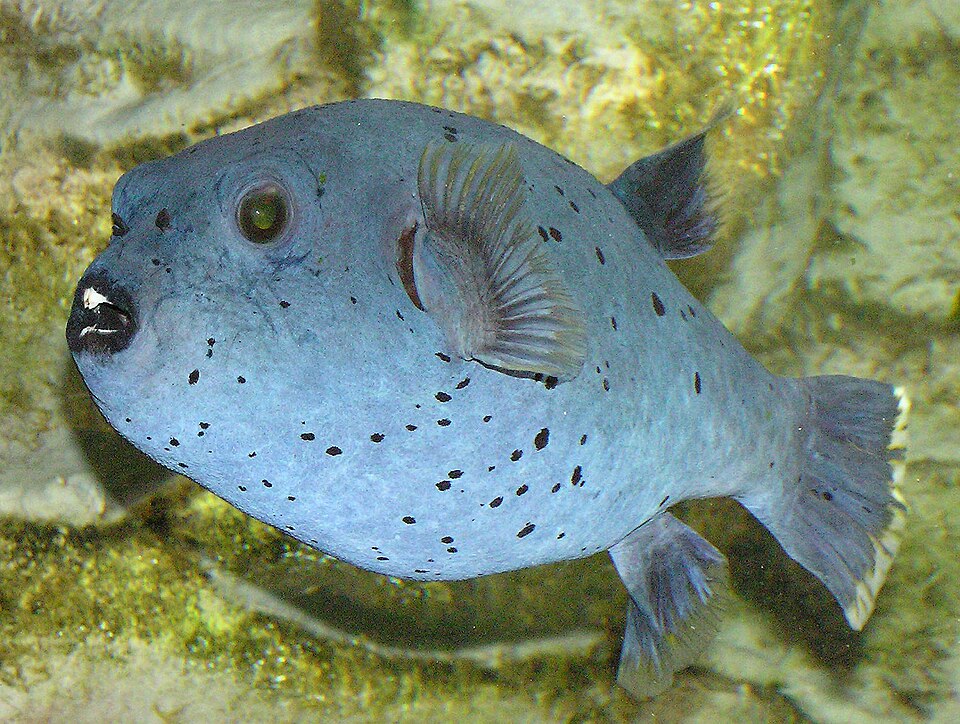
The Pufferfish is a marine fish recognizable by its ability to inflate its body by absorbing water or air when it feels threatened. This family brings together several hundred species distributed in the warm and temperate seas of the globe. Its skin and some internal organs contain tetrodotoxin, a powerful neurotoxin that makes it dangerous to consume without proper preparation. It has a stocky body, skin often devoid of classic scales but sometimes covered with small spines, and fused teeth forming a robust beak. In the Mediterranean, an invasive species, Lagocephalus sceleratus, has established itself from the Suez Canal and poses ecological and health problems. This fish is studied for its toxin as much as for its spectacular defensive behavior.
Round or oval body that can inflate up to several times its normal volume. Skin generally smooth or slightly spiny, lacking classic interlocking scales. Teeth fused together forming a powerful beak used to break apart shellfish and crustaceans.
Characteristics
Indicative values: they vary by subspecies, sex and region.
Habitat and distribution
The Pufferfish mainly frequents coastal marine waters, lagoons and sometimes estuaries. Some species tolerate brackish or even fresh water. It likes sandy, rocky bottoms or reefs where it finds its prey.
CURRENT RANGE
The Tetraodontidae family is found in tropical and temperate seas around the world. Lagocephalus sceleratus, an invasive species present in the Mediterranean, has been observed along the Tunisian coast. Other species are found in the Atlantic, the Indo-Pacific and the tropical waters of Africa and Asia.
Behaviour
This fish is generally solitary and lives near the bottom or in open water depending on the species. When faced with danger, it sucks in water to inflate its body, thus deterring potential predators. It swims relatively slowly but compensates with this effective chemical and physical defense.
Reproduction
Reproduction takes place by external spawning, the eggs being released into open water or deposited on the bottom depending on the species. Fertilization is external and larval development takes place in a pelagic environment. No parental care is generally observed after egg-laying.
Peculiarities
The tetrodotoxin present in this fish is one of the most powerful natural toxins known, with no specific antidote. In Japan, its flesh is eaten under the name fugu, prepared only by certified chefs due to the deadly risks. Its ability to swell constitutes a unique mechanical defense among fish.
Threats and conservation
Accidental overfishing and degradation of coastal habitats affect certain populations. Conversely, the invasive species Lagocephalus sceleratus proliferates in the Mediterranean and threatens local biodiversity as well as fisheries. The Tunisian authorities recommend avoiding its consumption due to the risk of poisoning.
Numbers and trends vary across sources and regions. See the IUCN assessment for the latest reference data.
Gallery
1 documented photographs.
References
Profile updated 30 August 2026 · Reviewed by the TunisieVet editorial team.
Comments (0)
No comments yet.
CONSERVATION STATUS
Least concern (LC)
IUCN source, latest published assessment.
Species health
Documented diseases for this species.
See the 4 diseases of this species Find a veterinarianThis information is provided for educational purposes only and is not a substitute for a veterinary consultation. If you have any concerns about your animal's health, consult a veterinarian.
To discover around: Pufferfish
Videos, facts, stories and records linked to this species.
Similar animals
Other species documented in Animalpedia.

TunisieVet in your pocket 📱🐾 Access your veterinary services wherever you are. [ Download the app ]
Learn more