
Presentation
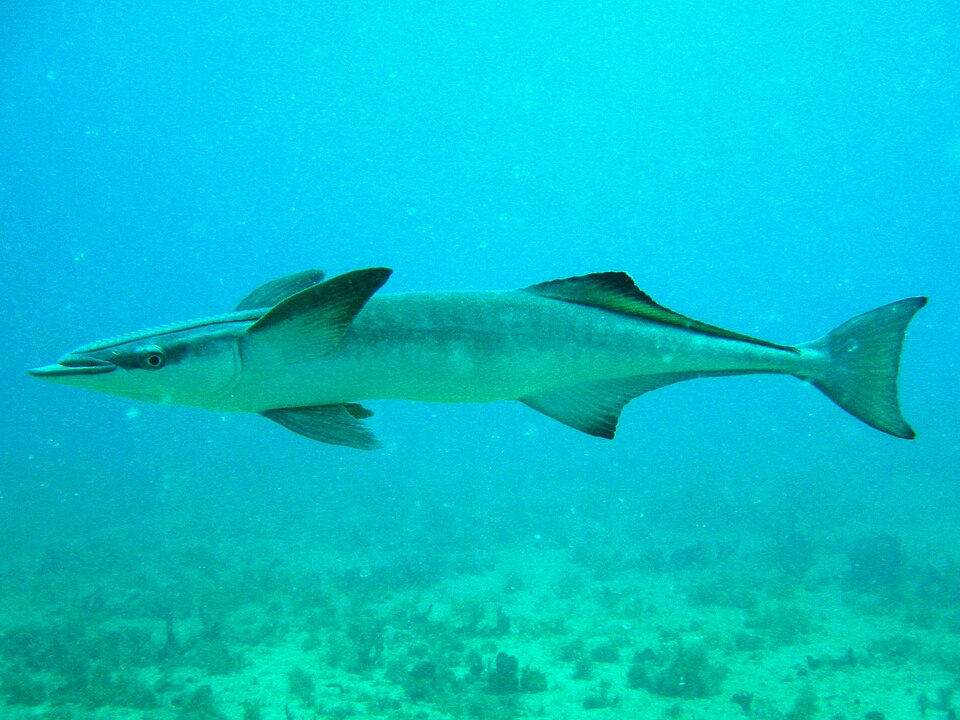
The Remora is a marine fish recognizable by its adhesive disc located on the top of its head, which allows it to attach itself to large marine animals. It lives in close association with sharks, rays, turtles or cetaceans, taking advantage of their movements and leftover food. This family brings together several species distributed throughout the tropical and temperate seas of the globe. The body is elongated and fusiform, adapted to a semi-parasitic or commensal life. The Remora swims freely but prefers to remain attached to a host to conserve energy. It has been well known since Antiquity, when it was wrongly believed to have the power to slow down ships.
The body is elongated, slightly flattened, and generally measures between 30 and 90 cm depending on the species. The main feature is the dorsal adhesive disc, derived from the modified dorsal fin, which functions as a suction cup with movable blades. The coloring is often grayish brown to blackish, sometimes with a lighter lateral stripe. The skin is smooth and free of visible scales.
Characteristics
Indicative values: they vary by subspecies, sex and region.
Habitat and distribution
The Remora frequents tropical and temperate marine waters, generally in the open ocean or near the coast. It is associated with the presence of large marine animals which serve as hosts and means of movement. It is found both in open waters and near coral reefs.
CURRENT RANGE
Remora is found in most of the world's warm and temperate seas, including the Atlantic, Indo-Pacific, and Mediterranean. Its distribution largely follows that of its usual hosts. It is occasionally observed along the Tunisian coast in the Mediterranean.
Behaviour
Remora adopts commensal behavior, attaching itself to various hosts such as sharks, manta rays, marine turtles or large cetaceans. It occasionally detaches to feed or change host, then reattaches using its adhesive disc. This lifestyle limits energy expenditure linked to long-distance swimming. The species is not territorial and moves according to the migrations of its host.
Reproduction
The reproduction of Remora remains poorly documented but takes place in open water, with external fertilization. Females lay numerous pelagic eggs which drift with the currents. The larvae lead a planktonic life before developing the characteristic adhesive disc and searching for a host.
Peculiarities
The Remora's adhesive disc can generate sufficient suction force to withstand strong sea currents. The ancients believed that this fish could slow down or immobilize ships, hence its scientific name derived from the Latin meaning "delay". In some coastal cultures, Remoras attached to a line have been used to capture sea turtles.
Threats and conservation
Remora is not directly threatened, its survival being linked to that of its hosts. The decline of certain populations of sharks or sea turtles could indirectly affect its distribution. It is not targeted by any specific commercial fishery.
Numbers and trends vary across sources and regions. See the IUCN assessment for the latest reference data.
Gallery
1 documented photographs.
References
Profile updated 31 August 2026 · Reviewed by the TunisieVet editorial team.
Comments (0)
No comments yet.
CONSERVATION STATUS
Least concern (LC)
IUCN source, latest published assessment.
Species health
Documented diseases for this species.
This information is provided for educational purposes only and is not a substitute for a veterinary consultation. If you have any concerns about your animal's health, consult a veterinarian.
Similar animals
Other species documented in Animalpedia.

TunisieVet in your pocket 📱🐾 Access your veterinary services wherever you are. [ Download the app ]
Learn more