
Presentation
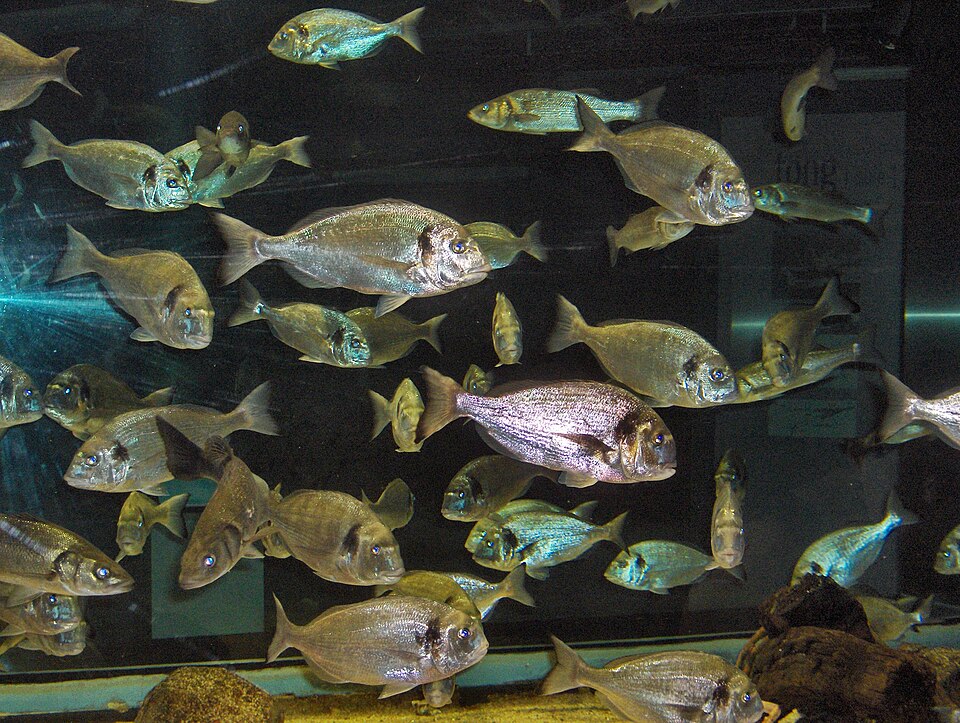
The royal Sea bream (Sparus aurata) is a marine fish of the Sparidae family, widely present in the Mediterranean, including on the Tunisian coasts. She can be recognized by her characteristic golden band between her eyes and her silver dress with metallic reflections. A prized species in fishing and aquaculture, it constitutes an important economic resource for Tunisia. It frequents shallow coastal waters, lagoons and estuaries, where it finds abundant food. Its intensive breeding in marine farms makes it one of the most consumed fish in the Mediterranean basin.
The body of the royal Sea bream is oval, laterally compressed and covered with shiny silver scales. A golden band connects the two eyes, giving the species its name. It has strong molariform teeth adapted to crushing hard-shelled prey such as molluscs and crustaceans.
Characteristics
Indicative values: they vary by subspecies, sex and region.
Habitat and distribution
The royal Sea bream frequents sandy, rocky bottoms and Posidonia beds in shallow coastal areas. It particularly likes lagoons, estuaries and brackish waters where it finds shelter and food. It can be observed at depths ranging from the surface to around 150 meters.
CURRENT RANGE
The species is widespread throughout the Mediterranean as well as in the eastern Atlantic, from the British Isles to Senegal. The Tunisian coasts, notably the Gulf of Gabès and lagoons like that of Bizerte, are home to significant populations. It is also the subject of intensive breeding in several Mediterranean countries including Tunisia.
Behaviour
It is a rather gregarious fish, forming small schools, especially among young individuals. She is a protandrous hermaphrodite: she is born male then becomes female after one to two years. It migrates between shallow coastal waters in summer and deeper areas in winter to protect itself from the cold.
Reproduction
Breeding takes place in autumn and winter, in deeper waters off the coast. Females lay pelagic eggs which drift with the currents before hatching. The growth of juveniles continues in the coastal lagoons and estuaries which serve as natural nurseries.
Peculiarities
The protandrous hermaphroditism of the royal Sea bream is a notable biological peculiarity, rare among commercial marine fishes. The golden front band which gives it its name is an easily recognizable distinctive sign. It is one of the flagship species of modern Mediterranean aquaculture.
Threats and conservation
Overfishing in certain areas can locally affect wild populations. The degradation of lagoons and coastal areas, which serve as essential nurseries, poses a threat to the renewal of stocks. Intensive aquaculture, however, helps to reduce pressure on natural populations.
Numbers and trends vary across sources and regions. See the IUCN assessment for the latest reference data.
Gallery
1 documented photographs.
References
Profile updated 29 August 2026 · Reviewed by the TunisieVet editorial team.
Comments (0)
No comments yet.
CONSERVATION STATUS
Least concern (LC)
IUCN source, latest published assessment.
Species health
Documented diseases for this species.
This information is provided for educational purposes only and is not a substitute for a veterinary consultation. If you have any concerns about your animal's health, consult a veterinarian.
Similar animals
Other species documented in Animalpedia.

TunisieVet in your pocket 📱🐾 Access your veterinary services wherever you are. [ Download the app ]
Learn more