
Presentation
The Piranha is a carnivorous freshwater fish from South America, known for its sharp triangular teeth and powerful jaw. It lives in schools in the rivers and tributaries of the Amazon basin and other tropical waterways. Its reputation as a ferocious predator is partly exaggerated by popular culture, with most species being rather opportunistic and scavengers. There are several dozen species of Piranhas, varying in size and diet. Some species are raised in aquariums as new pets. The red-bellied Piranha (Pygocentrus nattereri) is the best-known and most traded species.
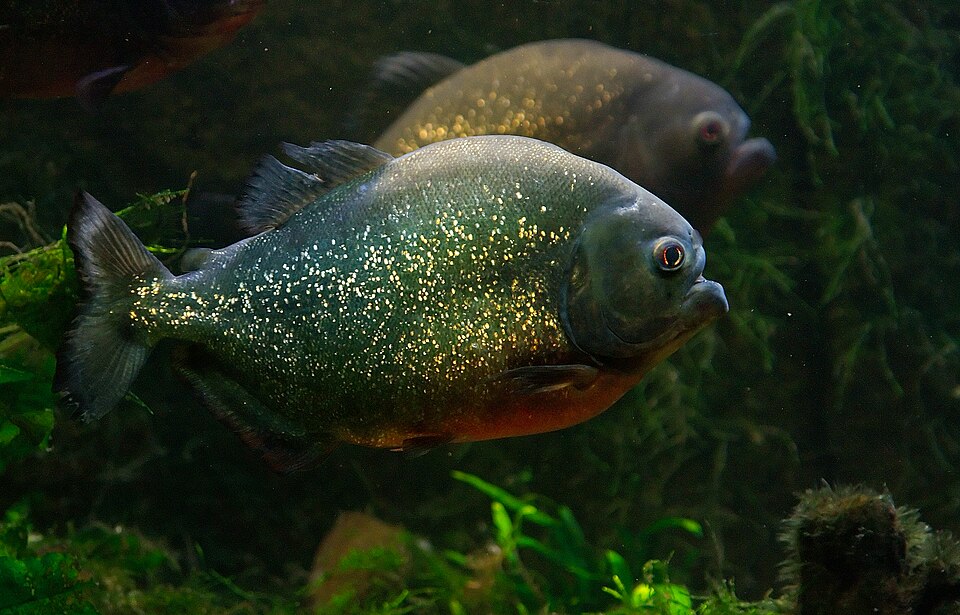
Body oval and laterally compressed, covered with small silvery or grayish scales, sometimes tinged with red or orange on the belly. Powerful jaws with interlocking triangular teeth, sharp as blades. Single dorsal fin and adipose fin present, characteristic of Characiformes. Size varies depending on the species, generally between 15 and 40 cm as adults.
Characteristics
Indicative values: they vary by subspecies, sex and region.
Habitat and distribution
The Piranha frequents slow to moderate freshwater rivers and lakes, often in areas rich in aquatic vegetation. It likes the warm, well-oxygenated waters of tropical regions. Some species tolerate temporarily flooded areas during the flood season.
CURRENT RANGE
Piranha is native to South America, where it inhabits large river basins such as the Amazon, Orinoco and Paraná. It is present in several South American countries including Brazil, Peru, Colombia, Venezuela and Argentina. Introduced populations, often resulting from aquarium releases, occasionally exist outside their natural range, with no confirmed lasting establishment anywhere.
Behaviour
The Piranha generally lives in schools that can number several dozen individuals, this gregarious behavior offering it protection against its own predators. It is most active at dusk and dawn, periods when it preferentially hunts. Group behavior intensifies its collective hunting efficiency on weakened or injured prey. In captivity, it can be fearful and easily hides in the presence of sudden movements outside the aquarium.
Reproduction
Breeding generally takes place during the rainy season, when water levels rise. The female lays her eggs on aquatic plants or plant substrates, where they are fertilized by the male. Some species display parental guarding behaviors, with the male watching the nest until hatching. The fry disperse quickly after hatching and grow by feeding on small invertebrates.
Peculiarities
The teeth of the Piranha are so sharp that they have been traditionally used by certain Amazonian populations as cutting tools or to shape objects. Contrary to legend, fatal attacks on humans are extremely rare and mainly occur in cases of low water or the presence of blood in the water. The word “Piranha” comes from a Tupi-Guarani term meaning approximately “toothed fish”.
Threats and conservation
The Piranha is not subject to major threats at the species level and its populations are generally stable. The degradation of certain river habitats through pollution, deforestation and the construction of dams can locally affect certain populations. It is not considered a threatened species in its natural range.
Numbers and trends vary across sources and regions. See the IUCN assessment for the latest reference data.
Gallery
1 documented photographs.
References
Profile updated 30 August 2026 · Reviewed by the TunisieVet editorial team.
Comments (0)
No comments yet.
CONSERVATION STATUS
Least concern (LC)
IUCN source, latest published assessment.
Species health
Documented diseases for this species.
Find a veterinarianThis information is provided for educational purposes only and is not a substitute for a veterinary consultation. If you have any concerns about your animal's health, consult a veterinarian.
To discover around: Piranha
Videos, facts, stories and records linked to this species.
Similar animals
Other species documented in Animalpedia.

TunisieVet in your pocket 📱🐾 Access your veterinary services wherever you are. [ Download the app ]
Learn more