
Presentation
The Catfish glane (Silurus glanis) is a large freshwater fish native to central and eastern Europe, widely introduced elsewhere in Europe for sport fishing. It is one of the largest freshwater fish in the world, capable of reaching impressive sizes in large rivers and lakes. An opportunistic predator, it feeds on fish, crayfish, amphibians and occasionally small aquatic birds or mammals. It likes calm, deep waters, rich in hiding places such as riprap or submerged branches. Its longevity can exceed several decades under favorable conditions. Although not naturally present in Tunisia, it is attracting growing interest among European sport fishermen for its record size.
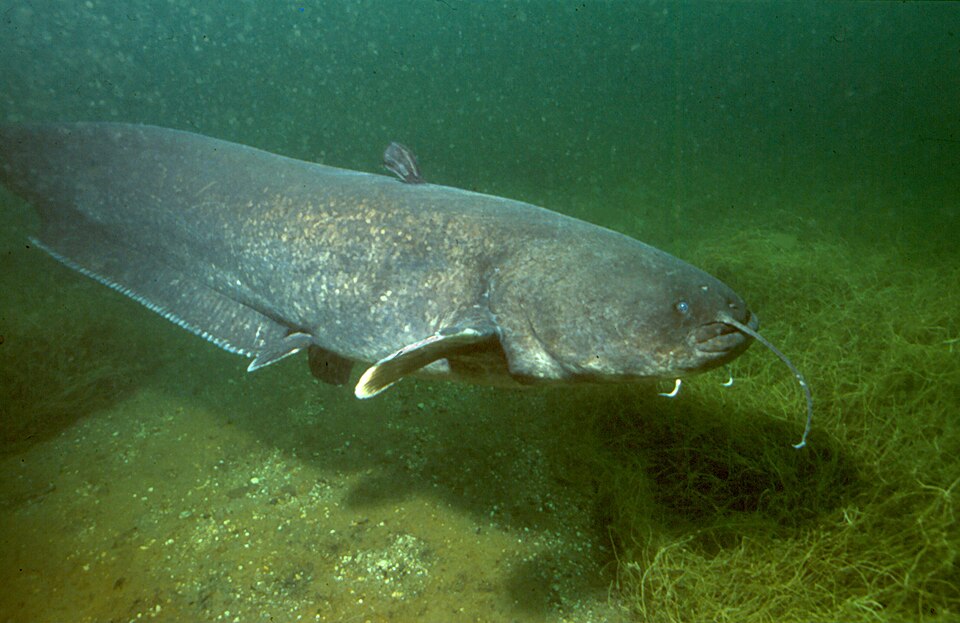
The Catfish glean has an elongated body without scales, with smooth skin covered in protective mucus. Its wide mouth is lined with two long maxillary barbels and four shorter barbels under the lower jaw. Its color varies from greenish brown to black on the back, with a lighter mottled belly. Its dorsal and anal fins are respectively short and very elongated, characteristic of the species.
Characteristics
Indicative values: they vary by subspecies, sex and region.
Habitat and distribution
The Catfish gleans frequents large rivers, lakes and reservoirs with calm and deep waters. It particularly likes areas rich in shelter such as submerged stumps, riprap and silted areas. This species tolerates a wide range of temperatures but prefers temperate to warm waters in summer. She generally avoids the flowing, well-oxygenated waters of mountain streams.
CURRENT RANGE
The Catfish glean is native to the river basins of central and eastern Europe, including the Danube, Elbe and Volga. It was widely introduced in Western Europe, notably in France, Spain and Italy, where it has acclimatized well. Its natural range also extends towards western Asia, in the Caspian Sea and Aral Sea basins. The species is not present in Tunisia or North Africa.
Behaviour
The Catfish glean is a mainly nocturnal fish, hunting on the prowl using its highly developed sensory barbels. It appears solitary or not very gregarious as an adult, occupying fixed positions near submerged structures (stumps, pits, bridges). Its activity decreases sharply in winter, during which it remains not very mobile at the bottom of the water. It can be opportunistic, sometimes approaching banks or areas frequented by humans to hunt birds or small mammals.
Reproduction
Reproduction of the Catfish gleans takes place in spring and early summer, when the water temperature reaches around 18-20°C. The female lays her eggs in a rudimentary nest built among roots or submerged vegetation. The male then guards and aerates the eggs until they hatch, a rare parental care behavior among fish. The fry grow quickly during their first year if food resources are abundant.
Peculiarities
The Catfish glane lacks scales, a characteristic it shares with other members of the Siluridae family. Its particularly long oral barbels serve as essential sensory organs for detecting prey and obstacles in often murky water. It may emit low-frequency sounds or vibrations perceptible to other fish. Some individuals adopt hunting behavior on the surface, leaping partially out of the water to capture pigeons perched on the banks, a behavior documented particularly in France.
Threats and conservation
The Catfish glean is not among the threatened species and its populations are generally stable or even expanding thanks to introductions. In some regions where it has been introduced, it is rather seen as a potentially invasive species that could affect native fish populations. Water pollution and degradation of river habitats can locally affect certain natural populations.
Numbers and trends vary across sources and regions. See the IUCN assessment for the latest reference data.
Gallery
1 documented photographs.
References
Profile updated 30 August 2026 · Reviewed by the TunisieVet editorial team.
Comments (0)
No comments yet.
CONSERVATION STATUS
Least concern (LC)
IUCN source, latest published assessment.
Species health
Documented diseases for this species.
Find a veterinarianThis information is provided for educational purposes only and is not a substitute for a veterinary consultation. If you have any concerns about your animal's health, consult a veterinarian.
To discover around: Catfish
Videos, facts, stories and records linked to this species.
RECORD
up to 2.5-3 m and more than 100 kg
One of the largest freshwater fish in Europe
Measurement carried out on exceptional specimens captured in major European rivers such as...
Similar animals
Other species documented in Animalpedia.

TunisieVet in your pocket 📱🐾 Access your veterinary services wherever you are. [ Download the app ]
Learn more