
Presentation
The Sperm whale (Physeter macrocephalus) is the largest of the odontocetes (toothed cetaceans) and the animal with the largest known brain. Recognizable by its massive, square head occupying almost a third of its body, it dives to very great depths to hunt cephalopods, notably giant squid. This cosmopolitan species frequents all oceans, from tropical to subpolar waters. It lives in structured matriarchal groups and communicates by powerful clicks used in echolocation. The Sperm whale was heavily exploited by whaling in the 19th and 20th centuries for its oil and the spermaceti contained in its head.
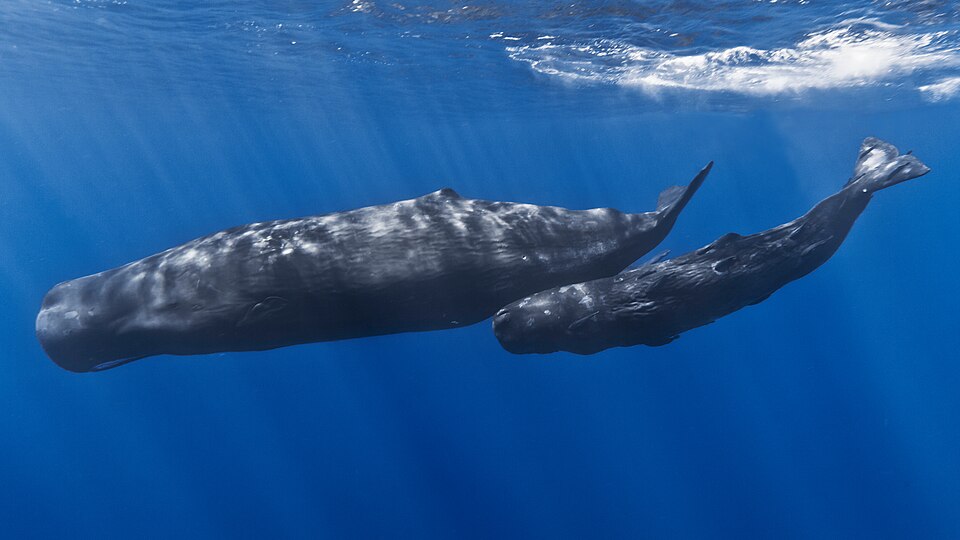
The Sperm whale features a bulky, rectangular head, a wrinkled dark gray body, and a unique vent located at the front-left of the skull, producing a characteristic forward-facing blast. Its narrow lower jaws bear large conical teeth, while the upper jaw has only vestigial teeth. It has the largest brain in the animal kingdom, in absolute volume. The dorsal fin is reduced to a simple hump followed by crenellations on the dorsal line.
Characteristics
Indicative values: they vary by subspecies, sex and region.
Habitat and distribution
The Sperm whale mainly frequents deep ocean waters, far from the coast, where it finds its prey in deep waters. It generally avoids shallow areas and narrow continental shelves. It is found from tropical waters to subpolar waters, with a marked preference for underwater canyons rich in cephalopods. In the Mediterranean, it particularly frequents areas of deep trenches.
CURRENT RANGE
Sperm whale is present in all the world's oceans, from tropical to subpolar regions, with the exception of the most glaciated polar waters. It forms a resident population in the Mediterranean Sea, of which the offshore Tunisian waters are part of the potential frequentation area. Adult males migrate to higher latitudes while females and young tend to stay in temperate and tropical waters.
Behaviour
The Sperm whale lives in matriarchal groups consisting of females and young, while adult males often become solitary or form bachelor groups. The species is known for its deep, prolonged dives, lasting more than an hour, followed by long series of surface breaths. It communicates through sequences of clicks called “codas”, specific to certain cultural groups. The Sperm whale displays complex social behavior including mutual assistance and collective defense of young people.
Reproduction
The Sperm whale female reaches sexual maturity around 9 years old, while males mature later, around 18 to 20 years old. Gestation lasts approximately 14 to 16 months and results in the birth of a single calf. Breastfeeding can continue for several years, and the interval between two births is generally 4 to 6 years. Young people remain associated with the matriarchal group for a long time for social and nutritional learning.
Peculiarities
Sperm whale is the animal with the largest known brain, weighing up to 8 kilograms. Its head contains an organ filled with spermaceti, a waxy substance historically exploited by the whaling industry. It produces some of the most powerful biological clicks in the animal kingdom, used for deep-water echolocation. The species inspired the character Moby Dick in literature.
Threats and conservation
The Sperm whale suffered a major population decline due to intensive whaling from the 18th to the 20th centuries. Today, major threats include ship strikes, ingestion of plastic waste, and entanglement in fishing gear. Ocean noise pollution also disrupts its communication and echolocation abilities.
Numbers and trends vary across sources and regions. See the IUCN assessment for the latest reference data.
Gallery
1 documented photographs.
References
Profile updated 27 August 2026 · Reviewed by the TunisieVet editorial team.
Comments (0)
No comments yet.
CONSERVATION STATUS
Vulnerable (VU)
IUCN source, latest published assessment.
Species health
Documented diseases for this species.
This information is provided for educational purposes only and is not a substitute for a veterinary consultation. If you have any concerns about your animal's health, consult a veterinarian.
To discover around: Sperm whale
Videos, facts, stories and records linked to this species.
RECORD
up to 8 kg
The largest brain in the animal kingdom
Brain mass measured in adult individuals, the highest known in an animal.
Similar animals
Other species documented in Animalpedia.

TunisieVet in your pocket 📱🐾 Access your veterinary services wherever you are. [ Download the app ]
Learn more