Presentation
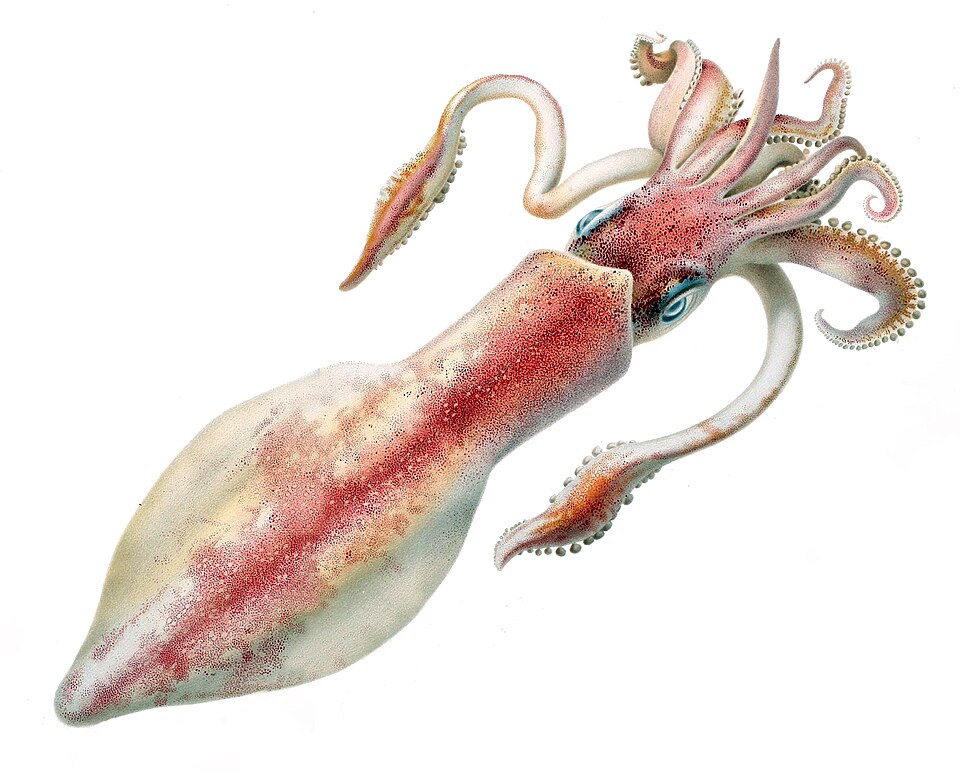
The squid is a marine cephalopod mollusk with an elongated, spindle-shaped body, lateral fins, and ten arms including two prehensile tentacles equipped with suckers. Its soft body is protected by a muscular mantle and supported by an internal horny structure called a gladius. It moves by jet propulsion, expelling water through a siphon, which allows it to reach high speeds. Its skin contains pigment cells called chromatophores, which enable it to change color rapidly for camouflage or communication. The squid is an active predator found in coastal and open waters throughout all the world's seas. It is also an important food resource for humans and many marine predators.
Soft spindle-shaped body surrounded by a mantle, with ten arms including two retractable tentacles with suckers. Presence of chromatophores allowing rapid color changes and a well-developed nervous system with complex eyes similar to those of vertebrates. The internal gladius, a vestige of a shell, provides structural support without external rigidity.
Characteristics
Indicative values: they vary by subspecies, sex and region.
Habitat and distribution
The squid lives in marine waters, ranging from shallow coastal zones to the deep ocean. Some species undertake daily vertical migrations, rising to the surface at night to feed. Others remain pelagic, living in the open sea far from the coast.
CURRENT RANGE
Squid are found in all the world's oceans, from tropical to temperate and cold waters. Some species, such as the common squid, inhabit the Mediterranean Sea, including the coasts of Tunisia. Other species populate the Atlantic, Pacific, and Antarctic waters.
Behaviour
The squid is typically solitary or gregarious depending on the species, with some forming large schools during breeding season. It moves by jet propulsion, which allows it to accelerate rapidly to escape a predator. Its intelligence is recognized in several species, with elaborate camouflage and visual communication behaviors.
Reproduction
Reproduction occurs through mating, in which the male transfers a spermatophore to the female using a specialized arm called the hectocotyle. The female then lays clusters of eggs, which she either attaches to the seabed or allows to drift depending on the species. Most squid die shortly after reproduction, as their life cycle is short, typically lasting one year.
Peculiarities
The squid has a complex nervous system, which includes the largest axon known in invertebrates—long used in neurophysiology research. It can expel a cloud of ink to escape predators. Some deep-sea species reach impressive sizes, a fact that has long fueled marine legends.
Threats and conservation
Overfishing is the main pressure on some commercially exploited squid populations. Ocean warming and acidification can alter their distribution and reproduction. Marine pollution and coastal habitat degradation also affect certain species.
Numbers and trends vary across sources and regions. See the IUCN assessment for the latest reference data.
Gallery
1 documented photographs.
References
Profile updated 13 September 2026 · Reviewed by the TunisieVet editorial team.
Comments (0)
No comments yet.
CONSERVATION STATUS
Least concern (LC)
IUCN source, latest published assessment.
Species health
Documented diseases for this species.
Find a veterinarianThis information is provided for educational purposes only and is not a substitute for a veterinary consultation. If you have any concerns about your animal's health, consult a veterinarian.
To discover around: Squid
Videos, facts, stories and records linked to this species.
Similar animals
Other species documented in Animalpedia.