
Presentation
The Suede (Dama dama) is a medium-sized deer native to the Mediterranean region, widely introduced into Europe and other continents for park decoration and hunting. It is distinguished by its spotted coat in summer, often reddish-brown with white spots, and by the webbed antlers of the male. The species lives in groups and frequents light forests and edges rich in brush. The Suede is appreciated for its robustness and its ability to adapt to varied environments, including semi-urban in certain parks. It constitutes an emblematic species of large European herbivores, although its exact area of origin remains debated between the eastern Mediterranean basin and Anatolia.
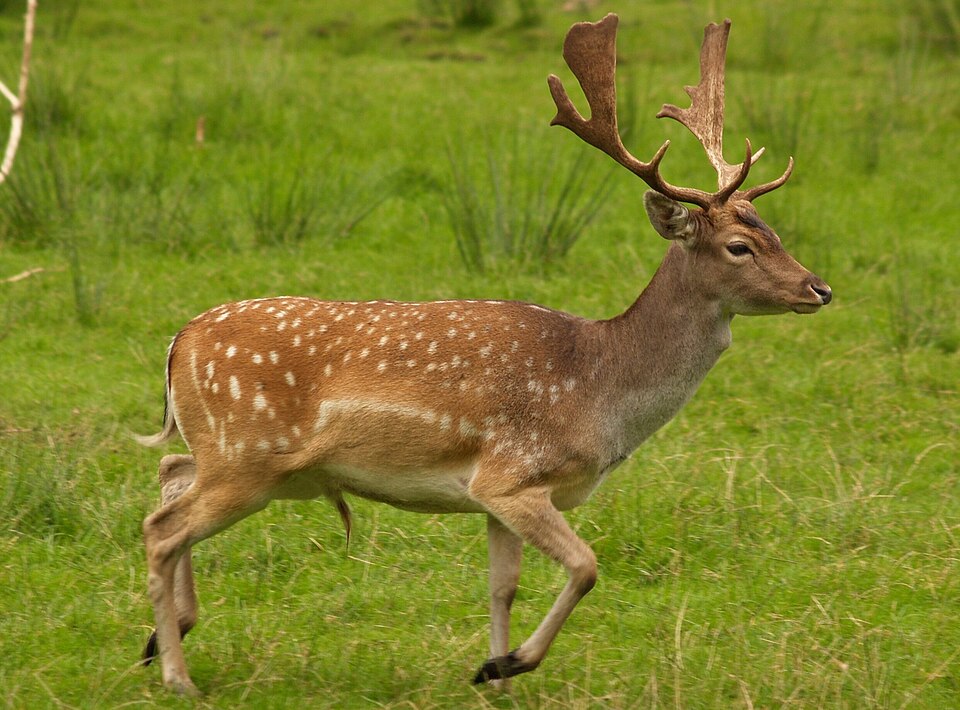
The Suede has a summer coat spotted with white on a reddish-brown background, which darkens and evens out in winter. The male (dagger then adult Suede) bears characteristic webbed antlers, renewed each year, while the female (doe) is devoid of antlers. The tail is relatively long for a deer, marked with a black dorsal stripe. An all-white or black color variant also exists in some captive populations.
Characteristics
Indicative values: they vary by subspecies, sex and region.
Habitat and distribution
The Suede frequents open forests, thickets and edges offering both cover and open grazing areas. It also enjoys wooded parks and tree-lined meadows, where it finds a balance between herbaceous food and shelter. The species avoids overly dense forests and areas devoid of plant cover. It adapts well to semi-open landscapes shaped by man, such as large estates and game reserves.
CURRENT RANGE
Native to the eastern Mediterranean basin and possibly Anatolia, the Suede was introduced in Antiquity and the Middle Ages across much of Europe for hunting and ornamentation. It is now found wild or semi-wild in many European countries, as well as in North America, Australia and New Zealand following introductions. The original populations are still found in Türkiye and some Mediterranean islands. Its current distribution is largely the result of human action rather than natural expansion.
Behaviour
The Suede is a gregarious animal that lives in separate groups of males and females outside of the breeding season. It is active mainly at dusk and dawn, during which it actively feeds. During the rut in autumn, males gather in harems and emit loud bellows to assert their dominance. The rest of the year, the species remains rather discreet and avoids direct contact with humans in the wild.
Reproduction
The Suede rut takes place in the fall, a period during which males defend territories or harems of females through vocalizations and wood fights. Gestation lasts approximately eight months, culminating in the birth of a single fawn the following spring. The fawn remains hidden in the vegetation for the first weeks before rejoining the group. Sexual maturity is reached around sixteen months in females, a little later in males.
Peculiarities
The male's webbed antlers, shaped like a flattened shovel, constitute a distinctive feature which differentiates it from other European deer such as the red deer. Suede exhibits great color variability, including white, melanistic or spotted forms depending on the population. It is also known for its ability to adapt to enclosures and parks, making it a frequent animal in hunting areas since Antiquity.
Threats and conservation
In the wild, Suede does not face major threats thanks to its wide distribution and numerous populations introduced and managed by humans. Regulated hunting and hunting management constitute the main pressures in the countries where it is present. The fragmentation of forest habitats can locally limit the movements of wild populations. The species is not listed among the globally threatened deer.
Numbers and trends vary across sources and regions. See the IUCN assessment for the latest reference data.
Gallery
1 documented photographs.
References
Profile updated 20 August 2026 · Reviewed by the TunisieVet editorial team.
Comments (0)
No comments yet.
CONSERVATION STATUS
Least concern (LC)
IUCN source, latest published assessment.
Species health
Documented diseases for this species.
See the 8 diseases of this species Find a veterinarianThis information is provided for educational purposes only and is not a substitute for a veterinary consultation. If you have any concerns about your animal's health, consult a veterinarian.
Similar animals
Other species documented in Animalpedia.

TunisieVet in your pocket 📱🐾 Access your veterinary services wherever you are. [ Download the app ]
Learn more