
Presentation
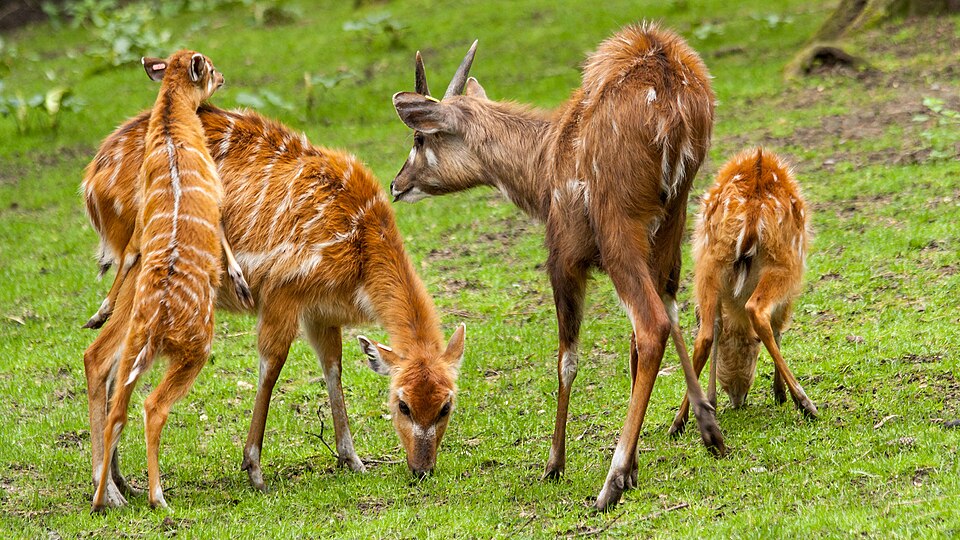
The Sitatunga (Tragelaphus spekii) is a semi-aquatic antelope from sub-Saharan Africa, remarkably adapted to life in swamps and wetlands. Its waterproof coat and specialized hooves allow it to move easily through mud and shallow water, where it finds refuge from predators. Shy and discreet, it is rarely seen and remains one of the least known antelopes on the continent. Its particular morphology, with powerful hind legs and a streamlined body, makes it a competent swimmer. This species plays an important ecological role in the wetland ecosystems it inhabits.
The Sitatunga has a thick, waterproof coat, varying from reddish-brown to gray-brown depending on sex and age, often marked with white stripes and spots. Its long, spread hooves, adapted to spongy soils, prevent it from moving effectively on dry ground. Only males have spiral horns that can reach 90 cm. Its stocky body and slightly more developed hind limbs make it easier to swim and walk in mud.
Characteristics
Indicative values: they vary by subspecies, sex and region.
Habitat and distribution
The Sitatunga lives exclusively in swamps, deltas, peat bogs and wetlands dense with aquatic vegetation. It depends on shallow, permanent water and dense plant cover for hiding and feeding. This specialized habitat strongly limits its presence to well-defined areas of the African continent.
CURRENT RANGE
Sitatunga is found in several regions of central, eastern and southern Africa, including the Congo Basin, Uganda, Botswana and Zambia. Its distribution is fragmented and closely linked to the presence of large permanent wetlands. Populations are generally isolated from each other by unsuitable terrestrial habitats.
Behaviour
The Sitatunga is a secretive, mostly crepuscular animal, capable of remaining submerged almost entirely to escape predators. Il se déplace avec aisance dans la vase et les marécages grâce à ses sabots allongés et écartés qui répartissent son poids. Solitaire ou vivant en petits groupes lâches, il évite les zones ouvertes et privilégie la végétation dense des marais. When threatened, it can freeze with only its head above water for several minutes.
Reproduction
The Sitatunga female generally gives birth to a single calf after a gestation of approximately 7 to 8 months. The fawn remains hidden in dense vegetation for several weeks before following its mother. Sexual maturity is reached around 1 to 2 years old depending on the sex. Births can occur at any time of the year, without marked seasonality.
Peculiarities
The Sitatunga is one of the few truly semi-aquatic antelopes, capable of swimming and partially diving to hide from predators. Its disproportionately elongated hooves, unique among bovids, are a specific adaptation to walking on soft substrates. Unlike most antelopes, it actively avoids dry, firm ground.
Threats and conservation
Sitatunga is threatened by the destruction and drainage of wetlands for agriculture and urbanization. Illegal hunting for bushmeat also represents significant pressure in some areas. Habitat fragmentation isolates populations, reducing genetic diversity.
Numbers and trends vary across sources and regions. See the IUCN assessment for the latest reference data.
Gallery
1 documented photographs.
References
Profile updated 21 August 2026 · Reviewed by the TunisieVet editorial team.
Comments (0)
No comments yet.
CONSERVATION STATUS
Least concern (LC)
IUCN source, latest published assessment.
Species health
Documented diseases for this species.
See the 8 diseases of this species Find a veterinarianThis information is provided for educational purposes only and is not a substitute for a veterinary consultation. If you have any concerns about your animal's health, consult a veterinarian.
Similar animals
Other species documented in Animalpedia.

TunisieVet in your pocket 📱🐾 Access your veterinary services wherever you are. [ Download the app ]
Learn more