Presentation
The Himalayan tahr is a sturdy wild goat living on the rocky escarpments of the Himalayan range. It is distinguished by a thick golden-brown coat and short horns curved backward, present in both sexes. An excellent climber, it moves with ease across steep slopes and cliffs that are inaccessible to most predators. The species lives in groups structured by age and sex, with adult males often remaining separate from female herds outside the breeding season. Introduced to several countries beyond its native range, it is sometimes considered an invasive species in those areas. In its native habitat, it faces hunting pressure and habitat degradation.
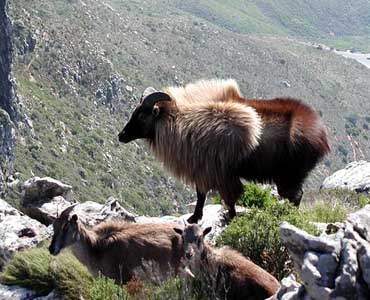
The tahr has a compact, muscular body adapted to life in rough terrain, with short and powerful legs. Its coat is thick and shaggy, ranging from reddish-brown to dark brown, longer in males around the neck and shoulders. Horns, present in both males and females, are short and thick at the base, curved backward. Its hooves, equipped with a central rubbery pad, provide excellent grip on rock.
Characteristics
Indicative values: they vary by subspecies, sex and region.
Habitat and distribution
The Himalayan tahr occupies rocky and steep mountain slopes between coniferous forests and alpine meadows, usually between 2,500 and 5,000 metres in altitude. It seeks out cliffs and rock outcrops that provide both food and shelter from predators. It makes seasonal movements, descending to lower altitudes in winter.
CURRENT RANGE
The species originates from the Himalayas, found in Nepal, northern India, Tibet and Bhutan. It has been successfully introduced to several regions worldwide, notably New Zealand, South Africa and the United States, where wild populations have become established. These introduced populations are sometimes managed as game or considered a pest to local vegetation.
Behaviour
The species is diurnal and social, living in groups of females with young and bachelor males kept separate. It is particularly active early in the morning and late in the afternoon, resting in sheltered areas during the warmest hours. Dominant males establish hierarchy through displays and horn clashing during the rutting season. The tahr is renowned for its exceptional agility on steep rocky terrain, allowing it to escape predators quickly.
Reproduction
The breeding season (rut) typically occurs in late autumn and winter. After a gestation period of approximately seven months, the female gives birth to a single young, rarely two. The young is able to follow its mother shortly after birth and is weaned after several months. Sexual maturity is reached between two and three years of age.
Peculiarities
The tahr is able to leap onto nearly vertical rock faces thanks to the unique structure of its hooves. Adult males develop a thick mane around the neck and shoulders, which females lack. The species has been introduced into ecosystems very different from its original habitat, where it has sometimes had a notable impact on native flora.
Threats and conservation
In its native range, the Himalayan tahr is threatened by hunting, poaching and habitat loss due to domestic livestock grazing. Population fragmentation and competition with domestic herds reduce its food resources. Paradoxically, introduced populations outside Asia are abundant and sometimes classified as species requiring control.
Numbers and trends vary across sources and regions. See the IUCN assessment for the latest reference data.
Gallery
1 documented photographs.
References
Profile updated 03 September 2026 · Reviewed by the TunisieVet editorial team.
Comments (0)
No comments yet.
CONSERVATION STATUS
Near threatened (NT)
IUCN source, latest published assessment.
Species health
Documented diseases for this species.
See the 4 diseases of this species Find a veterinarianThis information is provided for educational purposes only and is not a substitute for a veterinary consultation. If you have any concerns about your animal's health, consult a veterinarian.
Similar animals
Other species documented in Animalpedia.

Be among the first to use our app. Sign up and get early Google Play access.
Discover