
Presentation
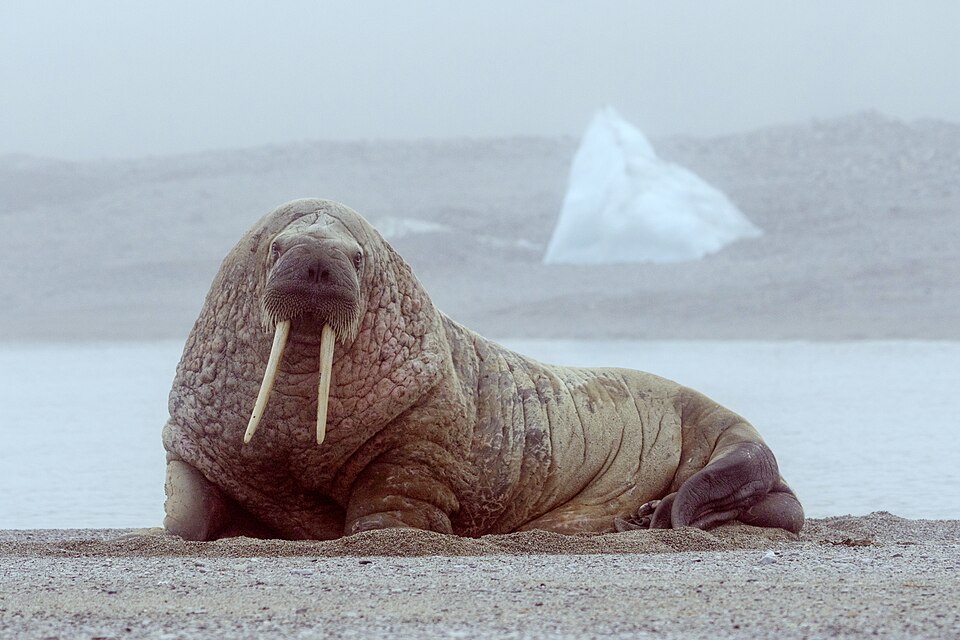
The Walrus (Odobenus rosmarus) is a large Arctic marine mammal, recognizable by its long tusks and thick, wrinkled skin. It is the only living species in the Odobenidae family. It lives in large herds on pack ice and rocky coasts, moving between water and dry land. Its massive body and layer of fat allow it to withstand the extreme cold of polar waters. It is best known for its impressive tusks, used for hoisting itself out of water and during social interactions.
The Walrus has a bulky body, thick, wrinkled skin covered in short hair, and long tusks found in both sexes. Its sensitive vibrissae, arranged in dense whiskers, are used to detect molluscs on the seabed. A thick layer of subcutaneous fat provides thermal insulation in freezing waters.
Characteristics
Indicative values: they vary by subspecies, sex and region.
Habitat and distribution
The Walrus frequents shallow Arctic waters, drifting pack ice and rocky or sandy coasts where it congregates to rest. It favors areas where the depth allows easy access to molluscs on the seabed. The presence of stable sea ice is essential to certain populations for rest and reproduction.
CURRENT RANGE
The species occurs in Arctic and subarctic regions, distributed in Atlantic, Pacific and Laptev Sea populations. It is found particularly around Greenland, Arctic Canada, Russia and Alaska. Its distribution is closely linked to the extent of the sea ice and areas rich in molluscs.
Behaviour
The Walrus is a gregarious animal living in groups of several hundred individuals, often grouped together on ice floes or beaches. It alternates between phases of diving to feed and long periods of collective rest outside the water. Males use their tusks during displays and confrontations to establish a social hierarchy.
Reproduction
Reproduction takes place in winter, with gestation lasting approximately 15 to 16 months including delayed implantation. The female generally gives birth to a single young, which she nurses for about two years. The young remain close to their mothers during an extended period of learning.
Peculiarities
Walrus tusks, present in both males and females, can reach remarkable length and serve as an indicator of social status. Its skin can change color depending on the temperature, becoming pinker as it warms in the sun after a dive in cold water.
Threats and conservation
Global warming and the melting of the sea ice are reducing the resting areas essential to the species. Historical hunting has strongly affected certain populations, although it is regulated today. Human disturbance and increasing maritime traffic in the Arctic pose additional threats.
Numbers and trends vary across sources and regions. See the IUCN assessment for the latest reference data.
Gallery
1 documented photographs.
References
Profile updated 27 August 2026 · Reviewed by the TunisieVet editorial team.
Comments (0)
No comments yet.
CONSERVATION STATUS
Vulnerable (VU)
IUCN source, latest published assessment.
Species health
Documented diseases for this species.
This information is provided for educational purposes only and is not a substitute for a veterinary consultation. If you have any concerns about your animal's health, consult a veterinarian.
To discover around: Walrus
Videos, facts, stories and records linked to this species.
RECORD
up to 1 meter
Longest tusks among pinnipeds
Maximum length observed in large adult males.
Similar animals
Other species documented in Animalpedia.

TunisieVet in your pocket 📱🐾 Access your veterinary services wherever you are. [ Download the app ]
Learn more