
Presentation
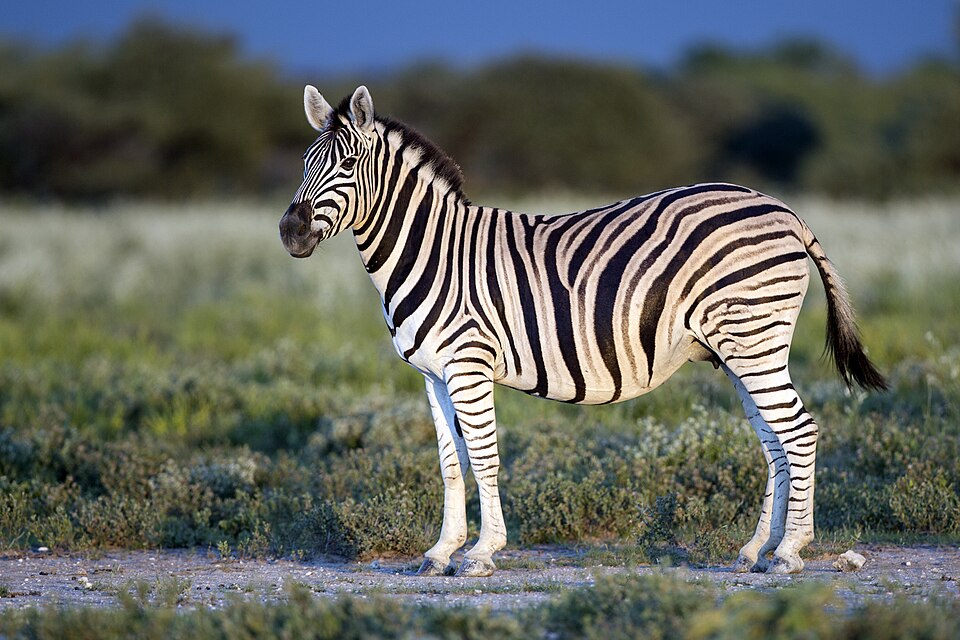
The Plains zebra is an African equine easily recognizable by its black and white striped coat. It is the most widespread and abundant zebra in southern and eastern Africa, forming spectacular herds in open savannahs.
Its stocky and robust body has well-contrasted stripes that cover its entire silhouette. The stripes are generally more widely spaced than in other zebra species, and the mane is erect, black and white.
Did you know?
Why do zebras have stripes?
Characteristics
Indicative values: they vary by subspecies, sex and region.
Habitat and distribution
The Plains zebra inhabits open savannahs, grasslands and semi-arid grassy areas of South, East and Central Africa. It adapts to different types of herbaceous vegetation, as long as water is accessible and fodder resources are sufficient.
CURRENT RANGE
Widely distributed in sub-Saharan Africa, notably South Africa, Botswana, Namibia, Zambia, Zimbabwe and East African countries such as Tanzania and Kenya. Residual populations also exist in central Africa. The species is not present in Tunisia.
Behaviour
Plains zebras are social and gregarious animals, living in stable harems led by a dominant stallion. They communicate through distinctive neighs, facial expressions and tail movements, and often form associations with other herbivores for better vigilance against predators.
Reproduction
The female zebra carries her young for about 13 months before giving birth to a single foal. The young are breastfed for 7 to 13 months and remain closely bonded to their mother. Reproduction is not strongly seasonal, although peaks in births are observed in periods following the rains.
Peculiarities
Each zebra's unique stripes act as a sort of natural fingerprint. Unlike other equines, the Plains zebra produces a particular neighing sound between the cry of a horse and that of a donkey. Harems can form super-harems of several hundred individuals in areas with abundant resources.
Threats and conservation
Plains zebra is not threatened with extinction in the short term due to its wide distribution and relatively stable populations. However, habitat loss due to agricultural expansion, fences that fragment migration territories, and predation by large carnivores remain ongoing challenges in some regions.
Numbers and trends vary across sources and regions. See the IUCN assessment for the latest reference data.
Gallery
1 documented photographs.
References
UICN — Liste rouge des espèces menacées
Profile updated 30 August 2026 · Reviewed by the TunisieVet editorial team.
Comments (0)
No comments yet.
CONSERVATION STATUS
Near threatened (NT)
IUCN source, latest published assessment.
Species health
Documented diseases for this species.
See the 4 diseases of this species Find a veterinarianThis information is provided for educational purposes only and is not a substitute for a veterinary consultation. If you have any concerns about your animal's health, consult a veterinarian.
Related species
To discover around: Plains zebra
Videos, facts, stories and records linked to this species.
Similar animals
Other species documented in Animalpedia.

TunisieVet in your pocket 📱🐾 Access your veterinary services wherever you are. [ Download the app ]
Learn more